

Rising demand for AI chips is changing how foundries set prices, giving TSMC and Samsung Electronics more leverage while forcing new entrants such as Rapidus to compete carefully on cost.
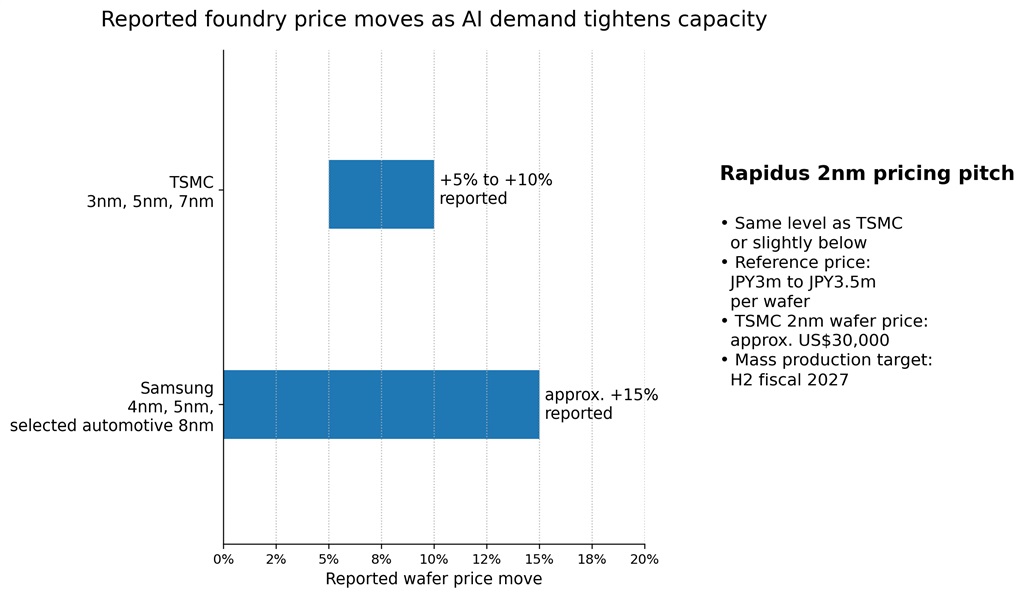
TSMC has notified major clients, including Nvidia, Apple, and AMD, of plans to raise wafer supply prices by 5% to 10% across 3nm, 5nm, and 7nm. Samsung Electronics, meanwhile, has raised prices by around 15% for new clients on selected 4nm, 5nm, and automotive 8nm nodes, according to Chosun Biz, citing industry sources.
The moves suggest the foundry market is shifting away from client-winning price competition and toward a structure shaped more by supply, demand, and investment burden.
Source: Chosun Biz, Bloomberg, Nikkei, Reuters; compiled by DIGITIMES Asia, July 2026
Pricing logic changes
The more important shift is not the size of the increases, but the logic behind them.
Foundry pricing has traditionally followed a node's life cycle. Prices tend to be higher at launch, then stabilize or gradually adjust once production yield improves and productivity rises. Raising prices again on an existing node was uncommon outside major technology transitions.
That pattern is breaking down. Orders for AI chips from major technology companies are outpacing available advanced-node capacity, while development costs for 2nm production and next-generation equipment continue to rise. That combination is pushing the industry toward a model where market conditions and investment costs, rather than node maturity alone, determine wafer prices.
For TSMC, the inclusion of 7nm is especially notable. It suggests that even established advanced nodes may retain pricing power if they remain important for AI accelerators, high-performance computing, and related silicon.
TSMC chairman and CEO C.C. Wei gave a similar signal in June, saying customer demand remained very high and that TSMC was working to avoid becoming a bottleneck in the global semiconductor supply chain. Asked whether TSMC could raise prices, Wei said he would like to do so, while adding that the company would avoid abrupt hikes.
Samsung makes selective increases
Samsung's move is viewed differently from TSMC's broader pricing stance. Rather than an across-the-board hike, Samsung's increases appear to reflect price normalization in specific nodes where AI and automotive chip demand have improved supply conditions.
That distinction matters. TSMC is using its dominant position in advanced foundry capacity to reset pricing across key nodes. Samsung is selectively recovering leverage in areas where demand has become stronger, and supply is tighter.
The shift could also change the profit structure of the foundry industry. While the most advanced nodes have traditionally carried stronger pricing power, persistent AI-driven capacity shortages are making supplier leverage more durable. As long as the AI investment cycle continues, price increases centered on advanced nodes are likely to persist.
Rapidus targets TSMC-level pricing
While TSMC and Samsung push prices higher, Japan's Rapidus is trying to enter the 2nm foundry market through competitive pricing.
Rapidus president Atsuyoshi Koike said the company plans to price its 2nm foundry service at the same level as TSMC or slightly below, according to Bloomberg and Nikkei. Koike cited a reference price of JPY3 million to JPY3.5 million(Approx US$18,460 to US$21,540) per wafer. Bloomberg noted that TSMC's 2nm wafer price is about US$30,000.
Rapidus is targeting mass production of 2nm chips in the second half of fiscal 2027. The company is in talks with more than 60 potential customers, mostly overseas firms, as it works to build a customer base before that timeline.
The strategy shows how difficult it will be for new foundry entrants to challenge TSMC. Pricing at or below TSMC's level may help Rapidus attract attention, but customer decisions will also depend on production yield, delivery reliability, design ecosystem support, and the ability to scale manufacturing.
Supply chain feels the pressure
Higher foundry prices are likely to ripple through the broader semiconductor ecosystem. Combined with rising HBM prices and tight advanced packaging capacity, the increases could add cost pressure for companies such as Nvidia, Apple, and AMD, with potential knock-on effects for AI server budgets and consumer devices such as smartphones and PCs.
For chip designers, cloud service providers, and system vendors, the shift means advanced-node access is becoming more than a technology question. It is also becoming a pricing, capacity, and supplier-leverage issue. As long as AI investment continues to absorb leading-edge and high-performance capacity, foundries with scarce manufacturing resources will have more room to defend margins, while new entrants will need to prove that lower pricing can be matched by reliable execution.
Article edited by Jerry Chen