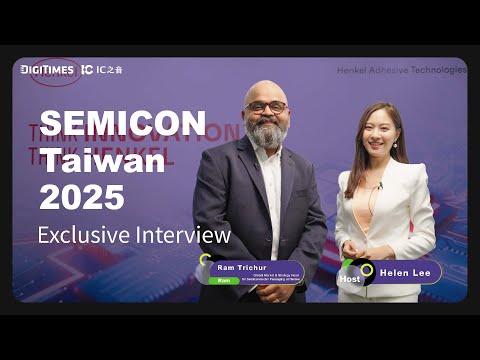
Henkel Adhesive Technologies today announced the launch of Loctite ABLESTIK CDF900, its next-generation conductive die attach film (cDAF) series, at SEMICON Taiwan 2026. Delivering thermal conductivity exceeding 8 W/m-K, the new material is designed to help semiconductor manufacturers overcome rising thermal and stress challenges in AI, 5G and emerging 6G telecommunications, and high-performance computing (HPC) applications
Henkel Adhesive Technologies today announced the launch of Loctite ABLESTIK CDF900, its next-generation conductive die attach film (cDAF) series, at SEMICON Taiwan 2026. Delivering thermal conductivity exceeding 8 W/m-K, the new material is designed to help semiconductor manufacturers overcome rising thermal and stress challenges in AI, 5G and emerging 6G telecommunications, and high-performance computing (HPC) applications.As AI, HPC, and next-generation communications drive higher chip frequencies, greater thermal design power, and more complex package architectures, efficient heat dissipation and stress control have become critical to device performance and reliability. Loctite ABLESTIK CDF900 addresses these challenges by combining high thermal conductivity with the precision and process consistency of a film-based die attach format.Technical Breakthrough for High-Performance AI Packaging"Henkel is a global leader in conductive die attach film, with technology widely adopted in Wi-Fi communications, automotive electronics, and power devices. Today, Loctite ABLESTIK CDF900 pushes thermal performance to new heights while expanding applications into large-die packaging scenarios such as processors and AI chips. This offers customers broader design flexibility and superior thermal management solutions," said Kaihua Zhou, Head of Market Strategy for Semiconductor at Henkel Adhesive Technologies Electronics.The core breakthrough of Loctite ABLESTIK CDF900 lies in its proprietary thermal filler technology, which substantially increases thermal conductivity to more than 8 W/m-K. This enables high-power components in mobile phones, processors, and Wi-Fi equipment to dissipate heat efficiently and maintain stable performance in demanding operating environments.Compared with competing liquid die attach adhesives, Loctite ABLESTIK CDF900's film-based format helps eliminate the risks of material bleed-out and non-uniform bondline thickness. This enables chip designers to achieve smaller, more precise die footprints within constrained spaces while enhancing overall package reliability and robustness.Complete Material Solutions to Address Stress Challenges in AI Advanced PackagingTo address warpage during processing and component stress issues inherent in large-die advanced packaging, Henkel continues to expand its material portfolio. The company has developed high-thermal-conductivity liquid molding compounds, high-performance capillary underfills, and diverse packaging material platforms to meet requirements for efficient heat dissipation, high reliability, and process flexibility. By reinforcing structural strength, toughness, and adhesion, Henkel's materials help mitigate stress imbalances while meeting the stringent reliability and high-volume manufacturing stability requirements of high-end AI packaging.At SEMICON Taiwan 2026, Henkel will present its complete portfolio for critical advanced packaging applications, including underfill, conductive die attach film, liquid molded underfill, and non-conductive liquid adhesive technologies.Kevin Becker, Senior Vice President of Product Development and Engineering, added, "These solutions support board-level to wafer-level packaging, low to high thermal conductivity applications, and small to large die footprints. Leveraging its comprehensive product portfolio, global R&D resources, and localized technical support, Henkel empowers customers to improve thermal performance, package reliability, and mass-production readiness in advanced package designs, while providing vital material support for the next generation of AI development."Global Footprint and Multi-Site Support Deliver Supply Chain ResilienceAmid geopolitical shifts and global expansion, semiconductor supply chain resilience has become a priority in international procurement decisions. Henkel has established a robust multi-site support network and operates manufacturing facilities across North America, Europe, and Asia, with established production and technical support hubs in Taiwan, South Korea, China, Japan, and Southeast Asia. Flexible backup production sites enable localized, real-time support to meet global customers’ capacity expansion and procurement flexibility needs.Sustainability Commitment: Advancing Circularity in Semiconductor MaterialsSustainability is a core value at Henkel. In material R&D, the company has pioneered the integration of eco-friendly product design methodologies. For example, Henkel is collaborating with partners to advance circular economy practices, including the use of silver powder from recycled silver, a precious metal widely used in semiconductor packaging. Henkel is committed to working hand in hand with industry partners to reduce carbon emissions and minimize resource waste.Visit Henkel at SEMICON Taiwan 2026During SEMICON Taiwan in September, Henkel will present its full suite of material solutions for advanced packaging and high-performance semiconductor applications in Room 404, Hall 1 of the Taipei Nangang Exhibition Center. The company will showcase its technical capabilities across AI infrastructure, HPC, next-generation communications, and Edge AI.The hospitality suite will feature a variety of interactive experiences, creating opportunities for customers and industry partners to engage directly with Henkel's technical experts. Together, participants will explore innovative solutions for advanced packaging, including thermal management, reliability enhancement, stress mitigation, and readiness for high-volume manufacturing. Through collaboration and knowledge exchange, Henkel continues to support the semiconductor industry's progress toward higher performance, greater reliability, and enhanced resilience.Details about Henkel consumer electronics materials are available here, and information about its semiconductor solutions can be found here.LOCTITE is a registered trademark of Henkel and/or its affiliates in the USA, Germany and elsewhere.
ViTrox, which aims to be the World's Most Trusted Technology Company, is excited to announce its participation in SEMICON Taiwan 2026, one of the world's leading semiconductor industry events. The exhibition will take place from 2 to 4 September 2026 at TaiNEX 1 & 2 in Taipei, Taiwan. Visitors can visit ViTrox at TaiNEX 2, 1F, Malaysia Pavilion, Booth #P6006.The semiconductor industry continues to face increasing challenges as packaging architectures such as SiP, memory technologies like HBM, and advanced processes such as CoWoS become more widely adopted. While these technologies enable higher performance and integration, they also introduce greater process complexity and stricter quality requirements.Key challenges include:-Precision Bottlenecks: Sub-micron defect detection requires inspection capabilities beyond conventional methods.-Hidden Complexity: Advanced 3D structures often conceal internal defects that are difficult to detect.-Yield Pressure: Rising investment in advanced manufacturing places greater emphasis on first-pass yield and equipment efficiency.To address these challenges, ViTrox provides next-generation AI-powered vision inspection solutions that enhance detection accuracy, improve process stability, and support efficient semiconductor manufacturing.At SEMICON Taiwan 2026, ViTrox will showcase a fully integrated inspection ecosystem that seamlessly supports the entire semiconductor manufacturing journey, delivering end-to-end quality assurance from wafer to board level.At the Wafer Level, we address the earliest stages of manufacturing with the WiX Ai Smart Wafer AOI Machine. This an unified platform that gives fabs full-depth wafer visibility, from surface to inner layer, before wafers progress to later stages. It detects sub-micron surface defects (< 1 µm) with AI-enhanced accuracy, while proprietary SWIR technology uncovers hidden inner cracks that conventional inspection cannot see.During Die Sorting & Packaging, once the wafer is transformed into dies, precision sorting becomes critical. Our PX40Ai Smart Die Sorting Machine streamlines high-speed sorting, six-sided inspection, and tape-and-reel packaging, replacing conventional manual inspection with exceptional accuracy and improved production efficiency.Designed to address the growing complexity of advanced packaging, the TH3000i Smart Tray Based Vision Handler combines an adaptive vision system with AI-powered defect detection to support diverse package inspection requirements. Building on this intelligent inspection capability, V-ONE In-Process Verification further enhances overall inspection efficiency by enabling remote inspection review and verification.During Final Assembly & Post-Seal, the VR20Ai G2 Smart Post Seal Vision Handler minimises machine idle time through a high-speed dual-track system design, while supporting automated tape insertion and width conversion (8 to 32 mm), ensuring compliance with international quality standards.At the Strip & Board Level Inspection stage, the V510Ai Smart 3D AOI System for Substrate-Level and SiP Inspection utilises high-resolution 3D measurements and SWIR imaging to detect surface anomalies, component offsets, and inner die cracks on strips and complex high-density modules, ensuring robust inspection for IC package integrity.During the show, ViTrox will also introduce our SMT Full Line Solutions, including Smart 3D SPI, Smart 3D AOI System, Smart 3D AXI System, and Smart Robotic Optical System (ARV). These smart manufacturing solutions are linked to ViTrox's Manufacturing Intelligence Solutions Towards Industry 5.0 – V-ONE to form an end-to-end AI-driven Inspection Ecosystem, guaranteeing seamless data connectivity and true closed-loop control. Ultimately, this comprehensive integration enables manufacturers to reduce human error, accurately detect defects early, optimise process performance, and maintain consistent product quality across every production stage.Visit at TaiNEX 2, 1F, Malaysia Pavilion, Booth #P6006 to connect with experts and discover tailored inspection solutions for any manufacturing needs. To schedule a meeting with ViTrox team during the exhibition, simply complete the appointment form. For further inquiries, please contact us at enquiry@vitrox.com.
Tracking devices play a critical role in the Internet of Things (IoT) by enabling real-time monitoring and data collection across various industries. As IoT applications expand, the demand for energy-efficient solutions becomes increasingly important. This article explores the rise of battery-efficient tracking devices and their transformative impact on IoT ecosystems.Advancements in Tracking DevicesTracking devices first emerged with the advent of GPS technology, revolutionizing location-based services. Early applications were limited, but as the Internet of Things (IoT) grew, tracking devices expanded into sectors like logistics, agriculture, and personal safety, offering real-time monitoring.However, traditional devices faced challenges like short battery life and high maintenance costs. To address these issues, advancements in energy-efficient technologies, such as low-power wireless communication and optimized sensors, led to the development of battery-efficient models. These innovations have paved the way for longer-lasting and cost-effective tracking devices that are essential for the expanding IoT landscape.How Battery-Efficient Technology WorksBattery-efficient tracking devices use low-power wireless technologies like LoRaWAN, NB-IoT, and Bluetooth Low Energy (BLE) to enable long-range communication with minimal power consumption. Sleep modes, energy harvesting techniques (such as solar or kinetic energy), and ultra-low-power processors help extend battery life.Advances in sensor technology allow these devices to collect accurate data while consuming less energy. For example, a GPS trailer tracking uses these technologies to provide long-lasting performance to ensure reliable location tracking without frequent recharging. This makes it ideal for industries like logistics that require continuous monitoring with energy-efficient solutions.Impact on IndustriesBattery-efficient tracking devices have a significant impact across various industries:In logistics and fleet management, they reduce maintenance costs and extend tracking durations for vehicles.In agriculture, smart farming solutions leverage these devices to monitor livestock and machinery with minimal energy consumption.Personal safety benefits from wearable devices that track health and location, requiring less frequent charging.Additionally, the environmental impact of these devices is profound, as longer-lasting batteries help reduce waste and the environmental concerns associated with battery disposal.Benefits Over Traditional Tracking DevicesBattery-efficient tracking devices offer several key advantages over traditional models. Longer operational life is a major benefit, as these devices can run for months or even years on a single charge, reducing the need for frequent recharging or battery replacements. This is especially valuable in remote or hard-to-reach locations.Additionally, reduced maintenance requirements lower operational disruptions, as there’s less need for battery changes or regular maintenance. Lower operational costs are another advantage, with businesses saving on battery replacements and charging infrastructure.Lastly, increased accessibility and scalability enable businesses to deploy more devices across large-scale operations, such as fleet management or asset tracking, without incurring high costs. These benefits make battery-efficient tracking devices an essential solution for industries looking to optimize their IoT networks and reduce long-term costs while enhancing operational efficiency.EndnoteBattery-efficient tracking devices are playing an important role in making IoT systems more sustainable and practical. As technology continues to improve, these devices will become even more integrated into various industries, helping to streamline operations and reduce energy consumption. The ongoing development in this area promises a future where tracking solutions are efficient and cost-effective.
Amidst the reality of global oil prices continuously skyrocketing due to war, the global market is facing the formidable challenges posed by the turbulence impacting the global economy in 2026. Major Taiwanese electronics manufacturers and supply chains are pivoting to review comprehensive AI strategies. They are adopting a particularly aggressive stance in their strategic deployment of cloud server systems and AI infrastructure, aiming to achieve an operational breakthrough where the market outlook remains far from optimistic.ASUS unveils its complete Professional Services for Sovereign AI. Since the first project in 2018, which resulted in Taiwan's first AI supercomputer, Taiwania 2, ASUS has been actively developing sovereign AI infrastructure and providing customized AI solutions to clients. Delivering trusted AI with total flexibility, from rack-scale AI Factories, desktop AI supercomputing, Edge AI to Enterprise AI solutions deployment, the company is redefining Sovereign AI Solutions with reinforces the company's position as a global leader in AI-driven digital transformation.On April 1, 2026, ASUS joins the DIGITIMES online seminar titled "Leading the Way in Sovereign AI: A Look at Next-Generation AI Computing and Storage Architecture from Supercomputing Performance". This event starts with the construction and practical application of next-generation supercomputers at the National Center for High-Performance Computing (NCHC) of the National Applied Research Laboratories. This collaborative project shows ASUS Powering NCHC to building Taiwan's AI Supercomputer and the next generation of High Performance Computing (HPC) systems.As AI and high HPC workloads push compute density and power consumption beyond the capabilities of traditional air cooling, the flagship ASUS offerings are the ASUS AI POD systems redefining the new architecture of rack-scale powerhouse, storage architecture, and liquid cooling designed for massive AI workloads. This momentum will continue to maximize computing power density through the NVIDIA HGXTM and Blackwell platforms and provide insights into solving heat dissipation bottlenecks with advanced liquid cooling technology to meet the performance and energy efficiency requirements of high-computing environments.Practical experience in building a leading infrastructure in Taiwan High Performance ComputingThe first session features a keynote lecture by Nobel Hsia, ASUS Deputy Manager of Product Planning, titled "Leading the Sovereign AI Wave: From the National Center for High-performance Computing (NCHC) projects to ASUS's Forward-Looking Infrastructure and Storage Solutions." ASUS's Sovereign AI targets the business opportunities that countries are currently striving to play the vital role of innovation in securing data sovereignty and security with in-house data processing and computing capabilities, and promotes the transformation of scientific research in the industry. ASUS has partnered with NVIDIA to build a massive AI supercomputer system with an "ALL IN on AI" strategy. Through the maximum computing power density provided by the NVIDIA HGXTM and Blackwell platforms, ASUS has deployed complete portfolio ranging from rack-scale AI factories to edge and enterprise deployment. With its proven track record of successfully supplying AI infrastructure at the B300 and GB300 levels in the market, ASUS has become a trusted partner, providing complete end-to-end solutions.It is worth mentioning that ASUS has ten years of experience collaborating with the National Center for High-performance Computing on supercomputer projects. ASUS's sovereign AI expertise is proven by several successful national-level AI project deployments, including flagship supercomputing initiatives such as Taiwania 2 and Forerunner 1, cementing its leadership in high-performance computing and AI systems. Through ASUS Professional Services, the collaboration covers all aspects from design, deployment to operation.The latest Nano4 (Crystal 26) NVIDIA HGXTM H200 cluster AI server system was to build a next-generation AI supercomputer capable of handling complex large language models (LLMs), deep learning, and advanced HPC workloads. In this new project ASUS has built Taiwan's first AI supercomputer project based on NVIDIA GB200 NVL72 system architecture with direct-cooling technology. The engineering team has played an important role in the delivery of the servers, the planning of large-scale computing architecture, deployment and optimization, which has become the foundation for ASUS to expand its overseas AI deployment and demonstrate ASUS's ability to build computing power from national to international levels.Opening Agentic AI Frontier: ASUS Supports NVIDIA Vera Rubin Platform and InfrastructureIn response to the advent of the new-generation NVIDIA Vera Rubin platform and its accompanying infrastructure architecture, ASUS has developed the next-generation ASUS AI POD highlighting a proficiency in liquid-cooled AI solution. Spanning the new design from rack-scale AI factories, data center servers to desktop workstations and edge AI devices, this solution delivers end-to-end AI computing power and infrastructure, specifically targeting trillion-parameter models and million-token contexts, maximizing efficiency across power, memory, and compute.Hsia began by introducing the ASUS flagship XA VR721-E3 architecture. This system supports the NVIDIA Vera Rubin NVL72 platforms; it is purpose-built for large-scale AI model inference and training to deliver massive AI performance for large-scale AI factories. while also accommodating the specific workloads required for agentic AI. Designed as a 100% liquid-cooled, rack-scale system, it features a Thermal Design Power (TDP) reaching up to 227 kW, which is a capability that fully satisfies the demand for the immense performance required to compute AI models with trillions of parameters.Furthermore, addressing rigorous enterprise-grade data-center demands, ASUS has simultaneously launched the XA NR series. These product series support the NVIDIA HGXTM Rubin NVL8 architecture, featuring eight Rubin GPUs interconnected via the sixth-generation NVLink, which each GPU could deliver a maximum bandwidth of 800 GB/s. To facilitate a seamless and cost-effective transition to liquid cooling, ASUS offers two distinct solutions: the XA NR1I-E12L, an innovative hybrid-cooled option; and the XA NR1I-E12LR, a 100% liquid-cooled system.To support these powerful systems and democratize AI development, ASUS also has established a robust data ecosystem by partnering with NVIDIA-Certified storage providers. The storage solutions offers the technologies such as JBOD, DPDK, and Object Storage, thereby delivering scalable, resilient solutions for memory-intensive AI applications to support robust capabilities for the integrated storage and operational management.On the software front, ASUS provides a suite of one-stop platforms. Leveraging the ASUS Infrastructure Deployment Center (AIDC), ASUS automated the setup process including ACC (ASUS Control Center) and BMC, accelerating time-to-market for critical research resources. To address the full spectrum of requirements for system construction, deployment, and operations, ASUS provides expert consultation, a broad portfolio of tailor-made AI solution while simultaneously catering to the comprehensive lifecycle management needs of the entire data center.WEKA data storage platform is redefining AI storage economicsTo meet the elastic data storage requirements of AI workloads across diverse usage scenarios, ASUS's AI POD system incorporates a comprehensive storage solution featuring a high-speed, All-Flash NVMe SSD storage architecture. ASUS has collaborated with its ecosystem partners to develop a next-generation unified storage system with high-reliability storage servers and professional validation of network. WEKA, the AI storage company, is one of partners providing high-performance, software-defined storage for GPU-accelerated AI and HPC environments, combining low latency with unified data management.In the second presentation of the session is delivered by Ray Wu, Senior Consultant for the Asia-Pacific region at WEKA. His speech titled the theme "Ultimate Data Empowerment: How WEKA Helps NCHC Build an AI-Accelerated Computing Storage Architecture". To address NCHC's requirements for extreme performance and energy efficiency, Wu highlighted the unified data management solutions to provide rapid scalability, which emphasizing flexibility and intelligent adaptive capabilities, and effectively addressing the demands of a wide array of usage scenarios.Addressing the requirements of diverse application environments such as Kubernetes and Slurm in NCHC Nano4, WEKA serves as the high-performance storage foundation through its efficient storage platform. Based on the NVIDIA AI Data Platform reference architecture, the solution employs an end-to-end system to accelerate data processing performance for HPC applications. This assists the NCHC in optimizing the deployment of high-efficiency AI computing, dramatically reducing the time required for AI application deployment and development from months to mere minutes.This ASUS WEKA storage solutions demonstrates the NCHC's technical excellence in leveraging its ecosystem and integrated services to rapidly deliver the low-latency, scalable and high throughput required capabilities and swiftly support the next generation of agent-based AI applications. WEKA solutions empower enterprises to transition from experimentation to full-scale operations, rendering AI applications economically viable and maximizing performance across a wide spectrum of fields, ranging from next-generation AI agent systems to AI-enabled healthcare applications.In this event, ASUS showcases fully liquid-cooled AI infrastructure with the critical thermal management required for the next-generation NVIDIA Vera Rubin NVL72 system platform. By efficiently dissipating heat from high-performance CPUs, GPUs, and accelerator-dense racks, ASUS significantly reduces energy consumption while supporting unprecedented rack density to enable enterprises and cloud service providers to build high-performance, energy-efficient large-scale AI clusters with unmatched efficiency and dramatically reduced PUE and TCO.【White paper download】Empowering Scalable AI Reasoning with ASUS AI POD featuring【Webinar on-demand】Bridging NCHC Success to NVIDIA Vera Rubin Architecture
HQ Pack is a global leader in high-tech packaging solutions. The company is expert at designing, producing, (precision) cleaning, and making packaging solutions reusable again after use, as well as manage the packaging logistics of high-quality industrial products. They do so for clients in the semiconductor and other high-tech industries. The process procedures and packaging solutions ensure the parts, modules or components of highly sophisticated equipment are fully protected during transportation and logistical arrangements. And at the same time, the system will meet the customer demand for protection of valuable products during transit while adhering to environmental, social, and governance (ESG) principles. The packaging design incorporates features like sustainable materials, waste reduction strategies, and carbon footprint minimization, alongside ensuring the integrity of high-value goods through robust physical protection. The company provides complete packaging solutions, starting with the development and sourcing of customized packaging materials. HQ Pack's regional Service Centers ensure that reusable packaging materials are ready to use again by cleaning and repairing them to like-new condition. They can also support reuse of parts by harvesting them before scrapping for new build packaging. If there is material destined for waste management, HQ Pack supports this at the same time.Because most of its high-tech clients operate on a global scale, HQ Pack operates not only at its headquarters in Eindhoven, the Netherlands, but also in Johor and Penang in Malaysia, Taiwan, Singapore, Germany, and in the United States (locations in Brookfield (CT), Newark (CA), and San Diego (CA)) providing the same quality and service at each location. With their Service Centers they support both their customers' sustainability goals as well as their own. Their slogan "We Create to Protect" is exactly what they do. The high-quality packaging solutions ensure that valuable and fragile products, modules, components and/or parts can be safely transported worldwide. With over 40 years of experience and global presence, no compromission on quality, flexibility at the heart of our organization, they are a full-service provider with fast, reliable and sustainable packaging solutions.
DigiKey, has introduced an industry-power supply configuration tool, which simplifies the process of designing power supply solutions.Developed for engineers, designers, and system integrators, this intuitive online tool enables the quick selection of key attributes - such as outputs, voltage, current and more - to generate a tailored power supply solution that meets users’ desired requirements. Once configured, the custom power supply is assembled and shipped directly within days. Hosted on DigiKey's trusted, high-performance website, the configurator enables fast and accurate selection and sourcing - making it easier than ever to design, customize and order the right power solution for the project."DigiKey is thrilled to offer this industry-first tool that allows our customers to configure their own power supply independently," said Heather Fulara, senior director, interconnect and electromechanical for DigiKey. It dramatically reduces the time it takes to acquire a configured unit, which allows for more efficient workflows, saving time and accelerating design.The tool available from DigiKey currently features the NEVO+ and VCCM series from Vox Power, which is the first supplier involved in the program."Vox Power is proud to collaborate with DigiKey as the first supplier to participate in this innovative, time-saving tool," said Marco Prinsloo, co-owner of Vox Power. "We trust DigiKey's expertise in making our customers' designs come together seamlessly through its efficient online design and customization options."
The European Union Artificial Intelligence Act (EU AI Act) is set to be fully implemented in 2026, and the Cyber ??Resilience Act (CRA) is scheduled for 2027. Adding the Radio Equipment Directive Delegated Act (RED-DA) already took effect on August 1, 2025, those three legislative measures collectively emphasize mandatory requirements for information security and cybersecurity.These regulations strengthen the comprehensive lifecycle management mechanisms for critical applications, IT components and telecommunications, impacting corporate strategies for complying with international information security standards while providing new opportunities for next-generation technological innovation. As a globally leading standards testing and certification organization, TUV NORD combines multiple international standards to meet comprehensive regulatory requirements, helping global enterprises address major challenges in AI, cybersecurity, and information security regulations.Eric Behrendt, Global Key Account Manager of TUV Information stechnik GmbH (TUVIT), and Chia-Hung Lin, Director of the Information Security Business Division at TUV NORD Taiwan, were jointly interviewed. This interview coincided with the relocation of TUV NORD Taiwan's testing laboratory to its new address in Kaohsiung City. Taking advantage of the new facility's inauguration. In addition to inviting industry customers to celebrate together, they introduced TUVIT's global organizational developments and its comprehensive assessment and verification services, helping Taiwan customers understand new information security standards and the laboratory's development to seize new market opportunities.TUVIT is an independent subsidiary within the TUV NORD Group, dedicated to the Digital and Semiconductor Business Unit, focusing on information security and data infrastructure resilience technologies. Established in 1995, TUVIT provides cybersecurity verification, testing, and consulting services, specializing in establishing information and networking security technology, testing hardware, software and certifying information security management systems. With the global industry's growing emphasis on and attention to semiconductor chips and network equipment information security standards compliance, TUVIT has established a robust information security environment to advance technological progress and ensure digital security.In partnership with TUV NORD Taiwan, TUVIT assists Asian semiconductor, electronics manufacturing, and OEM/ODM manufacturers in obtaining certifications for various international and national information security standards. This will include Germany Federal Office for Information Security (or named BSI) IT Baseline Protection to enhance cybersecurity with a structured framework for organizations to protect their IT systems effectively.TUV NORD Taiwan laboratory offers services for CC, FIPS 140, and FIDOTUV NORD Taiwan, together with TUVIT, has collaborated to help assisted 12 semiconductor customers in the Asia-Pacific region (across more than 20 factories) achieving the German BSI Common Criteria safety certification. TUV NORD Taiwan's Kaohsiung testing laboratory is the only laboratory in Taiwan equipped to certify three major international cybersecurity standards including Common Criteria (CC), the U.S. National Institute of Standards and Technology (NIST) FIPS 140-3 standard, and the Fast Identity Online (FIDO) standard.TUV NORD Taiwan has further expanded its services to include financial and industrial PC sectors, in addition to its existing work in semiconductors and networking, to help Taiwanese electronics manufacturers meet global compliance requirements. This expansion offers a broader range of services like product safety, information technology, and vendor assessment audits to support companies in navigating complex global standards.Meanwhile, TUVIT also has expanded more actively into emerging fields such as artificial intelligence and quantum computing certification services, which are key technologies poised to redefine problem-solving, innovation, and competitive landscapes. TUVIT supports companies in implementing these new requirements and contributes to the safety and reliability of emerging technologies in the post quantum era.As AI technologies become increasingly integrated into everyday business operations, ensuring ethical, transparent, and secure AI systems is very important. The AI Act is the first legal framework on AI, which addresses the risks of AI and positions Europe to play a leading role globally. Since 2018, BSI has reacted quickly to the rapid development in the field of artificial intelligence and created a framework that keeps pace with technological developments. This also includes intensive testing and the implementation of countermeasures. TUVIT carried out these tests and began developing and applying initial testing methods for AI applications at an early stage, Behrendt highlighted. He proudly stated that TUVIT continues to work closely with BSI to ensure compliant in AI devices keeping pace with rapid technological advancements.NIST Post-Quantum Cryptography Standards become a key role in Information security certificationUsing Quantum Key Distribution (QKD) technology as an example, Behrendt noted that the threat of quantum computer attacks on classical cryptographic mechanisms must be considered to ensure future-proof protection of information. QKD offers a promising solution by harnessing the principles of quantum mechanics to establish secure keys. TUVIT assists enterprises in following NIST-adopted Post-Quantum Cryptography (PQC) standards, providing industry testing and certification services to ensure their systems can withstand future quantum computer attacks.Of course, this also involves enterprises' information systems requiring continuous assessment and upgrades to adapt to the practical operational needs of new PQC algorithms. Current cutting-edge technological developments involving data transmission and remote data exchange all require secure certification mechanisms for assurance. TUVIT is working with global technical partners to develop testing technologies and equipment, enabling related certification work and standard development to proceed in parallel.Beyond facing new challenges such as QKD technology, customers currently face multiple certification requirements including CRA and EU AI Act standards, which inevitably leaves them feeling overwhelmed. Behrendt recently participates in three or more technical consultation meetings with customers regarding CRA standards almost every week. He observes that many customers neglect preparations from the initial stages of product design planning. He especially reminds customers of the importance of a secure internal product development framework that considers information security planning.Large or middle scale manufacturers meet multiple product line launch requirements by leveraging a common product development or manufacturing platforms that incorporates information security standards from the start. This enhances the security of specific environments and allows for the reuse of verification results when certifying products manufactured in those environments, thereby simplifying subsequent product certification processes, saving time and costs.Furthermore, regarding CRA and AI Act, he provides several strategic recommendations. First, priority attention should be given to CC for IT security evaluation and IEC 62443 for industrial automation system information security standards. Currently, these fundamental cybersecurity standards have become prerequisites for new products entering international markets. Furthermore, for consumer electronics product cybersecurity requirements, all security requirement items will require to follow ETSI/EN 303 645 IoT network security standards as important cybersecurity requirement guidelines.Since Taiwan's electronics industry consists major OEM/ODM manufacturers for global brands, TUV NORD Taiwan supports Taiwan's electronics supply chain by providing premium testing, inspection, certification, and consulting services to meet the specifications requested by global branding customers. These services help ensure that products comply with safety , quality, and cybersecurity standards across various industries, and contribute to market access and customer confidence.Behrendt sincerely advises Taiwan OEM/ODM customers that from the first day of designing products under CRA, they must consider security and information security design. If these requirements are not considered, ultimately they will still need to go back to resolve these compliance challenges. Once these basic requirements are overlooked, regulatory agencies for these new standards will impose high penalty as punishment, which will cause product brand name value and enterprises to suffer significant losses. Therefore, he recommends that enterprises need to take seriously and genuinely prepare response plans early and avoid violations. Passing certification and presenting evidence of proven effectiveness is the best product compliance strategy.FIPS 140-3 Cryptographic Module and Software Testing Compliance GuidelinesGovernment agencies in the United States and Canada require FIPS 140-series certification for cryptographic products, while Taiwan's requirements align with this international standard. This certification is mandatory for products used to protect sensitive information and ensures that cryptographic modules have been independently tested and validated for security.Since cryptographic applications involving information exchange and sharing are not limited to hardware or software, as long as they participate in encryption and decryption operations, they need to pass FIPS 140-3 certification. For example, the systems including operating system software, semiconductor chips, network routers, firewalls, and other hardware devices all require to grant the requiring certification.TUV NORD Taiwan's cryptographic module testing laboratory in Kaohsiung is the only local laboratory specifically providing testing and consulting services for this standard. Teddy Tsui, Senior Manager and FIPS 140 Lab Director, introduced that TUV NORD Taiwan laboratory obtained FIPS laboratory certification in 2014. This laboratory is also the only one in Taiwan recognized by NIST, serving ASIA customers for over ten years with expertise in the cybersecurity field. Currently, the laboratory can perform FIPS 140-3 testing for three types of cryptographic validation including hardware cryptographic modules, software algorithms, and entropy sources. Meanwhile, this lab also provides customer consulting and educational training.Credit: TUV NORDTsui explained that the Cryptographic and Security Testing (CST) laboratory only conducts testing and issues test reports for a FIPS 140 standard certification. But the NIST is the authority that issues the formal certification or validation. Talking about the time consuming for hardware cryptographic modules, the process will include checking design process documentation, functional testing, and even code inspection are required.The average time for a FIPS 140-3 certification for hardware cryptographic modules is approximately from 18-month to 2-year, largely due to a backlog caused by the transition from FIPS 140-3 and the high volume of requests, which contributes to the extended waiting period. But software algorithm testing is relatively faster. The laboratory uses software verification programs, expecting to complete testing in two to three weeks. Since NIST released three PQC standards for algorithms that can resist quantum computer attacks in August 2024: FIPS 203 (for key encapsulation), FIPS 204 (for digital signatures), and FIPS 205 (for hash-based digital signatures). These algorithms are now available for certification testing.NIST estimates that quantum computers could threaten current cryptography in the next 10 years, leading to risks for long-term sensitive data through the "harvest now, decrypt later" attack. This involves attackers collecting encrypted data today and decrypting it in the future when a powerful enough quantum computer becomes available.Tsui also frankly stated, FIPS 140 standards for software algorithm testing will require re-testing when PQC algorithms are updated. Customers will face challenges in migrating their systems. The main challenges include the complexity of inventorying all cryptographic systems, integrating the new algorithms into products, and the long timeline for the transition, which requires careful management and strategic planning.TUV NORD Taiwan Leverages Localization Advantages with Rich Experience Serving Taiwanese ManufacturersFurthermore, Chia-Hung Lin, Director of the Information Security Business Division at TUV NORD Taiwan, especially emphasized the importance of information products passing CC verification. The requirement starts from the entire product development lifecycle to ensure cybersecurity every stage of the manufacturing process receives complete protection.The evaluation process of CC certification will include Site Certification where product development or manufacturing occurs. This is ensuring that the physical and procedural environment where a product is developed or manufactured meets security standards, protecting design data and products throughout their lifecycle. These audits are crucial steps in the evaluation, as it validates the developer's claims about product security and confirms the integrity of the entire supply chain, not just the final product itself. Meanwhile, Site Certification also saves time and money for re-audits by allowing a single certification to cover multiple products developed or manufactured at that site. Currently, the major semiconductor fabs and OSAT vendors in Taiwan have obtained Site Certification with TUV NORD Taiwan's assistance.Among the experience of serving Taiwanese customers for decades, most notably, Lin pointed out one real case for customer support in Taiwan. The COVID-19 pandemic induced systemic disruptions by semiconductor shortage for the auto industry during the years in 2020. At that time, Taiwan government has implemented strict border quarantine for all passengers. A Taiwanese semiconductor fab manufacturing automotive chips urgently needed certification but caused delays for the quarantine policy with TUVIT German auditors and professionals. TUV NORD Taiwan's team overcame difficulties and communicated with the government, resulting in a breakthrough that allowed German auditors perform audits on time to certify this Taiwanese customer. This case becomes an important case in TUV NORD Taiwan's customer support history.TUV NORD Taiwan maintains an important market reputation and actively maintains long-term relationships with customers. Combined with the unique and important value demonstrated by the localized laboratory - not just testing equipment, but also the extensive practical experience and know-how accumulated over the years - TUV NORD Taiwan's services have earned customer trust. With Global information security product opportunities to increase Asian manufacturing by helping companies diversify supply chains, TUV NORD Taiwan aims to partner with Taiwan clients to leverage new business opportunities that arise from information security standards. This partnership focuses on helping customers to seize the critical business opportunities on the growing importance of cybersecurity by ensuring compliance with standards, protecting sensitive data, and maintaining business resilience.Credit: TUV NORD
Axelera AI is a startup targeting Edge AI applications. Leveraging its Metis AI Processing Unit (AIPU) chip, embedded hardware AI inference acceleration cards, and Voyager SDK software solutions, the company specializes in imaging application solutions for applications in edge nodes. Unlike AI systems developed in high-density cloud data centers, Edge AI computing offers energy efficiency, information security, low latency, and fast speed of response, rapidly powering real-time vision and smart detection applications for embedded AI systems. Axelera AI's technology offerings span 4K/8K image resolution real-time image recognition, security surveillance, campus safety, and drone imaging, pioneering a new model for the development of high-performance AI inference in diverse fields. The company's Metis chip boasts a computing performance of up to 214 TOPS (TeraOPS) of inference performance at INT8 precision. For example, using ResNet-50 Convolutional Neural Network (CNN) model doing object segmentation and analysis, a single Metis chip can achieve a high processing speed of 3200 frames per second (FPS), providing stable, real-time analysis capabilities while consuming only approximately 10W. This balance of performance and environmental benefits has attracted significant market attention.Meanwhile, the AI inference acceleration cards integrated with Metis chips are also a major product line. There are two types of accelerator cards that support M.2 and PCIe interfaces, which can quickly meet the needs of system integrators, OEM customers and industrial PC (IPC) makers. With these flexible connection interface, Axelera could engage the business with various embedded AI system makers.In addition to the hardware lineups, Axelera's software support is also a key factor in its success. The Voyager SDK software suite facilitates hardware and software integration for system integrators. There are open source software framework currently available on GitHub for computer vision and enabling customers to solve their AI business requirements. This Voyager SDK comes with a Model Zoo, a catalog of turnkey AI models, allowing customers either to import their own AI models or choose from Model Zoo models. These offerings significantly reduce developing time and excels in functional completeness and efficiency.Axelera AI's business model is based on collaboration with system integrators and OEM clients, encompassing joint development of AI projects and customized data architectures, providing clients with one-stop, high-performance Edge AI solutions. Axelera AI is working closely with major Taiwanese industrial PC vendors and OEM/ODM clients to develop key applications for financial and research institutions, medical solution providers and other public facilities that prioritize data security, privacy, and safety. This initiative aims to create emerging applications for Edge AI and unlock its significant value.
Xinyx IC Design B.V. is a 100% Filipino owned IC Design house and has been in operations since 2009, with more than a decade of experience in the field of integrated circuit design, giving its clients scalability and access to highly qualified Filipino engineers. Xinyx provides end-to-end semiconductor design solutions, spanning front-end architecture, circuit realization, and physical implementation for analog, digital, and mixed-signal domains.Xinyx offers comprehensive IC design services customized to meet each customer's unique requirements. The company's capabilities span digital, analog, and mixed-signal design and layout, enabling it to support projects across a wide range of applications and technologies. Xinyx provides flexible engagement models, from full turnkey solutions to project-based and specialized design services, allowing clients to leverage its expertise at any stage of the design process to achieve faster turnaround times and optimized results. With over 16 years of experience, Xinyx has grown from a 15-person team into a 400-strong engineering and service organization, operating across five sites in the Philippines and one in Eindhoven, the Netherlands. Built on the strength of its large pool of talented young Filipino engineers, the company helps customers bring innovative silicon solutions to market. As Xinyx continues to expand its global footprint, it is optimistic about the booming Taiwanese semiconductor industry and is eager to collaborate with Taiwanese IC design firms to broaden its reach and explore mutually beneficial opportunities.As part of its commitment to developing the IC design ecosystem, Xinyx actively drives its flagship Campus Connect Program, which focuses on nurturing IC design talent at the university level. The program bridges industry and academia by providing a pathway for Filipino students to enter the IC design field through collaborative learning opportunities, internships, and training programs. In line with this vision, Xinyx continues to explore strategic partnerships with universities abroad, including recent engagements with Chung Yuan Christian University in Zhongli District, Taoyuan City, Taiwan.
XIVER, 120 employees, located in High Tech Center of the Netherlands, a carve out from Philips Research started its business on January 2025.XIVER is unique in that they combine the strength of a pure-play foundry with more than 20 years of MEMS process development knowledge and experience in high tech micro systems solutions. A state-of-the art cleanroom of 2600m2 (28,000 sqf), independent positioning in the market and European ownership. XIVERs increasing share of wallet of its top-tier customers in medical, semiconductor equipment and defense are driving its initial growth and success. Secured by high barriers of entry and scarce availability of available manufacturing, make XIVER a first option for innovations in high tech market segments like data centers/AI and IR applications. Further strategic investments in Photonics and Transducers will provide longevity and will be driving accelerated growth in mid to long term.