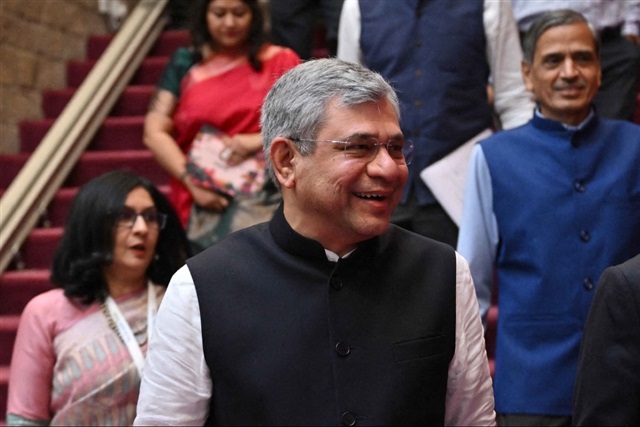
India's electronics and IT minister, Ashwini Vaishnaw, has set October 23, 2028, as the date by which the country will have mobile phones that are designed, manufactured, and branded domestically, as New Delhi seeks to move beyond assembling devices for foreign brands.
India's tech push opens markets unevenly: foreign suppliers get first crack at Tata's fab, Lam courts local vendors, Jio's IPO tests its 5G pitch, and CleanMax powers AI data centers.
India's "Make in India" policy is driving demand for smart manufacturing and machinery. As such, Taiwanese machinery manufacturers are positioning themselves to seize the opportunities presented by the country's manufacturing push.
CleanMax's partnerships with Apple, Meta, and other technology companies highlight how artificial intelligence (AI) data centers are intensifying global demand for renewable power.
Lam Research is grooming Indian companies to become its suppliers rather than relying only on its global vendor base, a senior executive said, as the US chip equipment maker deepens its presence in a market where the government now ties incentives to local sourcing.
India's first commercial chip fab is opening a long-awaited new market for the country's chemical makers, but the companies best placed to profit in the near term are Japanese, South Korean, and European materials suppliers that already have the purification know-how and customer trust that chipmakers demand.
Tata's Dholera fab faces customer and shareholder tests as India's semiconductor push broadens, with packaging, chip services, AI hardware and infrastructure investments accelerating across the country's domestic technology ecosystem rapidly.
Samsung Semiconductor India Research (SSIR), Samsung's semiconductor research and development center in India, and the Indian Institute of Science (IISc) inaugurated a Quantum Research Lab on the IISc campus in Bengaluru on October 15, 2026, aiming to build India's research capabilities in quantum technologies and advanced semiconductors.
Hyundai Motor Group plans to invest approximately US$15.5 billion in India from 2026, expanding production, research, and partnerships as it positions the country as a base for domestic growth and exports to emerging markets. The commitment could strengthen India's role in the group's mobility strategy and broaden its manufacturing footprint.
India's RRP Electronics has inaugurated an Advanced Wafer-Level Packaging (AWLP) facility at its semiconductor unit in Navi Mumbai, Maharashtra, adding SIM and eSIM module production and specialized testing to its outsourced semiconductor assembly and test (OSAT) operations. The facility opened on October 12, 2026, according to Dalal Street Investment Journal.
IBM and MeitY Startup Hub, an initiative of India's Ministry of Electronics and Information Technology (MeitY), have signed a memorandum of understanding (MoU) to support India's deep tech startups with enterprise technology, mentorship, and market access. The deal could help founders build products for domestic needs while also improving their chances of scaling into global markets and ecosystems.
Tata Group's semiconductor fab in Gujarat, held up as the foundation of India's chipmaking ambitions, now faces scrutiny from within, as the group's controlling shareholder presses for quicker returns on capital-intensive bets.
A proposed Adani-Jabil venture could boost India's role in the global AI supply chain by adding local manufacturing of servers, racks, and cooling systems. If approved, the tie-up may help meet rising demand for data center hardware, lower supply risks, and widen access to AI infrastructure worldwide.
Indian semiconductor engineering services firm Tessolve has raised US$75 million from US-based Vector Line Capital and says it is in advanced discussions to close multiple acquisitions over the next couple of quarters, as the Hero Electronix company pushes deeper into designing AI and high-performance computing chips.
Kaynes Semicon, the chip packaging arm of Indian electronics maker Kaynes Technology, is calling for foreign semiconductor companies to form joint ventures in India, as its executives point to India's lack of expertise in key packaging materials just as output at its first plant begins to scale.
HCLTech has signed a Global Premier Partnership with Anthropic, tying one of India's largest IT services companies more closely to an AI developer that has spent 2026 building out its India presence, even as HCLTech separately moves to own AI computing capacity at home.