
Taiwan Semiconductor Manufacturing Company (TSMC) posted record second-quarter earnings for 2026, issued third-quarter revenue guidance above market expectations, and raised its full-year US dollar revenue growth forecast to more than 40%. The company also increased its 2026 capital expenditure guidance to US$60-64 billion. However, investors focused more closely on its softer gross margin outlook for the third quarter, the additional US$100 billion investment planned for Arizona, and the company's evolving global manufacturing strategy.
According to supply chain sources, TSMC is reconfiguring its global manufacturing footprint as three forces converge: surging AI demand, US efforts to localize semiconductor production, and intensifying competition in the global foundry industry. Together, these trends are reshaping TSMC's long-standing Taiwan-centric manufacturing model, suggesting that higher overseas production costs and pressure on margins will likely become long-term realities rather than short-term challenges.
Supply chain observers noted that TSMC would have little incentive to relocate its most advanced manufacturing technologies overseas under normal circumstances. Taiwan continues to offer the industry's strongest advantages in construction efficiency, labor costs, equipment availability, engineering management, and supplier ecosystems. However, the combined influence of AI demand, US industrial policy and global supply chain security concerns has compelled the company to rethink its global capacity allocation.
The US seeks more than fabs; it wants complete AI semiconductor ecosystem
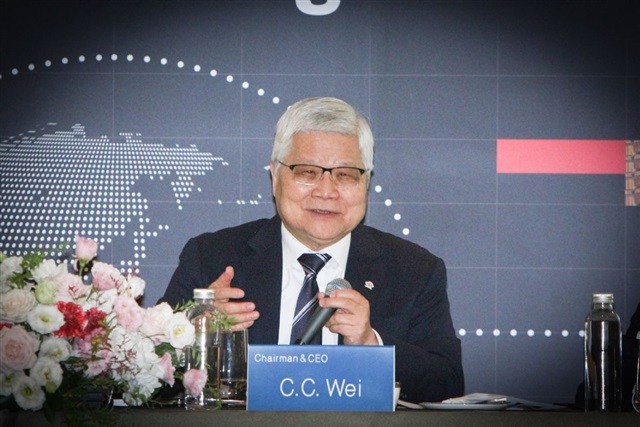
TSMC Chairman and CEO C.C. Wei said the additional US$100 billion investment will fund new fabs for 2nm and more advanced process technologies, as well as advanced packaging facilities to support US customers over the coming years. Arizona is already planned to host six wafer fabs, two advanced packaging plants, and one R&D center. With four additional fabs now planned, the site is expected to evolve into a fully integrated AI semiconductor manufacturing hub and become TSMC's largest production base outside Taiwan.
From Washington's perspective, the investment represents far more than additional fabrication plants. It completes the final pieces needed to establish an end-to-end domestic semiconductor ecosystem spanning advanced process technologies, advanced packaging and localized supply chains.
Recent policy initiatives—including the CHIPS and Science Act, semiconductor subsidies and tariff measures—along with President Donald Trump's renewed goal of securing 40% to 60% of global semiconductor manufacturing capacity, underscore Washington's continued commitment to reshoring chip production. Trump recently cited TSMC's expanding investment in Arizona as evidence that advanced semiconductor manufacturing is gradually returning to the United States.
Supply chain sources said the US has never lacked chip design capabilities; its biggest weakness has been advanced manufacturing. Investments by TSMC, Intel, Samsung Electronics, Amkor, GlobalFoundries, and Tesla are now helping establish the comprehensive semiconductor supply chain required for the AI era. TSMC's presence has also created a strong clustering effect, attracting suppliers from across the global semiconductor ecosystem.
AI demand dictates expansion while US policy accelerates globalization
Wei stressed that the additional US$100 billion investment is not driven solely by political considerations. During the earnings call, he explained that TSMC plans capacity not only according to direct customer demand but also through close discussions with customers' customers—primarily cloud service providers (CSPs)—regarding AI data center construction, power availability and infrastructure planning, allowing forecasts to be refined from both the top down and the bottom up.
Because bringing a leading-edge fab from technology development through construction to volume production typically takes more than five years, TSMC's current capital spending is aimed at positioning the company for AI demand beyond 2028–2030 rather than responding to today's business cycle.
Wei added that the rapid emergence of agentic AI is restoring CPUs as a critical computing engine within AI data centers, driving additional demand for advanced process technologies. Most of these processors are being developed by TSMC's customers, with manufacturing technologies and production capacity planned jointly well in advance.
Supply chain sources argued that without sustained AI demand, TSMC would have had little reason to increase its 2026 capital spending. Likewise, without continued US efforts to localize semiconductor production and customers' desire to establish second manufacturing bases, there would have been far less urgency to expand advanced manufacturing capacity overseas.
In other words, AI demand is driving TSMC's capacity expansion, while US industrial policy is accelerating the restructuring of the global semiconductor supply chain.
Higher overseas costs challenge TSMC's high-margin model
Another key focus for investors is how TSMC's expanding overseas manufacturing footprint—particularly in the US—will affect profitability. While investors have historically judged the company by its ability to maintain industry-leading margins, the growing share of overseas production is prompting a reassessment of its long-term earnings model.
According to TSMC CFO Wendell Huang, overseas fabs have already begun diluting gross margins. Third-quarter gross margin is projected to range between 65% and 67%, with a midpoint of approximately 66%. Mass production of 2nm chips is expected to reduce second-half 2026 gross margins by around three to four percentage points, while overseas fabs are projected to dilute margins by another two to three percentage points during their initial ramp-up, potentially widening to three to four percentage points in the coming years.
The softer-than-expected third-quarter margin outlook was therefore one of the primary reasons behind investors' cautious reaction following the earnings call. Supply chain sources emphasized, however, that the margin pressure primarily reflects simultaneous global capacity expansion and the early costs of ramping 2nm production, rather than any weakening in AI demand.
Construction and operating costs in the US remain substantially higher than in Taiwan, meaning that a larger share of advanced production in Arizona will inevitably raise TSMC's overall cost base.
At the same time, growing demand for advanced process technologies, advanced packaging, and engineering services means that talent recruitment, project execution, and the maturation of local supplier ecosystems will become critical challenges in TSMC's next phase of overseas expansion.
Rising investment keeps TSMC ahead of Samsung and Intel
Beyond AI demand and US policy, intensifying global foundry competition has become another major factor driving TSMC's continued increase in capital spending.
Samsung is advancing its 2nm gate-all-around (GAA) process, HBM, and advanced packaging while leveraging its memory leadership and US manufacturing presence to compete for orders. Intel is pushing forward with its 18A and 14A nodes, together with EMIB and Foveros advanced packaging technologies. Meanwhile, major customers including Apple, Tesla, Google, and Nvidia have either established or are evaluating second-source manufacturing strategies.
Supply chain sources believe Samsung and Intel still trail TSMC technologically, with AI GPUs and the industry's most advanced sub-2nm products remaining heavily dependent on TSMC in the near term. The company's immediate challenge is therefore not losing flagship AI chip orders outright but adapting to customers' growing efforts to establish second sources of supply.
Competition in the semiconductor industry is cumulative. As rivals gradually build large-scale manufacturing capabilities, the competitive landscape could shift significantly over the next five to ten years.
Rather than slowing investment, TSMC is accelerating capital spending while speeding up deployment of its 2nm process, advanced packaging capacity and global manufacturing footprint in an effort to widen its lead in technology, production capacity and supply chain integration before competitors catch up.
As AI demand continues to grow rapidly, TSMC alone can no longer satisfy all market requirements, allowing portions of AI-related demand to gradually spill over to competing manufacturers.
Supply chain sources believe TSMC's expanded investment in the US is intended to support AI customers' needs over the coming years while responding to the stronger enforcement of US industrial policy, requiring the company to reshape its global manufacturing network.
Although overseas expansion will raise costs and place sustained pressure on margins, TSMC's leadership in technology will become even more critical to maintaining its dominance in the AI-era foundry market amid challenges from memory leader Samsung and Intel, whose advanced manufacturing ambitions continue to receive strong backing from the US government.
Article translated by Scarlett Yu and edited by Jack Wu