

These are the most-read DIGITIMES Asia stories in the week of December 8 to December 14, 2025.
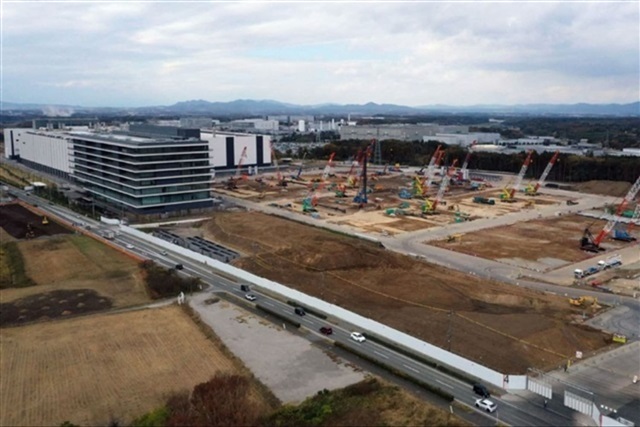
TSMC pauses work on second Kumamoto wafer fab amid potential shift to AI chip production
TSMC, through its Japan Advanced Semiconductor Manufacturing unit, has effectively paused construction of its second wafer fabrication plant in Kumamoto only weeks after groundbreaking as it reconsiders the facility's production focus amid shifting market demand, according to Nikkei Asia and the Kumamoto Nichinichi Shimbun. The project, backed by about US$22.5 billion in investment and roughly JPY1.2 trillion in Japanese government subsidies, was originally set to begin producing 6–7nm and 40nm chips for automotive and image sensor uses by late 2027, but suppliers said construction activity dropped sharply from November without a clear explanation.
Sources said TSMC is considering a shift toward more advanced 4nm chips for AI workloads as automotive semiconductor demand weakens alongside a slowdown in electric vehicle sales, while AI data center demand continues to rise. Japan's Ministry of Economy, Trade and Industry and JASM have denied any change to the mass production timeline, saying discussions are focused on optimizing building design, though the pause has unsettled local stakeholders and equipment suppliers and highlights the challenge of aligning long-term chipmaking investments with rapidly changing end markets.
Exclusive: Tesla Powerwall orders triple in Taiwan amid growing power supply concerns
Demand for Tesla's Powerwall in Taiwan has surged as concerns over power reliability have grown, with orders reportedly having tripled in 2025 amid frequent outages and voltage instability, according to industry sources. The increase reflects mounting pressure on the island's electricity system stemming from nuclear plant shutdowns, disruptions at natural gas facilities, delays in solar projects and extreme weather, prompting households and small businesses to seek reliable backup power. The Powerwall's ability to store solar energy, smooth voltage fluctuations and reduce electricity costs under time of use pricing has made it an increasingly attractive option, while Tesla's safety record and local installation network have helped drive adoption. The trend underscores how residential energy storage is moving from a niche product to a practical safeguard as Taiwan's power supply challenges intensify.
Huawei founder sees oversupply risk, reveals training of 3,000 chip specialists
Huawei founder Ren Zhengfei said artificial intelligence is likely to deliver its biggest industrial gains over the next three to five years but warned that global computing capacity could eventually outpace demand, offering a more cautious view than much of the current AI investment narrative. Speaking in Shanghai, Ren said Huawei is prioritizing practical AI applications in manufacturing, healthcare and heavy industry rather than artificial general intelligence, citing examples such as AI managed steel production, automated coal mining and faster software development, where large models already handle about 30% of coding tasks.
He also revealed that Huawei has spent three years training more than 3,000 workers to operate advanced chip-making tools, as US export restrictions force the company to develop more technology in-house. Ren argued that future constraints will come from a lack of viable AI applications rather than hardware, adding that compute demand is nonlinear and difficult to predict, while Huawei continues to invest cautiously in areas such as quantum computing and domestic semiconductor capabilities.
Samsung shifts focus from HBM to DDR5 modules for higher profits
Rising DDR5 prices are reshaping the memory market as tight supply boosts profitability for general DRAM, according to market sources. The official price of a 64GB DDR5 RDIMM jumped nearly 70% to US$450 in the fourth quarter of 2025, giving Samsung gross margins above 75% and exceeding returns from HBM3E, where margins have fallen as the company cuts prices to compete with SK Hynix and Micron. Samsung is shifting a large share of DRAM capacity to newer 1b and 1c nodes to support DDR5 output, while SK Hynix plans to expand general DRAM capacity by 2026, though AI demand is expected to absorb most supply. Taiwanese suppliers such as Winbond and Team Group are also benefiting from the price surge as shortages persist.
Samsung moves up Pyeongtaek Phase 4 timeline in aggressive HBM4 push
Samsung Electronics is speeding up DRAM capacity expansion to strengthen its position in AI memory after completing development of its sixth-generation HBM4, according to industry sources. Asia Today reported that Samsung plans to bring forward completion of Phase 4 at its Pyeongtaek P4 fab as early as the fourth quarter of 2026 to support mass production of 10nm class 1c DRAM for HBM4. The move reflects rising HBM demand from customers beyond Nvidia, including Google, Broadcom and Amazon, and a shift of capacity away from foundry work. Analysts say the earlier timeline could help Samsung scale HBM output in 2026, though some reports of customer validation and future orders remain unconfirmed.
SK Hynix reportedly delays HBM4 mass production amid Nvidia Rubin AI accelerator launch plans
SK Hynix has delayed mass production of its sixth-generation HBM4 memory to the third quarter of 2026 from the end of the second quarter, aligning more closely with Nvidia's planned 2026 launch of its Rubin AI accelerator, according to ZDNet Korea and Chosunbiz. The one- to two-month shift follows earlier delivery of 12 layer HBM4 samples to Nvidia and reflects supply and pricing talks as demand for current generation HBM3E has exceeded expectations. Market sources said SK Hynix is prioritizing continued HBM3E output for Nvidia's Blackwell chips into the first half of 2026, prompting a more cautious HBM4 ramp. SK Hynix has not confirmed details but said it will adjust plans as market conditions evolve, highlighting the tight coordination between memory roadmaps and AI chip launch schedules.
Huawei–SMIC chip hits milestone, still lags TSMC's 5nm
China is intensifying its drive for semiconductor self-sufficiency through technical advances at Huawei and SMIC alongside procurement rules that push state buyers toward domestic chips to sidestep US export controls. Bloomberg, citing a TechInsights teardown, said Huawei's Kirin 9030 uses an upgraded SMIC 7nm process, the most advanced Chinese chip to date, while the Financial Times reported that Beijing has added AI accelerators from Huawei and Cambricon to a government supplier list. The shift is also boosting demand for DDR5 over restricted high bandwidth memory and accelerating growth at ChangXin Memory Technologies, which Counterpoint Research estimates could raise its global DRAM share to 10 percent by 2027.
Article edited by Jerry Chen