


Kioxia has ruled out deeper manufacturing ties with SK Hynix while resisting another round of aggressive NAND price increases, leaning instead on longer customer contracts and disciplined capacity expansion as data-center demand keeps memory supply tight.
Kioxia President and CEO Hiroo Ota said closer production cooperation with SK Hynix would face antitrust hurdles and would be difficult to reconcile with Kioxia's existing manufacturing partnership with SanDisk. The Japanese and South Korean memory makers are not discussing joint production, Ota told Bloomberg.
The comments push back against an idea floated earlier this month by SK Group Chairman Chey Tae-won, who identified cooperation with Kioxia as one option for expanding memory supply. Potential areas included joint production, research and development, and supply-chain cooperation. Chey estimated that data-center memory supply was running roughly 20% to 30% below demand.
The relationship between the two companies is unusually layered. Kioxia and SK Hynix compete in NAND while cooperating in selected technology areas, including magnetoresistive random-access memory research. Kioxia also sources DRAM from SK Hynix for some solid-state drives, while SK Hynix maintains a longstanding indirect financial interest in Kioxia through a convertible-bond structure.
SK's appetite for additional capacity has not diminished. In comments released Sept. 8, Chey said the semiconductor shortage driven by surging demand could persist and that SK Hynix's substantial investment plans in South Korea would still be insufficient. The group is evaluating sites worldwide based on access to land, electricity, talent and semiconductor ecosystems, with a decision on priority locations and investment structures expected soon.
The moves highlight a broader challenge for memory suppliers: adding enough capacity to capture strong data-center demand without recreating the overinvestment and sharp price corrections that have characterized past memory cycles.
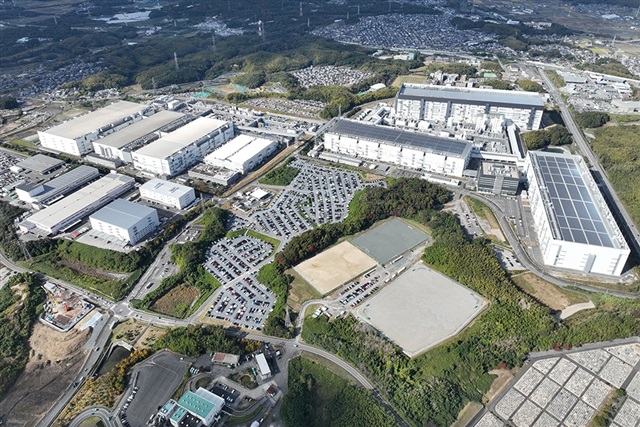
Kioxia and SanDisk unveiled plans in August to invest more than US$31 billion in Japan through 2032, extending their long-running flash-memory manufacturing partnership. The investment plan is subject to government support and includes expansion of their operations in Yokkaichi and Kitakami.
SK Hynix is also expanding aggressively. Its board approved about KRW54 trillion in August for new production capacity in South Korea, including KRW35.2 trillion for the Yongin Y2 fab and KRW19.1 trillion for the Cheongju M17 fab. The company plans to expand DRAM and NAND production in stages based on customer demand.
The Korean memory maker is separately building a more than US$4 billion advanced-memory packaging and R&D operation in West Lafayette, Indiana. SK Hynix CEO Kwak Noh-jung expects the current memory-chip shortage to persist through the end of 2030 and sees no clear signs of a downturn. Any eventual slowdown could involve moderating rather than sharply falling demand.
Kioxia is seeing similarly long purchasing horizons from its own customers. Demand from major technology companies remains strong, with some seeking NAND supply agreements extending to 2030. Kioxia is also close to achieving its target of placing 50% of shipment volume under long-term agreements.
Kioxia shifts toward multi-year demand visibility
Those commitments fit a broader strategy Kioxia laid out months before Ota's latest comments.
At its June Investor Day, the company described a structural shift from "consumer-driven cyclicality" toward growth led by AI infrastructure. It is also moving from one-year long-term agreements to multi-year LTAs to improve revenue visibility and stability, supporting more proactive capital investment.
Kioxia plans annual capital expenditure averaging approximately JPY470 billion over the next three years, roughly 60% above FY2025. The program includes manufacturing equipment, cleanroom infrastructure and additional production headroom, while customer commitments including LTAs are intended to support a more stable supply framework and disciplined investment.
The company is also shifting its portfolio toward higher-value data-center applications. Data-center and enterprise products are targeted to account for more than 60% of revenue, while smartphones and PCs remain a core business base.
Kioxia's June market outlook showed NAND supply and demand remaining tight through 2027 as strong data-center demand collides with supply constraints. The company is increasing capital expenditure and R&D to capture that growth while emphasizing capital efficiency rather than pursuing market share for its own sake.
Pricing restraint takes priority as NAND stays tight
Tight supply does not mean Kioxia intends to push prices as high as the market will bear.
Its average NAND selling price rose 70% sequentially in the June quarter after more than doubling in the preceding three months. Ota has instructed sales teams not to seek substantially higher prices from data-center customers out of concern that excessive increases could eventually hurt the investment driving demand.

Kioxia President and CEO Hiroo Ota. Credit: Bloomberg
"Prices have already risen enough," Ota said.
He did not rule out future increases, but indicated that maintaining prices around current elevated levels is the immediate priority. Another 70% quarter-on-quarter increase appears unlikely because even hyperscale data-center operators operate within finite budgets.
The pricing stance and Kioxia's expansion of multi-year contracts point to an effort to turn today's tight market into more predictable demand rather than rely solely on near-term price increases. Longer customer commitments also give the company greater visibility as it commits billions of dollars to new production.
The 2030 horizon is notable on both sides of the market. Some Kioxia customers are already seeking NAND contracts extending that far, while SK Hynix expects shortages across the broader memory market could persist through the end of the decade. The latter outlook covers memory chips generally and is not a NAND-specific shortage forecast.
Ota's rejection of deeper manufacturing integration does not signal an end to cooperation with SK Hynix. Instead, it draws a clearer boundary around Kioxia's production structure as both companies confront the same question: how quickly to add capacity into a memory market increasingly tied to long-term data-center spending.
For now, SK Hynix is evaluating additional production options across multiple geographies, while Kioxia is emphasizing multi-year customer commitments, controlled expansion and restraint on further NAND price increases.
Article edited by Jack Wu
