CONNECT WITH US
Tuesday 28 July 2026
electronics as the basis for the All Electric Society
Whether it's speech and object recognition, image classification, predictive maintenance, or autonomous control, Artificial Intelligence (AI) applications require powerful electronic systems. It is only modern semiconductors and sensors, scalable embedded systems, and efficient connectivity that enable AI solutions in industry, mobility, energy, and medicine in the first place. At the same time, as the use of AI grows, so do the demands on computing power, energy efficiency, and cyber resilience. The electronics industry will show which technologies are driving this development at electronica in Munich from November 10 to 13.The electronics industry provides the technological basis for the All Electric Society and enables intelligent applications in energy supply, mobility, industrial automation, and buildings. "Artificial Intelligence places whole new demands on electronic systems. What's needed are powerful, energy-efficient, and secure solutions in which hardware, software, and connectivity work together seamlessly," says Caroline Pannier, Exhibition Director for electronica. "It's precisely these developments that are the focus of electronica." AI as an accelerator and stress test for the economy and infrastructure.?AI as an accelerator and stress test for the economy and infrastructureTo remain innovative and competitive, companies today must integrate AI into their products, services, and processes. According to the German Economic Institute, 66.3 percent of large companies are already using AI, while about half of medium-sized companies are doing so. Small businesses have the most ground to make up: Only 35.6 percent use AI in their operations.At the same time, AI is opening up entirely new possibilities: machines and vehicles are becoming smarter, energy grids more efficient, medical diagnoses more accurate, and devices more autonomous. However, as the use of AI grows, so do the energy needs and cybersecurity requirements.Energy efficiency and cyber resilience as key criteriaDue to the increased use of AI, modern electronic systems must provide high computing power, use energy sparingly, and operate reliably under thermal conditions. At the same time, the attack surface for cyber risks grows as systems that exchange large amounts of data become increasingly connected, and software updates are released regularly.As a result, energy efficiency and cyber resilience are evolving from individual, isolated requirements into core system criteria. In addition, the EU Cyber Resilience Act (CRA) increases the pressure on companies to take action. Approaches such as "security by design" must therefore be incorporated as early as the architecture phase and integrated across hardware, software, interfaces, updates, and operating concepts.Hardware, software, and the application layer are convergingThe development of modern electronics is increasingly shifting from optimizing individual components to integrated, complete systems. What matters is no longer just the performance of an individual processor, sensor, or module, but rather the interaction between hardware and software, the operating system, connectivity, security, and the application layer. Customers expect products that can be quickly integrated, easily scaled, and updated throughout their lifecycle. This places greater demands on system design, software quality, and lifecycle management. At the same time, that opens up opportunities for the electronics industry to tap into new markets and make itself competitive for the future.electronica as a platform for AI, cyber resilience, and energy efficiencyAs the world's leading trade fair for electronics, electronica brings together key players that cover the entire spectrum of the industry. Around 3,500 exhibitors from some 60 countries will show how individual components are transformed into integrated, intelligent, and secure complete systems. The focus will be on the key topics of Artificial Intelligence, energy efficiency, and cyber resilience. An extensive supporting program will provide for further discussion and knowledge sharing. SEMICON Europe, taking place in parallel across two and a half halls, will offer insights into the entire semiconductor industry value chain.
Tuesday 28 July 2026
Secure components: Focus shifts to cyber resilience in electronics development
?Connected and digitized vehicles, machines, and energy systems place new demands on electronics. From now on, electronics must not only deliver high-performance but also detect cyberattacks, contain disruptions, and enable secure updates. Cyber resilience is therefore becoming a key factor for trust, availability, and market success. electronica 2026, taking place in Munich from November 10 to 13, will showcase the technologies that are essential for this.?Industrial systems, vehicles, and energy systems are increasingly evolving into networked electronic systems that are controlled, updated, and secured via software. Security mechanisms can therefore no longer be added as an afterthought but must instead be integrated right from the start into the system design, particularly for interfaces, updates, and software-defined functions.?At the same time, customers, regulators and operators expect solid proof of the security and updatability of electronic systems. "As the world's leading electronics trade fair, electronica 2026 in Munich brings together key players from across the entire value chain. In doing so, it creates a framework for addressing cybersecurity not in isolation, but as a shared architectural challenge for the electronics industry", explains Caroline Pannier, Exhibition Director of electronica.?Studies show growing pressure to act?Recent studies show how important an issue this is. The ENISA Threat Landscape 2025 report, for example, identifies attacks on public administration and the transport sector as the most common targets of cyberattacks, with phishing being the most frequently used method. In many cases, hackers target companies' operational technology (OT).?However, according to a PwC study, only about 15 percent of German companies have so far invested specifically in proactive security and resilience measures. The vast majority remain reactive: Investments are only made after incidents occur or as part of regular updates, without a systematic transformation concept for prevention.?Increasing regulation of cybersecurity?To encourage companies to take action and integrate security into products from the outset, the European Union has enacted the Cyber Resilience Act (CRA). It specifically regulates products that companies place on the European market. Among other things, it requires that products with digital components remain secure throughout their expected service life and address vulnerabilities throughout their lifecycle. It covers a wide range of electronic products, not just internet-enabled devices, but essentially all products with a direct or indirect logical or physical connection to a device or network.?Effectively countering cyberattacks?As a result, the CRA makes security a key development requirement. At the same time, AI-based systems give rise to new risks: data poisoning, model poisoning, and adversarial attacks can manipulate AI models and lead to incorrect decisions. Developers are responding to this with "security by design"—that is, with security mechanisms integrated from the outset into the architecture, secure firmware, and verifiable updates.?At the component level, this includes a hardware root of trust, Secure Boot, and Trusted Platform Modules (TPMs). Secure microcontrollers (MCUs) implement security functions directly within the device, ensuring, for example, that only authenticated firmware or signed code is executed during system startup.?Exhibitors showcase relevant technologies?At electronica, numerous exhibitors will present their innovations and solutions for resilient electronics. Infineon, for example, will address the issue of cyber resilience with, among other things, its "Optiga" security solutions for embedded security. In the context of secure, connected devices, Renesas primarily offers its secure "RA" microcontrollers, including isolated cryptographic operations, secure key storage, Arm TrustZone technology, and protection measures against side-channel attacks. Texas Instruments is expanding its product portfolio with its AM263x Sitara MCUs, providing, among other things, Secure Boot, cryptographic keys, and a hardware security module.?electronica as a platform for resilient electronics?The supporting program at electronica will also focus on cyber resilience, for example in the Cyber Security Forum and in a series of presentations and workshops on the Cyber Resilience Act. Industry experts will provide insights into the latest technologies as well as practical approaches and strategies for resilient electronic products. With this framework, electronica 2026 will provide developers, technical decision-makers, and CEOs with concrete guidance on how to make their companies more resilient against cyberattacks.
Tuesday 28 July 2026
Energy efficiency as a key topic in electronics
?Manufacturers are driving energy efficiency in electronics, automation and industrial applications?Energy efficiency is not a new trend in the electronics industry. However, demands are growing, driven by rising electricity prices, regulatory pressure as well as the increasing need for energy-efficient components for systems, power electronics, and IoT devices. From November 10 to 13, 2026, the international electronics industry will gather at electronica to discuss the latest trends in energy efficiency.?The debate over energy efficiency now encompasses the entire electronics value chain. It ranges from semiconductors, power supply and embedded systems to electromechanics and industrial connection technology. The question of how best to achieve energy efficiency is a recurring theme across nearly all application areas, from consumer electronics and automotive electronics to industrial systems and devices.?As the world's leading trade fair and conference for electronics, electronica brings together companies from across the entire value chain to discuss technical challenges and current trends in using energy efficiently. "Energy efficiency is becoming a key requirement for the electronics industry. At electronica, it's clear that efficient products are in demand today in virtually every sector—from electromechanics and automation to connected industrial applications," says Caroline Pannier, Exhibition Director for electronica.?Energy costs are falling thanks to efficient electronicsRecent studies show that energy efficiency is becoming increasingly important across various industries. In the automotive sector, the IEA's Global EV Outlook 2026 shows that electric mobility continues to gain momentum: in 2025, more than 20 million electric cars were sold worldwide, meaning that roughly one in four new cars sold is already electric. As a result of this trend, the demand for energy-efficient electronics is growing—from power electronics and charging infrastructure to battery technology.?A study by Fraunhofer IZM shows that modern technologies are improving energy efficiency. Because of this, the energy requirements of mobile networks will increase only moderately in the coming years despite rising data volumes. Energy efficiency is also becoming a greater focus in other sectors, such as electronics manufacturing. McKinsey concludes that it is possible to reduce energy costs for semiconductor factories by 20 to 30 percent through efficiency measures.?Energy efficiency often stems from the system?For the electronics industry, this means that energy efficiency is becoming a strategic factor both in the product itself and in the manufacturing process. This is particularly evident in the field of electromechanics. This field doesn't just deal with individual components, but also with the way connectors, housings, cable routing and interfaces interact with each other.Low contact resistance, robust connection technology, EMC-compliant design and maintenance-friendly systems reduce losses, enhance operational reliability and simplify maintenance. The focus is therefore increasingly shifting toward the system as a whole, which has to be designed to be energy-efficient in order to conserve energy directly at the source.?electronica provides a platform for efficient electromechanics?electronica covers the entire electronics value chain, which is the reason for the focus on electromechanics. Exhibitors such as Harting, Phoenix Contact and Weidmüller will be showcasing connectors, relays, switches and enclosure technology, among other products. Harting, for example, specializes in industrial connectivity solutions for the transmission of data, signals and power, and focuses on applications in the fields of electric mobility, renewable energy, automation and mechanical engineering.?Phoenix Contact also demonstrates that energy efficiency begins right at the electromechanical level, for example in connectors, terminals, enclosures, power supplies and interface solutions for electrification and automation. Weidmüller's product portfolio includes the likes of terminal blocks, connectors, PCB connectors and other components for the safe transmission of power, signals and data. Meanwhile, the distributor Arrow Electronics, together with its partners, focuses on electromechanical components and high-performance passive components, which are designed to improve energy storage and efficiency and reduce losses in applications such as electric mobility, renewable energy systems and industrial automation.?This clearly demonstrates that any visitors looking for energy efficiency at electronica will find it not only in semiconductors and power electronics, but also in the field of electromechanics.?At electronica 2026, around 3,500 exhibitors from some 60 countries will showcase their latest solutions for the All Electric Society. Topics such as energy efficiency, automation and the circular economy will also be addressed in the supporting program and in the forums, where participants will discuss technological developments, regulatory issues and sustainable concepts for the future.
Tuesday 28 July 2026
Caroline Pannier: electronica 2026 is in a strong position
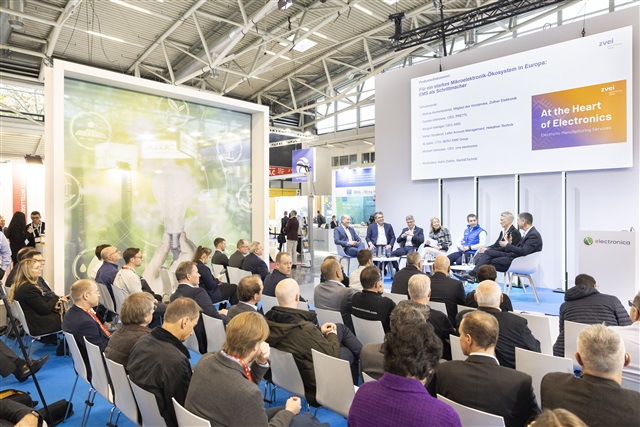
?"Empowering the All Electric Society" – that is at the heart of electronica 2026, which will open its doors at the Munich Exhibition Center from November 10 to 13. The world's leading trade fair for electronics will once again present the industry's entire spectrum of technologies, products and solutions helping to pave the way for an All Electric Society. In this interview, electronica's new Exhibition Director Caroline Pannier provides an insight into the upcoming trade fair and the results of a long-term analysis of the industry's assessment of the economic situation.?There are still a good nine months to go before electronica 2026, but preparations are already in full swing. What can you already tell us about the upcoming trade fair, which you will be accompanying for the first time as Exhibition Director??We are delighted that electronica 2026 will once again occupy all 18 halls of the Munich exhibition center, together with SEMICON Europa, taking place at the same time in two and a half halls. That means that electronica once again covers the entire spectrum of the industry, which makes it unique worldwide. To keep track of everything amid this diversity, we have made the hall layout even more coherent and clear. The semiconductor area has also been extended by an entire hall.As far as exhibitor registrations are concerned, we are at the same high level as for the previous event. All the key players are back on board. There will be a very strong European presence, and we are seeing significant growth in part, from France, Italy, Poland and the UK, for example. There's also been a high level of interest from exhibitors from the U.S. and Asia.?What topics will the trade fair focus on in particular??In discussions with industry representatives, we have identified three overarching key topics that are currently in the spotlight and that all ultimately contribute to the All Electric Society: artificial intelligence, cyber resilience and energy efficiency. We are currently in the process of refining these themes and identifying sub-topics that are particularly relevant to the electronics industry right now from the user's point of view.?What will be new at the trade fair, and what highlights can you already reveal to us??As you know, we attach great importance to offering a very extensive supporting program that leaves plenty of room for sharing expertise and ideas, and for networking. That's why the electronica stages, for experts to provide practical knowledge in talks on almost all fields of application, will once again be set up in the respective exhibition areas. A new addition, for example, is edge lab LIVE, a special area on edge computing that is very practice-oriented with workshops and lectures. There are also award ceremonies, pitch formats and several career initiatives. The CEO Roundtable with top-class speakers will kick off the event on Monday evening before the trade fair starts. The electronica Automotive Conference, where trends and challenges in the automotive value chain will be discussed, will also be held on Monday.?Messe München recently published a Future Monitor based on exhibitor surveys from the past 13 years. The companies were asked to assess the current and expected future economic situation in their sector. How do electronica exhibitors see the future??The evaluation of the long-term analysis produced exciting results for our industry. The electronics companies surveyed are remarkably confident about the future and are far more positive about the economic prospects than the current situation. This optimism clearly shows the key role of the electronics industry. With its solutions and innovative strength, it is helping to tackle current social challenges. Our excellent booking situation underscores just how important world-leading trade fairs such as electronica are. They bring the entire world of electronics together in one place and offer a stage for new products, professional exchange and new impetus.?The next electronica takes place from November 10 to 13, 2026.Caroline Pannier is the new Exhibition Director of electronica. Messe München GmbH
Tuesday 28 July 2026
AI powers electronics growth from Edge AI to smart mobility
?From November 10 to 13, 2026, the international electronics industry will gather at electronica. This year, the world's leading trade fair for electronics will focus, among other topics, on Artificial Intelligence. From Edge AI to AIoT and machine learning—in Munich, a spirit of innovation, key technologies, and industry expertise will come together in one place to showcase, discuss, and further develop the technologies of tomorrow.?Today, Artificial Intelligence (AI) ranges from Edge and Cloud AI to AI-powered quality control in manufacturing and robotics to smart mobility. AI has long become a strategic competitive factor, helping companies make their processes faster, more precise, and more cost-effective. At the same time, however, the demands on data quality, IT security, and integration into processes and products are increasing. The electronics industry is systematically driving the transformation through AI and strengthening its international competitiveness as a result. "This transformation is visible at electronica, which brings together top decision-makers and developers from around the world, and showcases the entire electronics value chain," explains Caroline Pannier, Exhibition Director of electronica.?Semiconductor industry benefits from AI boom?Recent studies confirm the trend that AI is emerging as the key driver of growth and innovation in the industry. The Capgemini study The Semiconductor Industry in the AI Era, for example, shows that the widespread adoption of AI and generative AI is driving up demand for semiconductors. At the same time, downstream industries expect chip demand to rise by 29 percent by the end of 2026. A study by McKinsey also shows that semiconductor segments that produced components for AI applications grew by 21 percent annually from 2019 to 2023, while the industry as a whole achieved growth of just 6 percent.?Edge AI and AIoT are becoming key factors in the electronics industry?The trending topics of Edge AI and AIoT, in other words, the use of Artificial Intelligence directly on devices and in connected systems, are currently particularly relevant for the electronics industry. Both approaches enable data to be processed in real time where it is generated, such as in sensors, controllers, or embedded systems. That reduces latency, takes the load off the cloud, and improves data privacy, energy efficiency, and reliability.?At the same time, AI and robotics are becoming increasingly important in industrial automation, above all in the field of AI-based quality control. Automatic detection of the smallest deviations and defects on components, printed circuit boards, or in production processes helps reduce scrap, speeds up inspection processes, and ensures more stable operation of production lines. Another focus is on AI on microcontrollers: Advances in TinyML and optimized embedded AI models make it possible to provide intelligent AI functions even on hardware with limited resources.?Bringing hardware and software closer together through AI?At electronica 2026, Infineon, STMicroelectronics, and NXP Semiconductors rank among the particularly relevant exhibitors in the AI sector. Infineon is primarily driving the development of Edge AI and IoT solutions for smart, energy-efficient devices. STMicroelectronics combines embedded processing, Edge AI, and mobility-related applications. NXP Semiconductors demonstrates how solutions for automotive, industrial & IoT, and communications infrastructure can be integrated into embedded systems, microcontrollers, and microprocessors. In the automotive sector in particular, the focus is shifting toward the AI-Defined Vehicle (AIDV): a vehicle in which AI not only optimizes individual functions but also increasingly shapes perception, assistance, interaction, and driving behavior. Together, these companies demonstrate that AI is increasingly being integrated directly into sensors, embedded systems, and industrial applications.?This semiconductor environment is complemented by traditional embedded systems providers such as Advantech and Kontron, which are driving the practical application of AI. Advantech explicitly describes its portfolio as the foundation for AIoT solutions—from sensor nodes to embedded PCs, gateways, and IoT cloud platforms. With its expanded portfolio of IoT, and industrial control and communication solutions, Kontron covers the entire spectrum from modules to complete systems, including software. Both companies are thus creating infrastructural conditions needed to operate AI-based solutions in industrial environments in a reliable, connected, and scalable manner.?A platform that brings together embedded computing, edge technologies, and IoT—as well as developers, decision-makers, and system architects—is edge lab LIVE, which is making its debut at electronica this year. It combines the latest embedded technologies with practical applications and allows visitors to interactively experience edge environments.?Knowledge transfer and networking?At electronica 2026, about 3,500 exhibitors from around 60 countries will showcase their cutting-edge applications and solutions that are paving the way to the All Electric Society. Visitors can learn firsthand about all aspects of Edge AI, AIoT, and related topics across 18 halls at the Munich Trade Fair Center. In addition, a top-class supporting program, featuring an Executive Event with CEO roundtable, expert lectures, or networking events, will contribute to knowledge transfer. The numerous forums, such as the IIoT Forum and the Circular Economy Forum, will also encourage open discussion. SEMICON Europe, taking place in parallel across two and a half halls, will offer insights into the entire semiconductor industry value chain.