The global memory market is facing a structural supply-demand imbalance that shows little sign of easing. Micron's stronger-than-expected quarterly results have drawn fresh attention from investors and the technology industry, while the broader supply picture remains tight.
According to industry estimates, the world's three major memory makers are currently able to meet only about 60-70% of customer demand. As the industry prepares for a prolonged upcycle, SK Hynix is accelerating construction of its Yongin Semiconductor Cluster in South Korea, one of the most visible large-scale capacity expansion plans among the top memory suppliers.
SK Group chairman Chey Tae-won recently said SK Hynix plans to speed up development of the Yongin site, with the company aiming to double overall wafer capacity within five years and expand it to roughly three times current levels by around 2034. The Yongin project was originally planned as a long-term development running toward 2045, but rising demand for AI memory is pulling the construction schedule forward.
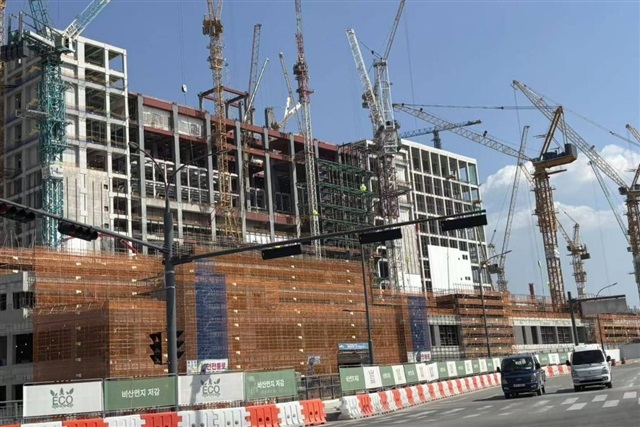
DIGITIMES visited the Yongin Semiconductor Cluster in Gyeonggi Province, where construction crews were working across the site as SK Hynix prepares to bring new capacity from its first fab online in 2027.
Yongin takes shape as memory hub
The AI boom has triggered a surge in memory demand, and cloud service providers are moving quickly to secure supply for the next several years. Long-term agreements have now been extended to 2028, while Chey has said the memory supply bottleneck could persist through 2030.
To address the long-term capacity gap, Chey said SK Hynix aims to double its overall wafer capacity within five years, with Yongin expected to serve as the main source of new output. The site is expected to become one of the world's largest memory production bases and a key part of SK Hynix's AI memory strategy.
SK Hynix first announced plans for the Yongin Semiconductor Cluster in 2019. The site, originally hilly terrain, has undergone extensive leveling and land preparation and is planned to house four fabs over time. The area has now been transformed into a broad, flat construction base.
At the site, the steel frame of the first fab rises against the surrounding hills. Construction vehicles and earthmoving work are also visible across areas reserved for the second, third, and fourth fabs.
SK Hynix recently announced a plan to list American depositary receipts on Nasdaq, targeting proceeds of up to KRW45.45 trillion(US$29.4 billion). The ADRs are expected to begin trading on July 10, 2026.
The fundraising is expected to support capacity expansion at the Yongin cluster and the Cheongju advanced packaging facility, as well as equipment purchases needed to meet demand from Nvidia and other AI customers.
First cleanroom schedule moves up
SK Hynix began planning peripheral infrastructure for Yongin in 2022, including underground power cables and water supply systems. Even as the global memory industry fell into a downturn in 2023, with suppliers cutting prices and production, SK Hynix kept long-term investment and construction work at Yongin moving. The company posted an operating loss of KRW7.73 trillion for that year.
After six years of planning and site preparation, construction of the first fab began in February 2025.
The first fab consists of two main structures and is planned to include six cleanrooms. The first phase covers three cleanrooms. After the main building is completed, industry sources said SK Hynix is expected to begin work on an adjacent second-stage building for the fourth to sixth cleanrooms.
To accelerate deliveries to customers, SK Hynix has moved up the completion target for the first cleanroom at the first fab by three months, from May 2027 to February 2027, according to industry sources. That makes Yongin one of the clearest and fastest sources of new visible supply among the three major memory makers.
SK Hynix has not disclosed when the second fab will enter production. But given Chey's target of doubling overall wafer capacity within five years, construction of the second fab is expected to move ahead quickly.
Chey has said SK Hynix will accelerate development of the four-fab Yongin cluster, which was originally planned as a long-term project running toward 2045. He has also said the company aims to expand wafer capacity to roughly three times current levels by around 2034 as it works to ease supply constraints for AI computing infrastructure.
ADR plan adds funding for expansion
SK Hynix previously announced an additional KRW21.6 trillion investment on top of an initial KRW9.4 trillion first-stage commitment, bringing the expected total investment for the first Yongin fab to KRW31 trillion.
The company is also benefiting from a rapid increase in memory contract prices driven by AI demand. SK Hynix reported record first-quarter 2026 earnings, with net profit reaching KRW40.3 trillion, beating market expectations.
That means first-quarter profit alone would be enough to cover the first-stage investment cost for the Yongin fab. Together with the planned US ADR offering, SK Hynix is expected to have a stronger funding base for capacity expansion, equipment spending, and later phases of development.
Article translated by Sherri Wang and edited by Jack Wu