

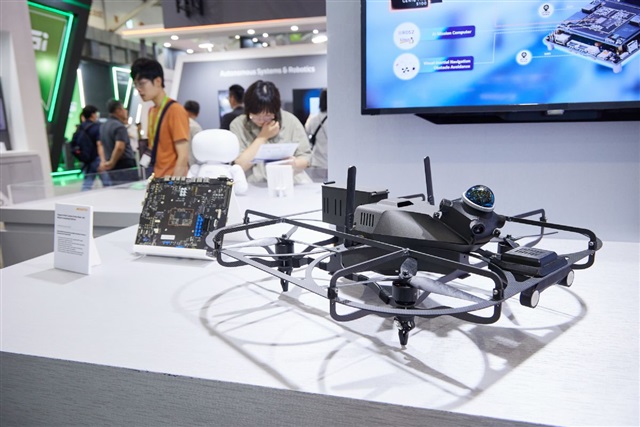
Taiwan's drone supply chain is notching fresh wins, with downstream players such as Thunder Tiger and Taiwan's Aerospace Industrial Development Corporation (AIDC) continuing to secure orders while upstream suppliers, especially chipmakers, are quietly expanding their deployments and market share. For military and commercial drones in particular, Taiwanese chip vendors are now working closely with local customers as well as customers in Europe and the US to integrate a range of on-board image-processing and AI recognition modules, plus applications such as flight control and ground control stations.
Computex puts chips in the spotlight
Over the past year, Taiwanese chipmakers have been bringing their drone-related collaborations into the spotlight. PixArt Imaging (PXI), which started with image chips and has continued to deepen its work in thermal imaging, and MediaTek and Elan, which showcased drone applications in their own exhibition areas at Computex 2026, are among them. MicroIP, which is focused on image-recognition AI, as well as Himax Technologies and Ene Technology, have also landed collaboration deals in the drone market, and some have already begun shipments.
Red ocean below, blue sky above
Industry players say the push for a non-China supply chain has become a global trend in drones. The public may not yet feel it clearly, they added, because demand for non-China sourcing is currently concentrated in commercial and military models, which are farther removed from everyday consumers. By contrast, consumer drones are still dominated by China's supply chain, making it hard for Taiwanese chipmakers to carve out a unique advantage in the mass market. That segment has already become a red ocean for Chinese vendors, leaving limited room for profits.
Scale and value: the military-commercial case
Even without consumer demand, total shipments of military and commercial models alone are expected to reach at least 6.5 million units in 2026, with annual volume gradually approaching 10 million units in the coming years. While that scale cannot match traditional consumer electronics, drone-related applications are high-value products with very large profit potential, and the revenue they generate is expected to be substantial. Over the next few years, drone revenues are likely to account for a meaningful share of total revenue at various IC design firms.
Cheap, fast, scalable — Taiwan's edge
Taiwanese chip vendors say overseas drone imaging modules are priced at exceptionally high levels, while Taiwanese companies have the ability to win business in the non-China supply chain at very competitive costs. The recent influx of major drone makers from Europe and the US setting up operations in Taiwan also shows how highly the island's cost control and mass-production capabilities are valued.
In the next round of drone competition, they said, "cheap, fast, and scalable" will be the most important baseline capabilities. With a clear cost advantage and software and hardware strengths that are no weaker than those of European and US rivals, chipmakers said their peers should see a wave of rapid revenue growth from military and commercial drones in the coming years.
Article translated by Charlene Chen and edited by Jerry Chen