
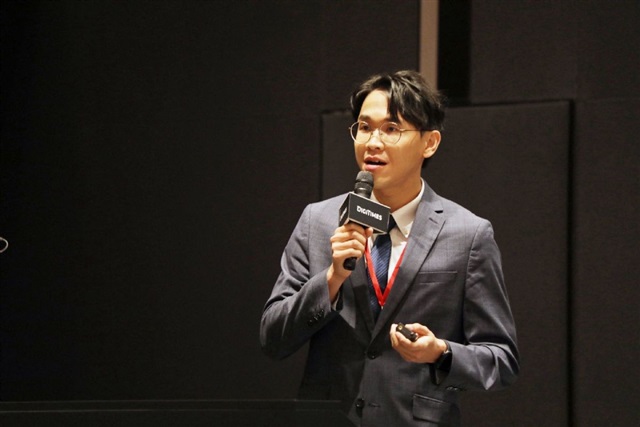
As Computex approaches, DIGITIMES hosted a forum where analyst Mark Yee argued that Physical AI is driving autonomous driving into full commercial validation, with implications for market structure and technology leadership.
Yee said autonomous driving has become the most representative real-world application of Physical AI. This concept integrates artificial intelligence with the physical world so machines can perceive, understand, and act autonomously. He told attendees the global auto market is expanding alongside growing penetration of autonomy, and that the industry is entering a new phase beyond prototype demonstrations.
Global auto market expands as autonomy penetration rises
Yee forecasts global auto sales to climb from 89.1 million units in 2023 to 99.8 million units in 2030. He cautioned that demand softened somewhat after 2024 due to US tariffs, high interest rates, and inflation, but maintained that overall market size and autonomous driving adoption will rise together. According to his projections, global autonomous passenger vehicle sales could reach 92.3 million units by 2030, with market penetration at about 92.5%.
Yee identified 2029 as a likely market inflection point, driven by technology maturity, large-scale robotaxi deployment, and efforts by Chinese automakers such as BYD to bring advanced self-driving features to mid- and lower-tier models.
Yee characterized Physical AI's main application domains as autonomous driving, humanoid robots, smart manufacturing, and drones. In the context of vehicles, he said that Physical AI enables cars to move from digital simulations into real-world environments, giving them autonomous decision-making capabilities intended to improve safety, comfort, and efficiency.
He cited use cases such as reducing accident risk, creating in-car entertainment spaces without steering wheels or pedals, and enhancing range efficiency through route optimization.
World models seen as next-generation standard
Yee described three core forces driving autonomous driving: algorithms, computing power, and data. He traced the evolution of algorithms from first-generation rule-based systems, which rely on manually written rules and struggle with complex situations, to today's mainstream end-to-end (E2E) neural networks that combine perception and control but lack deep physical-world understanding.
He identified third-generation E2E plus world model architectures as the next mainstream direction. World models, Yee said, provide both spatial cognition for understanding 3D spaces and obstacles, and temporal cognition for predicting nearby vehicle behavior. Together, these capabilities enable AI to learn physical rules and simulate future scenarios, improving generalization and safety.
Yee also outlined expectations for the computing and chip markets, projecting global growth of the autonomous driving chip market from US$9.7 billion in 2026 to US$19.2 billion in 2030. He said US vendors remain dominant: Mobileye leads Level 1 to Level 2 segments, Nvidia targets high-end Level 3-and-above applications and has seen adoption by established automakers, and Qualcomm leads in smart cockpit chips while moving into autonomous driving. Tesla relies on in-house chips for tight hardware-software integration, and some Chinese new-energy automakers are shifting from Nvidia to self-developed solutions.
Generative AI and edge data influence development
On the data side, Yee emphasized generative AI's role as a catalyst, enabling realistic virtual driving environments and varied traffic scenarios that address long-tail corner cases difficult to capture in the real world. He argued that improvements in data generation and training efficiency will be crucial alongside advances in algorithms and computing.
Yee said Physical AI's primary commercial applications will concentrate on two areas: robotaxi services for urban passenger transport and driverless trucks, or Robotrucks, for trunk-line freight. He described differing approaches among industry players: Tesla's strengths, he said, include large-scale vehicle data, mature E2E and world model work, and in-house AI chips, and noted Tesla's Cybercab entered mass production in February 2026 for driverless ride-hailing in Texas.
Waymo, Yee said, has logged more than 200 million fully autonomous miles, uses a world model from Google DeepMind, and operates in 10 US cities with more than 500,000 paid rides per week; it also demonstrated a next-generation Robotaxi developed with Geely Auto's Zeekr brand. Aurora was identified as representative in Robotrucks, focusing on hub-to-hub line-haul logistics in Sun Belt states and partnering with traditional truck and logistics firms while combining its Aurora Driver system with Nvidia chips.
Yee concluded that Physical AI is shifting autonomous driving from an assistive function to autonomous decision-making on real roads, and that future competition will hinge on algorithmic capabilities, computing platforms, and data-training efficiency. He said companies controlling these core technologies will determine market power as robotaxi and Robotruck deployments scale and the sector moves into full commercial validation.
Article translated by Jingyue Hsiao and edited by Jack Wu