India's first wave of OSAT facilities is moving from capacity announcements to competitive positioning, with some domestic players now benchmarking themselves against established backend hubs rather than solely against local peers.
Gujarat-based Suchi Semicon has indicated that it has reached price parity with established OSAT providers in Southeast Asia, while acknowledging that China's high-volume manufacturing still offers lower costs.
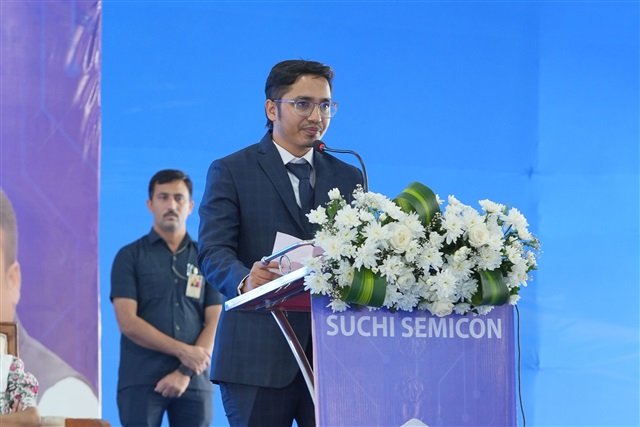
"Excluding China, we are highly competitive on pricing," said Shetal Mehta, director of Suchi Semicon. "Compared with Malaysia, Singapore, and even Taiwan, several customers have told us they find our pricing attractive and are keen to move forward."
The company is expanding beyond small outline packages into QFN and power packages for industrial and automotive applications. The positioning reflects a broader shift in how Indian OSATs are framing their progress, with regional competitiveness increasingly replacing purely domestic narratives.
Slow ramp from first production
Suchi's initial OSAT manufacturing focused on SOIC packaging. The facility, which began processing wafers from December 2024, is currently operating at what the company describes as low-volume manufacturing and qualification levels.
"Our SOIC line is currently running at LVM - Low Volume Manufacturing and some qualification lots," Mehta said. "This gives us comfortable headroom today and operational flexibility as we prepare for the QFN ramp, without stressing quality or delivery."
The timeline - approximately 12 months from first production to low-volume phase - is consistent with typical greenfield OSAT ramp cycles that often span 24 to 36 months before reaching sustained volume manufacturing. In backend manufacturing, early utilization is driven by customer audit schedules and qualification timelines rather than by installed capacity alone.
Qualification cycles dictate revenue timing
Suchi's expansion into QFN packaging followed customer engagement after its SOIC line entered operation. Sample shipments are expected to begin in early 2026, with the initial phase intended for customer qualification rather than volume production.
"The qualification time is around 12 to 18 months," Mehta said. "But when the orders come in, the contracts will start coming in somewhere between 36 months and 60 months."
Power packaging is being introduced on a separate schedule. Sample shipments of power packages are planned for April, with early engagement focused on industrial and automotive programs.
"The April samples are mainly for industrial and automotive customers at this stage," Mehta said. The company is working toward IATF 16949 certification, targeting completion in the first half of 2026. The company's recent (December 2025) announcement characterized its operations as "automotive-grade ready," though formal certification remains in progress.
The extended timelines reflect standard practice in automotive supply chains, where validation and reliability cycles affect the pace at which volumes can ramp.
Government support figures in the cost structure
When asked about pricing competitiveness against OSAT providers in Malaysia and Vietnam, Mehta pointed to both operational and policy factors.
"The cost advantage is a combination of both," Mehta said. "The low operational costs in India, the schemes and support from the government of India and Gujarat."
The company did not quantify the relative contribution of structural cost advantages versus government support. Mehta also acknowledged that China's backend ecosystem remains more cost-competitive.
How pricing dynamics evolve as volumes increase and as government incentives potentially phase down will be an important factor for Indian OSATs seeking sustained regional relevance.
Material constraints remain fluid
Asked about the primary bottlenecks facing India's OSAT sector in 2026, Mehta pointed to multiple challenges rather than a single constraint.
"Every day is a new battle to fight," he said. "Sometimes it's material, sometimes it's equipment. Sometimes you don't have engineers to fix that equipment. Sometimes people are not trained. Sometimes you want to ramp up your production, but there will be no trained people."
The comments reflect the ecosystem development challenges facing India's semiconductor backend sector as it scales beyond initial pilot operations.
Supply chain timeline implications
For supply chain planners evaluating India as a backend diversification option, Suchi's timeline suggests meaningful OSAT capacity - particularly for automotive and industrial applications - remains 18 to 24 months away. The qualification cycles required for automotive programs mean that even customers engaging now would likely see volume production in 2027 or 2028.
The pricing competitiveness claims, while unquantified in terms of subsidy versus structural advantage, indicate India-based OSATs are attempting to compete on more than proximity to domestic demand.
Whether that positioning translates into sustained regional competitiveness will depend on three factors: conversion of qualification programs into multi-year production contracts; cost structure evolution as government incentives potentially phase down; and the pace at which automotive certifications enable tier-1 supply chain integration.
Whether India's OSAT sector can sustain regional relevance beyond initial buildout will become clearer as Southeast Asian peers also expand capacity and as the relative weight of government support versus structural cost advantages becomes more transparent through operational results.
Article edited by Jack Wu