

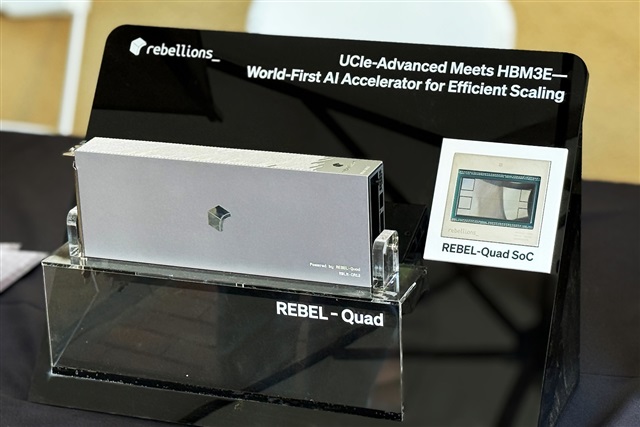
Korea-based Rebellions unveiled its next-generation AI accelerator, REBEL-Quad, at the Hot Chips 2025 symposium in California, positioning itself as a direct rival to Nvidia's Blackwell processors. The chip is the world's first neural processing unit (NPU) to adopt the UCIe-Advanced standard for chiplet interconnect, a design that enables faster and more power-efficient data transfer.
Blackwell-class performance, lower energy costs
Built on Samsung Foundry's 4nm process and equipped with 144GB of HBM3E memory delivering 4.8TB per second of bandwidth, REBEL-Quad is designed to handle today's largest AI models, including peta-scale mixture of experts (MoE) systems, on a single chip. At the event, the company showcased the accelerator running Qwen3's 235-billion-parameter MoE model.
Rebellions claims the chip delivers Blackwell-grade performance while consuming significantly less power, addressing what CEO Sunghyun Park called AI's "energy tax." "The industry can't afford to scale on GPUs alone," Park said. "With REBEL-Quad, we're showing another path—GPU-class performance without the energy tax. "
Expanding ecosystem and partnerships
The launch highlights Rebellions' push to move past its first-generation ATOM chip, which gained traction in Saudi Arabia, Japan and the US. The startup is backed by some of South Korea's major tech companies, including SK Hynix, SK Telecom, KT and Samsung Ventures. Samsung Electronics supported the new chip with advanced manufacturing and packaging, while Alphawave Semi provided UCIe IP to enable high-speed, low-latency chiplet integration.
Roadmap beyond REBEL-Quad
Looking ahead, Rebellions plans to expand its chiplet roadmap with products such as REBEL-IO and REBEL-CPU, designed for trillion-parameter models and large-scale multi-node systems. The company said proof-of-concept trials with global customers are already underway, signaling its ambition to scale into the next wave of hyperscale AI computing.
Article edited by Joseph Tsai