
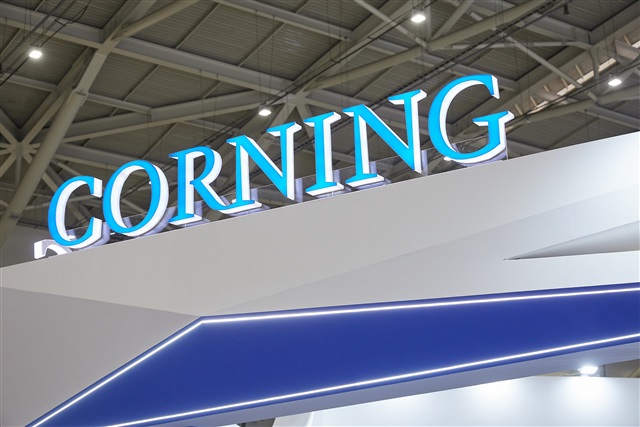
Corning expects AI infrastructure to become an increasingly powerful growth engine, outlining how its glass technologies will move beyond traditional optical fiber and into silicon photonics (SiPh) and co-packaged optics (CPO) for next-generation AI data centers.
The company reported a strong second quarter, with sales rising 17% year-over-year to US$4.74 billion and core EPS increasing 30% to US$0.78. Optical communications remained the biggest contributor, as revenue climbed 32% to US$2.07 billion, while enterprise networking sales surged 65% on accelerating AI demand. Management noted that sales of GenAI products nearly doubled during the quarter.
CEO Wendell Weeks said Corning's current AI business reflects only the "scale-out" phase of AI networking, emphasizing that "we are not yet seeing scale-up or photonics in our results."
The company believes three technology trends will increase optical content per GPU faster than GPU shipments themselves: larger AI clusters, higher bandwidth requirements, and the eventual transition from copper to optical connections within AI servers.
According to Weeks, AI clusters exceeding roughly 130,000 GPUs will require a third optical network layer, increasing fiber content by about 50% per GPU. Meanwhile, the introduction of optical scale-up networks inside AI systems could create a much larger opportunity. In a fully optical architecture, fiber content could rise from today's 16 fibers per GPU in scale-out networks to 160 fibers per GPU, a 10x increase, although actual deployments will likely fall somewhere between current copper-based systems and fully optical designs.
Besides supplying optical fiber between racks, Corning is preparing to supply components inside AI systems through SiPh and CPO.
Weeks said customers are increasingly exploring CPO and near-package optics, where optical engines are integrated alongside networking silicon to improve latency, power efficiency, faceplate density and reliability. In these architectures, optical signal generation, modulation and transmission move inside the equipment through SiPh optical engines, creating opportunities for Corning's passive photonics portfolio. He noted that "everything in yellow is potential Corning content," referring to glass-based passive optical components used to guide and manage light inside the package—an area where the company previously had no content.
During the Q&A session, Weeks clarified that Corning's new US$10 billion photonics platform target by 2030 includes fiber array unit (FAU) harnesses as well as a broader range of passive photonics products used inside SiPh modules. The adoption pace will depend largely on how quickly optical ports replace copper in AI scale-up architectures.
Despite ongoing industry debate over the timing of optical scale-up adoption, Weeks said Corning's long-term outlook remains unchanged, stating the company sees "no changes to our fundamental belief" since its May investor event and that "inside the real ecosystem, there is much less drama than what it looks like from the people outside of it."
To support growing AI demand, Corning plans to invest approximately US$2 billion in capital expenditures this year while continuing to expand long-term partnerships with customers including Nvidia, Amazon, and Meta.
Article edited by Jack Wu