AI infrastructure competition is intensifying, but the market is no longer focusing only on GPU performance and is instead re-evaluating the entire computing system. For AMD, the chance to turn software improvements into market share is now emerging, but two hurdles remain: whether ROCm can run stably in large clusters and whether Helios can enter mass production and ship on time.
Over the past few years, Nvidia has tightly integrated GPU computing, networking, and software tools through CUDA, NVLink, InfiniBand, and BlueField DPUs. AMD has taken a more open alternative path with ROCm, Ethernet-based UALink (UALoE), Pensando networking components, and standard Ethernet.
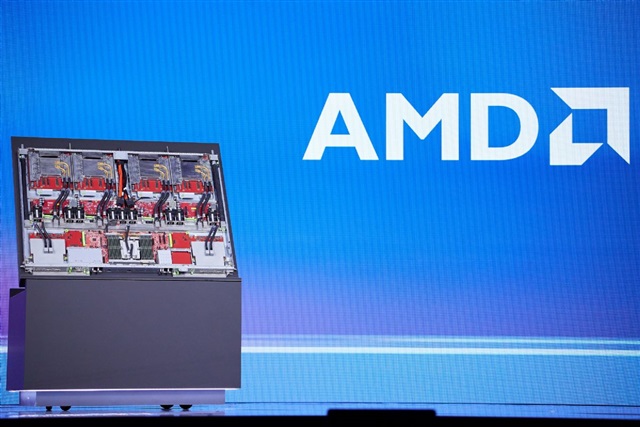
Future AI infrastructure competition will center on total system cost, memory capacity, bandwidth, interconnects, and the software ecosystem. That is why AMD unveiled the rack-scale AI system Helios, the MI455X GPU, and the ROCm.ai developer platform at its 2026 Advancing AI event, while also expanding its Ethernet interconnect strategy.
From zero to non-zero
Back when the industry previously discussed AMD's rivalry with NVIDIA, the consensus was that AMD's chips were not weak on specs, but software stability and usability remained the biggest concern. That view is beginning to change.
SemiAnalysis once gave AMD a sharply negative assessment. After spending about 5 months in 2024 testing the MI300X and ROCm, the research firm said AMD's publicly available stable versions of software had frequent bugs, the out-of-box experience was poor, and many issues required help from AMD's engineering team. Looking back at this 2026 review, SemiAnalysis said it had assigned AMD a 0% chance of catching up to NVIDIA's AI accelerator ecosystem at the time.
By 2025, the picture started to shift. AMD strengthened developer support, adopted a "developer first" strategy, and added MI300 to PyTorch's continuous integration and testing. It also increased investment in major open-source inference frameworks such as vLLM and SGLang, reducing the gap caused by long-term maintenance of in-house branches.
SemiAnalysis therefore raised AMD's chance of success from 0% to non-zero in 2025, and in 2026 went further, saying AMD had a significant chance of success if it could resolve two risks: the production ramp of Helios and the lack of internal test clusters.
The market's signal was even more direct. OpenAI signed a multi-generation 6GW partnership with AMD in October 2025, with the first 1GW originally scheduled for deployment in the second half of 2026.
Meta announced a multi-year partnership of up to 6GW in February, with the first 1GW expected to begin shipping in the second half of 2026. Anthropic followed in July this year with a deal worth up to 2GW, although the first 1GW will not begin deployment until the first half of 2027. The stated caps from the three companies total 14GW.
Customers begin to prefer entire systems
But 14GW does not mean all of that business is already locked in as orders and revenue. The agreements span multiple product generations, and future progress still depends on AMD delivering chips, racks, and usable software on schedule.
For OpenAI's first 1GW alone, multiple technical and commercial milestones must be met, and the customer can walk away if those conditions are not satisfied.
Even so, the partnerships have changed AMD's position in the AI chip market. MI300X previously relied mainly on lower pricing and larger memory capacity to win some inference clusters. MI455X and Helios now face frontier models and large-scale inference workloads from OpenAI, Meta, and Anthropic.
Customers are no longer just buying a single alternative GPU. They are asking AMD to deliver a complete system spanning GPUs, CPUs, networking, and software.
The clearest shift has come from Microsoft. SemiAnalysis said Microsoft had encountered reliability and software quality issues in high-bandwidth memory (HBM) when using MI300X, and later did not adopt MI325X or MI355X at large scale. AMD and Microsoft have not publicly explained why the middle two product generations were not adopted broadly.
Then in July this year, Microsoft formally announced a large-scale Helios deployment on Azure and plans to launch the ND MI455X v7 virtual machine. AMD expects to begin shipping to customers, including Microsoft, from the second half of 2026.
This time, Microsoft is not adopting just a single AMD chip. It is taking AMD's first rack-scale AI solution that covers GPUs, CPUs, and the above-mentioned complete system.
Second-half deliveries mark the first test
As AMD moves from chip-level products to full racks, it is entering territory it has not traditionally dominated. Nvidia designs its own GPUs, switches, and racks around NVLink. AMD, by contrast, has chosen a more open route.
Helios uses Ethernet-based UALoE to connect GPUs and adopts Broadcom Tomahawk 6 switch chips. That gives customers more freedom to choose different server and networking vendors without locking into a fully closed interconnect stack.
However, open standards also make system coordination more difficult even as they reduce vendor lock-in. AMD must get its GPUs, Broadcom switch chips, third-party connectors, copper backplanes, and system assemblers all aligned for mass production.
Any signal or assembly problem in the chain can slow down rack deliveries. Based on supply chain checks, SemiAnalysis said Helios is currently experiencing a slow production ramp.
Helios is scheduled to start delivering later this year, overlapping with the first deployments at OpenAI, Meta, and Microsoft. AMD now urgently needs to solve production issues while proving to its most important customers that the rack, entering mass production for the first time, can run reliably.
For AMD, these three are not just customers. These major buyers also have the latest models, the largest inference workloads, and some of the best engineers in AI systems.
Getting them to use AMD's Instinct GPUs means real workloads will expose ROCm's problems earlier, while customers help fix software, tune networking, and define next-generation hardware.
Whether AMD can further erode the dominance of Nvidia's CUDA may ultimately depend on whether the first Helios racks can leave the factory on time and be deployed smoothly.
Article translated by Lily Hess and edited by Jack Wu