
The 2026 Beijing Auto Show, which concluded on May 3, offered a glimpse into what may become the next defining chapter of China's automotive industry: not simply electric vehicles, but intelligent mobility powered by artificial intelligence, autonomous driving, and deeply localized innovation.
After touring the exhibition and interviewing industry executives, analysts at DIGITIMES Research identified three themes shaping the future direction of China's car market: Robotaxis, Physical AI and a growing strategic emphasis among foreign automakers on designing products "in China, for China."
Together, the trends suggest that China's auto industry is entering a new phase — one less defined by aggressive price wars and rapid hardware upgrades, and increasingly driven by software ecosystems, autonomous services and AI-enabled mobility.
The timing is significant. This year marks the first year China has implemented a reduced purchase tax policy for new-energy vehicles, a move widely viewed as signaling a transition away from short-term pricing competition toward a broader contest over technology platforms and intelligent transportation services.
Robotaxis move from concept to commercial reality
One of the clearest shifts at this year's show was the emergence of Robotaxis as a commercial product rather than a futuristic demonstration.
For the first time, major Chinese automakers unveiled Robotaxi prototypes and preproduction models designed specifically for large-scale deployment, signaling that autonomous ride-hailing has moved beyond the domain of technology startups and into the mainstream manufacturing strategies of established car companies.
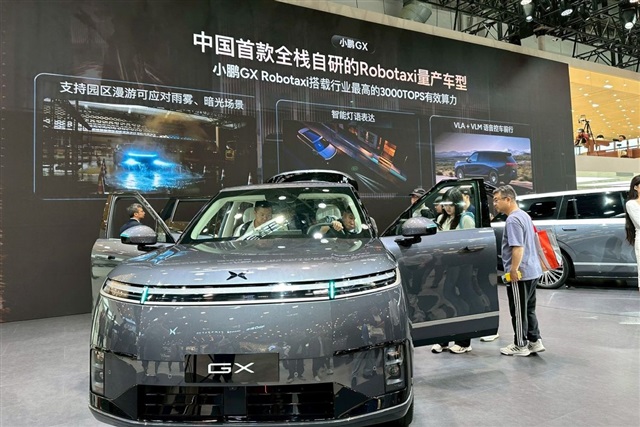
Among the most prominent participants were Geely, Xpeng and Chery, all of which announced plans to launch mass-produced Robotaxi vehicles by 2027.
Yet their business strategies differ sharply.
Geely is pursuing a vertically integrated approach, aiming to control everything from development and manufacturing to fleet operations. Xpeng plans to partner with mobility-service operators that would run its Robotaxi fleets, while Chery is focusing more heavily on selling autonomous-driving solutions directly to operators and third parties.
The shift reflects growing confidence that autonomous transportation may soon evolve from an experimental technology into a viable consumer business.
Physical AI becomes the next battleground
As electric vehicles become increasingly software-defined, the race for intelligent driving systems has intensified.
At the center of this competition is what Chinese companies increasingly describe as "Physical AI" — artificial intelligence designed not simply to process information, but to interact with and navigate the physical world.
At this year's exhibition, automakers and suppliers repeatedly highlighted technologies such as Vision-Language-Action models, known as VLA systems, and "world models," which attempt to simulate real-world driving environments and human decision-making behavior.
The technologies are emerging as the conceptual foundation for the next generation of advanced autonomous driving.
Huawei's automotive division, Qiankun, drew particular attention ahead of the show with the release of its latest intelligent-driving platform, ADS 5.0.
The system uses what Huawei calls a "World Engine" and "World Action" architecture — known internally as WEWA 2.0 — combining cloud-based simulation engines with vehicle-side behavioral models. The goal is to train AI systems in virtual environments that closely mirror real-world traffic conditions, allowing vehicles to learn increasingly human-like driving behavior.
Huawei said the first vehicles equipped with ADS 5.0 would include models jointly developed with Dongfeng, GAC and SGMW, the state-backed joint venture behind Wuling vehicles.
The broader message across the exhibition was unmistakable: Chinese automakers no longer view AI as an optional software feature. It is becoming the core competitive layer of the modern automobile.
"In China, for China" reshapes foreign automakers' strategy
Foreign automakers are also rethinking their position in the world's largest car market.
Facing intense pressure from rapidly advancing domestic brands, global manufacturers are increasingly shifting China from being merely a sales destination to becoming a center for local research, development and supply-chain integration.
The strategy — often described as "in China, for China" — is intended to accelerate product-development cycles while allowing foreign brands to create vehicles tailored specifically for Chinese consumers.
Volkswagen has become one of the clearest examples of the approach.
Since 2023, the German automaker has expanded partnerships with Chinese technology and automotive firms, including Xpeng for electric-vehicle platforms, Horizon Robotics for chip development, and AI-related collaborations with companies such as Volcano Engine and Momenta.
Volkswagen plans to launch 13 new-energy vehicles in China during 2026 alone, part of an effort to match what executives increasingly call "China speed" in product development and localization.
The shift underscores how dramatically the balance of power inside China's auto market has changed. Foreign brands that once dominated through manufacturing scale and legacy reputation are now racing to adapt to an ecosystem increasingly defined by Chinese software, supply chains, and consumer expectations.
A new model for China's car industry
Taken together, the trends emerging from the Beijing Auto Show suggest that China's automotive sector is evolving beyond the era of low-cost competition that defined much of the past decade.
Price remains important, but value, software integration, and mobility services are becoming increasingly central to competition.
DIGITIMES Research argues that Robotaxis, Physical AI, and localized China-specific strategies are no longer peripheral experiments. They are becoming the defining pillars of the industry's next stage.
And in many ways, the exhibition made clear that the future China's automakers are envisioning extends well beyond simply selling electric cars. They are increasingly trying to build the operating system for intelligent transportation itself.
Article translated by Elaine Chen and edited by Jingyue Hsiao