
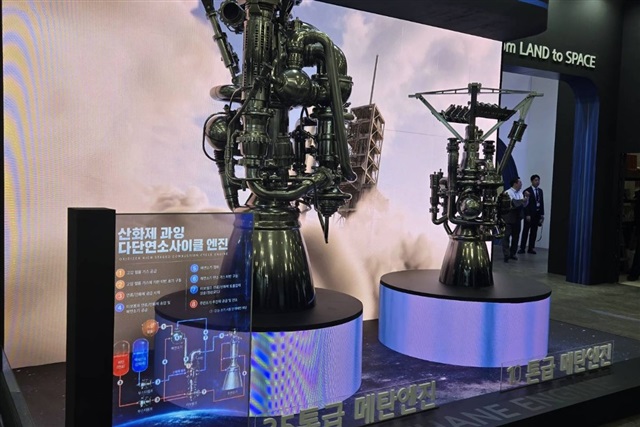
South Korea's Hyundai Rotem is accelerating its expansion into aerospace propulsion systems, showcasing 10-ton- and 35-ton-class methane rocket engines under development at AEROTEC 2026 as it targets growing demand for reusable launch vehicles.
The company is pursuing a dual-track strategy combining upgrades based on proprietary technologies with government-backed R&D programs, while expanding testing and production infrastructure to capture future opportunities in space transportation.
Jae-Kang Song, who leads methane engine development at Hyundai Rotem, said government-led space programs historically focused primarily on improving engine performance. While performance remains important in the New Space era, development priorities are increasingly shifting toward engines that can be developed faster and more cost-effectively.
Beyond engine size, Song said the ability to meet the evolving requirements of launch vehicles at different stages of development is becoming critical to propulsion technology.
Methane engines return to center of propulsion strategy
Hyundai Rotem is currently developing both 10-ton- and 35-ton-class methane engines.
The 10-ton-class engine is an upgrade program that builds on the company's existing technology assets. The 35-ton-class engine, meanwhile, stems from a reusable launch vehicle methane engine R&D project secured in late 2025.
The project, led by South Korea's Korea Research Institute for Defense Technology Planning and Advancement, represents a key step in Hyundai Rotem's expansion of its methane propulsion capabilities.
Song said Hyundai Rotem's space business dates back around three decades, with methane engines among the company's earliest propulsion technologies. In 2006, it completed South Korea's first methane engine combustion test.
However, with the country's early space programs largely government-led and offering limited opportunities for methane engine applications, Hyundai Rotem temporarily slowed its space-related activities and shifted its focus toward propulsion technologies for guided weapons.
The company never completely withdrew from the space sector. It continued supporting South Korea's rocket development by building qualification test facilities for launch vehicles and, after 2020, began strengthening methane engine R&D again, leveraging technologies accumulated through its testing infrastructure.
Methane targets easier turnaround for reusable rockets
Yoon-Sang Kim, a team leader at Hyundai Rotem, said methane produces less carbon buildup during combustion than conventional kerosene fuel, reducing the need to remove carbon deposits after an engine is recovered and making it better suited to reusable applications.
However, components including pumps, valves, and bearings must be specifically developed around methane's fuel characteristics and operating conditions.
Some critical components in South Korea have yet to reach technological maturity, Kim said, meaning further development will be required to build up the country's domestic capabilities.
Hyundai Rotem's ambitions extend beyond the engines themselves.
At AEROTEC 2026, the company also showcased models of its liquid rocket engine test site in Seosan, South Chungcheong Province, and a future aerospace production base planned for Muju County in North Jeolla Special Self-Governing Province, illustrating an integrated strategy spanning R&D, testing, and production.
A rocket launch scenario incorporated into the exhibit also demonstrated the company's longer-term vision of using methane-powered launch vehicles for satellite missions.
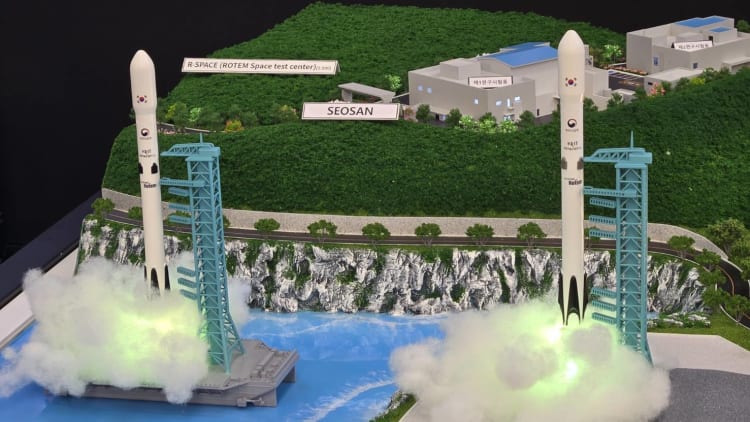
Note: Hyundai Rotem is expanding its aerospace R&D and production infrastructure. Credit: Daniel Chiang
Simulation tools expand into methane and hypersonic propulsion
Hyundai Rotem's exhibit also included a ducted ramjet engine for long-range air-to-air guided weapons and a hypersonic engine capable of switching between ramjet and scramjet operating modes.
To accelerate development, Hyundai Rotem signed a memorandum of understanding with Ansys Korea during AEROTEC 2026.
The partnership will introduce simulation-based design and analysis technologies into the development of methane and hypersonic engines while expanding technical exchanges between the companies.
Hyundai Rotem expects the collaboration to strengthen its design and analytical capabilities for core propulsion systems as it broadens its aerospace business from testing infrastructure toward reusable launch vehicle engines and other next-generation propulsion technologies.
Article translated by Scarlett Yu and edited by Ysi Chen