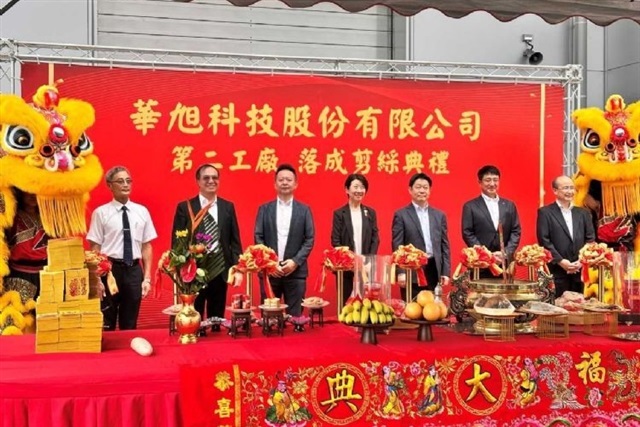
Huahsu, a semiconductor materials supplier established in 1997 through a joint investment by Japan's Asahi Kasei and Wah Lee, has launched a new capacity expansion plan as demand for AI, HPC, and advanced semiconductor packaging accelerates. The company recently held a completion ceremony for its second high-resolution dry film photoresist processing plant.
Once the new facility starts production, Huahsu's total capacity will rise to twice its current level, further strengthening supply to the advanced semiconductor packaging and high-end substrate markets.
Wah Lee chairman Gary Chang said the expansion is a key move in response to growth in demand for AI, high-end PCBs, and IC substrates. He added that the new plant's completion reflects confidence in the market outlook and commitment to customers, while also marking a new starting point for the company's next growth phase.
In recent years, the rapid buildout of AI servers, GenAI, and cloud data centers has driven sharp demand growth for high-end chips such as AI GPUs, ASICs, and HBM, further boosting momentum in the ABF substrate market.
Market research firms and foreign institutional investors expect tight supply and demand conditions for global ABF substrate makers such as Unimicron, Nanya PCB, and Kinsus Tech to persist through 2028. Supplies of key materials for high-end substrates also face challenges, with high-resolution dry film photoresist standing out as a critical material affecting yield and process precision in advanced packaging.
Wah Lee has long focused on the semiconductor and electronics materials market, and has distributed Asahi Kasei's high-resolution dry film photoresist for many years. Its customers cover all major domestic ABF substrate makers, and the product has successfully entered the supply chains of several benchmark customers and secured major orders.
As next-generation AI chips move toward larger package sizes and higher layer counts, requirements for finer circuit patterns and material quality continue to rise. Demand for high-resolution dry film has therefore remained strong, with related revenue maintaining high double-digit growth in recent years.
Wah Lee is also actively expanding into high-growth markets including AI server boards, optical communication modules, and low-Earth-orbit (LEO) satellites. Because satellite communications equipment demands extreme resistance to high and low temperatures, vibration tolerance, and long-term stable operation, its high-resolution dry film products have successfully entered the global LEO satellite PCB supply chain and are expanding their market reach alongside customers' overseas capacity expansions.
Looking ahead, Wah Lee said it will continue working with Asahi Kasei to deepen its advanced materials footprint, strengthen local supply capabilities and technical services, and build a more resilient global semiconductor materials supply chain with customers.
Article translated by Charlene Chen and edited by Jack Wu