

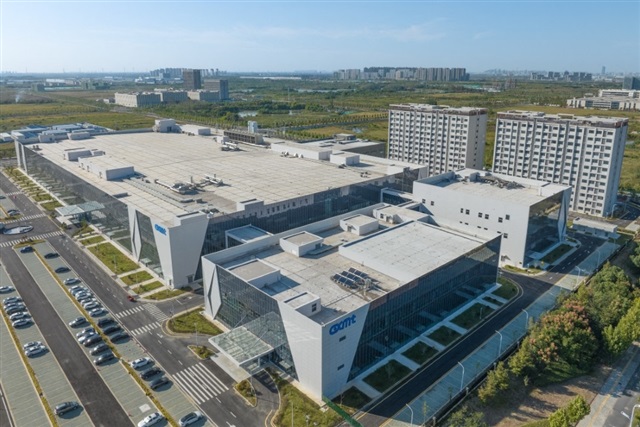
China's CXMT has moved from a little-known state-backed DRAM maker to one of the most closely watched companies in the global memory chip race, with Apple testing its chips for China-market devices and Beijing counting on the company to anchor a domestic AI supply chain.
According to the Financial Times, Apple has begun testing CXMT's DRAM for devices sold in China, while US tech companies are lobbying Washington to allow broader use of the company's products. The interest reflects a sharper reality for the memory market: AI demand has tightened global DRAM supply, and even politically sensitive Chinese capacity is becoming harder for device makers to ignore.
CXMT is now the world's fourth-largest DRAM producer after SK Hynix, Samsung Electronics, and Micron. SemiAnalysis estimates it held about 11% of global DRAM wafer capacity last year, with that share expected to rise to 15% by 2028 as new production lines in Hefei, Shanghai, and Beijing come online.
AI demand rewrites CXMT's story
The turnaround has been dramatic. CXMT posted net profit of CNY33 billion (US$4.8 billion) in the first quarter, according to its IPO prospectus, reversing years of heavy losses that totalled CNY37 billion over the past decade.
The company is seeking to raise CNY29.5 billion through its listing to upgrade manufacturing processes, develop next-generation DRAM and recruit engineering talent. Analysts expect its valuation could reach as high as CNY3 trillion, handing a major windfall to state-linked investors in Hefei, where local government backing helped build the company's industrial base.
CXMT's rise also shows how China's memory ambitions remain tied to global technology. The company built its DRAM business partly on patents acquired from Germany's Qimonda, recruited talent from Korea and Taiwan, and still depends on ASML's deep ultraviolet lithography tools. It has not been added to the US Entity List, allowing it to keep buying China-approved ASML equipment.
Capacity grows, but relief may be slow
China's memory expansion is accelerating. CXMT is expected to more than double capacity after 2027, with HBM currently produced in Hefei and a Shanghai plant set to begin formal production in 2027, according to Nikkei. YMTC is also building a third Wuhan plant for NAND and SSD production, with mass production potentially brought forward to late 2026.
That has fed expectations that Chinese supply could cool global memory prices after new fabs start ramping in late 2027. Counterpoint data cited by Chinese media put CXMT's DRAM revenue share at 8% in the first quarter of 2026, up 5% from a year earlier, while YMTC's NAND share reached 13%, also up 5%.
Still, analysts warn that CXMT is unlikely to ease shortages quickly because much of its output is already committed. AI servers, smartphones, and cloud infrastructure are competing for limited DRAM wafers, while higher-end memory remains technically difficult.
HBM is the real test
The bigger challenge is high-bandwidth memory, the premium memory used in AI accelerators. CXMT has allocated some new lines, including in Shanghai, to HBM, but its progress remains limited by restricted access to ASML's EUV lithography tools and lower yield rates than global leaders.
For Beijing, however, cost is secondary to control. Profits from conventional DRAM and proceeds from CXMT's IPO are expected to fund a longer HBM campaign. If Chinese AI companies align procurement with national self-sufficiency goals, CXMT could gain a protected demand base even before it matches Samsung, SK Hynix or Micron on technology.
That is why Apple's reported interest matters. CXMT is no longer just a domestic substitute. It is becoming a political, commercial, and strategic pressure point in the global AI memory supply chain.
Article edited by Jerry Chen