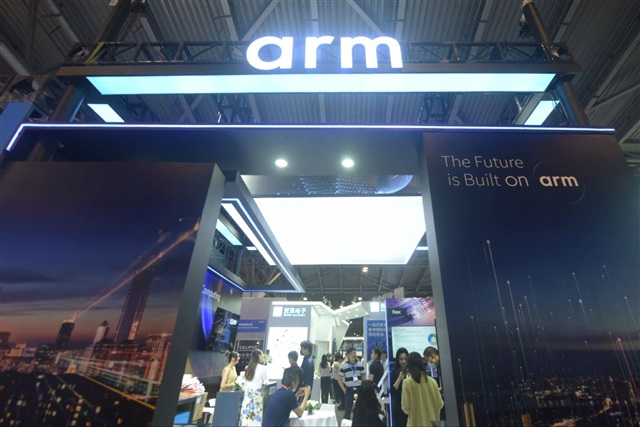
During the earnings call on May 6, Arm announced a significant expansion of its product strategy, centering on the emergence of "Agentic AI" and "Physical AI" as primary growth drivers for the next decade. The company defines agentic workloads as a shift from human-based queries to continuous, autonomous tasks where CPUs must coordinate data movement, manage memory, and orchestrate work across accelerators. To address this, Arm recently launched the Arm AGI CPU, a product purpose-built for these specific AI requirements.
CEO Rene Haas provided a strategic outlook for this new category, stating, "As Agentic AI scales, data centers will require more than four times today's CPU capacity, creating a data center CPU market opportunity of more than US$100 billion by 2030". Beyond the data center, the company is positioning its platform for "Physical AI," which integrates AI into vehicles, factories, robotics, and sensors. This sector is already contributing to royalty performance through autonomous systems and Advanced Driver Assistance Systems (ADAS). Looking ahead, Arm expects significant financial returns from this pivot, forecasting that "by FYE31, we will be generating US$15 billion in AGI CPU revenue".
Collaborative hardware ecosystem accelerates deployment
The successful deployment of the Arm AGI CPU relies on a broad hardware partnership ecosystem designed to reduce friction for end customers. Arm offers multiple deployment models, allowing customers to access compute via traditional IP licensing, compute subsystems (CSS), or finished silicon products. More than 50 leading industry partners support this flexibility.
A central pillar of this ecosystem is Arm's collaboration with Meta, which Haas described as a "lead partner and co-developer... working with us on a multi-generation roadmap to support personal superintelligence for more than 3 billion users". To facilitate rapid scaling, Arm has partnered with Original Design Manufacturers (ODMs) such as Supermicro, Lenovo, and ASRock to provide finished server racks. This allows customers to bypass complex internal design phases and deploy Arm-based capacity quickly. The demand for this integrated approach has surged, with Haas noting, "We now have more than US$2 billion of customer demand across fiscal 2027 and fiscal 2028. This is more than double what we stated at launch".
Core count metrics challenge traditional chip ratio calculations
Arm leadership addressed concerns that traditional methods for calculating market opportunities based on the CPU-to-accelerator (GPU) ratio may yield distorted conclusions. While investors often focus on "chip-to-chip" ratios, Haas argued that the true measure of value is shifting toward core density and orchestration complexity. As chips become "reticle limited"—meaning their physical size cannot easily increase—manufacturers are packing significantly more cores into a single socket.
The Arm AGI CPU, for instance, features 136 cores, and the company anticipates future designs reaching 256 or 512 cores. Haas explained that "ratios are a tough way to look at it" because "you may not see three extra chips, but the chips will be more expensive, which is why when people look at US$100 billion TAM... largely it's going to be driven by the fact that these CPU chips are going to have lots of CPU cores, which will drive ASP up". Consequently, the commercial opportunity lies in the increased "Average Selling Price" (ASP) and the sheer volume of cores doing independent batch jobs, rather than a simple count of physical processor units.
Hyperscaler partnerships solidify custom silicon leadership
The ecosystem for Arm-based compute has reached a critical tipping point among Cloud Service Providers (CSPs) and hyperscalers, who are increasingly replacing legacy x86 architectures with custom Arm-based silicon. Arm Neoverse CSS and Arm-based compute currently represent approximately 50% market share with top hyperscalers. This trend is exemplified by Google's recent announcement of its Axion CPUs, which replace x86 host processors for its TPU accelerators. According to Arm, "The increased performance at 50% less power enables an 80% improvement over the previous x86 solution".
Other major hyperscalers are following suit, with AWS scaling its Graviton strategy and Microsoft advancing its Cobalt CPUs for Azure workloads. Even traditional accelerator providers are integrating Arm deeply; Nvidia's next-generation Vera CPU is built specifically for Agentic AI. Arm's strategy "lifts all boats" by providing a common software ecosystem that spans from foundry partners like Samsung and TSMC to EDA partners like Synopsys and Cadence. This widespread adoption is reflected in the company's financial momentum, as Haas confirmed that "our data center royalty has more than doubled year-over-year" and is expected to continue this trajectory
Arm AGI CPU ecosystem roadmap | ||
Category | Key Partners / Participants | Strategic Planning and Functional Description |
Arm: Core Compute Platform | Meta | Lead partner and co-developer: Working on a multi-generation roadmap to support personal superintelligence for over 3 billion users. |
Arm: Cloud Services & Hyperscalers | Google (Axion), AWS (Graviton), Microsoft (Cobalt), NVIDIA (Vera/Grace) | Custom silicon ecosystem: Hyperscalers are building AI infrastructure around Arm-based custom silicon to replace x86 processors, achieving significant performance gains and power efficiency. |
Arm: Hardware & Server Infrastructure (ODM) | Supermicro, Lenovo, ASRock | Finished rack deployment: Partners provide finished server racks to allow customers to deploy Arm AGI CPU capacity quickly with minimal software and hardware friction. |
Arm: AI Chip Innovators | Cerebras, OpenAI, Rebellions, Positron | Accelerator collaboration: These companies utilize the Arm AGI CPU as head nodes for their high-performance AI accelerator systems. |
Arm: Software & Network Services | SAP, Cloudflare, F5, SK Telecom | Strategic migration and edge computing: SAP is moving core database workloads to Arm; Cloudflare is deploying Arm globally for traffic management and AI inference closer to users. |
Arm: Semiconductor Supply Chain | Samsung, TSMC, Synopsys, Cadence | Design and manufacturing support: The ecosystem includes foundry and EDA partners that optimize the hardware and software environment for Arm-based chips. |
Source: Compiled by DIGITIMES Asia, May 2026
Article edited by Joseph Chen