

China's drive to localize its semiconductor supply chain is reshaping the global chipmaking equipment industry, with three domestic suppliers now ranking among the world's top 20 for the first time — a shift fueled by heavy investment and tighter US export controls.
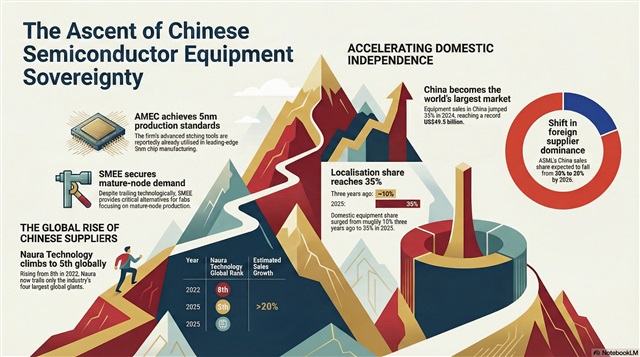
Sales data analyzed by Japanese research firm Global Net and cited by Nikkei Asia shows state-backed Naura Technology rose to fifth place globally in 2025, up from eighth in 2022, trailing only ASML, Applied Materials, Lam Research, and Tokyo Electron.
Founded in 2001, Naura has built a broad portfolio covering etching, deposition, and other core fabrication processes. Its estimated sales grew more than 20% last year, driven by rising domestic demand as Chinese fabs accelerate equipment substitution.
Entering the top 20 in 13th place is AMEC. Founded by an engineer formerly at Lam Research and Applied Materials, the company specializes in advanced etching tools reportedly already used in 5nm chip production, approaching leading-edge standards. AMEC also operates facilities in Taiwan and South Korea.
Ranked 20th is SMEE, one of China's few lithography toolmakers. While its systems remain several generations behind ASML's most advanced machines, SMEE continues to see steady domestic demand as fabs seek alternatives for mature-node production.
Expanding the ranking to the world's top 30 adds two more Chinese suppliers — ACM Research and Hwatsing — highlighting the rapid spread of local players across multiple process segments.
Localization surge accelerates under export curbs
The surge in Chinese equipment suppliers reflects Beijing's broad push for semiconductor self-sufficiency, led by national investment funds and reinforced by aggressive local government financing for equipment and materials.
US export restrictions have further accelerated the shift, forcing Chinese chipmakers to source domestically wherever possible.
Tetsuo Omori, senior analyst at Japan's Techno Systems Research, said China now produces roughly 20% to 30% of its semiconductor equipment locally, up from around 10% three years ago. More recent industry estimates suggest localization has moved even faster.
The South China Morning Post reported China's domestic equipment share climbed to around 35% in 2025, surpassing earlier targets, led by Naura and AMEC in etching and deposition. TrendForce echoed the figure, noting Naura now dominates tool supply for Semiconductor Manufacturing International Corp.'s 28nm lines, while Piotech and ACM Research continue to post strong order momentum.
An executive at a specialized trading firm said domestic suppliers can now cover nearly every step of advanced chipmaking, from deposition and etching to cleaning — a sharp shift from just a few years ago.
Modern semiconductor manufacturing involves more than 1,000 process steps, each requiring dedicated equipment. The growing depth of China's tool ecosystem is steadily reducing reliance on foreign suppliers across mature and increasingly advanced nodes.
Credit: DIGITIMES
China emerges as top equipment market
The shift is intensifying competition for Japanese, US, and European equipment makers within China, now the world's largest semiconductor manufacturing equipment market.
Data from industry group SEMI shows chipmaking equipment sales in China jumped 35% in 2024 to US$49.5 billion, overtaking all other regions. While Western suppliers still dominate advanced lithography and certain high-precision process tools, their long-term technological lead may narrow as China's domestic supply chain matures.
The impact is already visible at ASML. Reuters reported China accounted for 33% of the company's sales in 2025, its largest single market, but ASML expects the share to fall to around 20% in 2026 as export controls tighten.
ASML chief executive Christophe Fouquet has warned excessive technology restrictions could backfire by accelerating Chinese innovation. He noted ASML's tools currently shipped to China lag its most advanced high-numerical-aperture lithography technology by roughly eight generations — equivalent to equipment sold more than a decade ago.
EUV bottleneck and alternatives
Despite rapid progress, China has yet to develop EUV lithography systems required for cutting-edge 2nm and 3nm chips, a segment still monopolised by ASML.
Fouquet has said it would take "many, many years" for China to independently build EUV machines.
SCMP reported firms are also experimenting with advanced DUV techniques to bypass restrictions. A 2022 patent showed Huawei tested self-aligned quadruple patterning using older DUV systems to reach performance approaching 2nm-class processes.
Industry observers say such approaches could enable incremental scaling even without EUV tools.
Global competitive shift
Analysts argue that Washington may have underestimated China's ability to rapidly build a competitive equipment ecosystem. Nikkei previously quoted a US expert who said repeated export restrictions reflected a naive understanding of China's manufacturing capabilities, warning that once Chinese toolmakers become internationally competitive, their expansion would be hard to contain.
In the near term, Chinese suppliers are benefiting mainly from booming domestic demand. Over the longer term, rising scale, improving technology, and cost advantages could position them as global challengers.
With Naura, AMEC, and SMEE now firmly inside the global top 20 — and domestic equipment penetration already surpassing one-third of demand — China's former weak link in chipmaking gear is becoming a pillar of its semiconductor strategy, reshaping competition across the global supply chain.
Article edited by Jerry Chen