
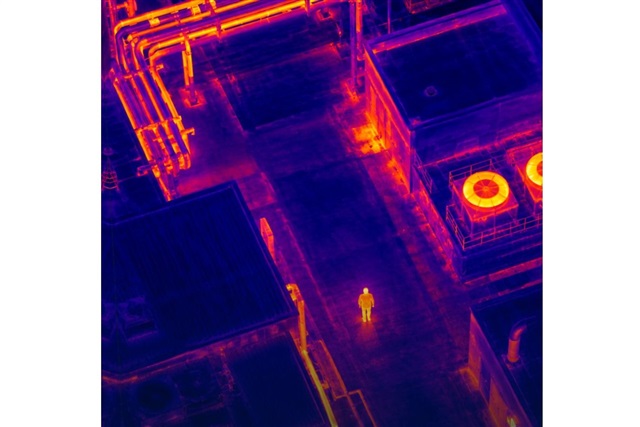
Critical infrastructure across power generation, petrochemicals, and manufacturing plays a vital role in industrial operations. As equipment ages, ongoing maintenance and safety management become increasingly urgent. Because unexpected downtime carries enormous financial costs, facilities have traditionally relied on personnel entering energized switchyards, climbing transmission towers, or working in hazardous, confined spaces. However, this conventional approach is constrained by limited efficiency and exposes workers to significant safety risks. As AI-powered drones integrated with thermal imaging modules mature, industrial inspection is transitioning from episodic manual checks toward automated, continuous monitoring and predictive maintenance.
Albert Wang, Business Development Manager of Suntek Global, pointed out that industries currently face a chronic shortage of certified thermographers and inspectors. Furthermore, manual inspections are episodic and subjective, with noticeable variance across inspectors evaluating the same anomalies, which often leads to inconsistent inspection accuracy. Consequently, industries are seeking autonomous inspection platforms equipped with thermal modules. Beyond keeping maintenance personnel out of high-risk environments, these systems deliver high repeatability through fixed flight paths, consistent viewpoints, and uniform time-of-day baselines. This enables enterprises to track asset degradation trends over time, upgrading traditional periodic audits into true predictive maintenance.
Market research indicates that the global power-inspection drone market across all payloads is projected to expand from $2.8 billion in 2025 to $8.6 billion by 2034. Within this sector, thermal-imaging adoption already exceeds 59%, with the directly thermal-addressable slice expected to reach $5 billion by 2034. With nearly a decade of deep collaboration with Teledyne FLIR, Suntek serves as an ideal partner for Taiwan and global industry players looking to seize this substantial market opportunity.
Detecting Subtle Thermal Signatures to Identify Faults Before Failure
Before catastrophic failure occurs, equipment typically exhibits electrical faults, mechanical wear, or process anomalies, accompanied by subtle hotspots invisible to the naked eye. Utilizing thermal imaging allows operators to detect temperature anomalies early and schedule repairs proactively, minimizing downtime impacts. In particular, significant advances in uncooled long-wave infrared (LWIR) sensitivity now resolve fine temperature differentials into quantifiable data for actionable asset health analysis.
Among key verticals, power and renewables represent prime deployment grounds for drone inspection. In solar operations, traditional manual thermography is labor-intensive; a single thermal-imaging drone can survey 1–2 MW of installed capacity per flight hour, compared with under 50 kW per hour using manual methods—delivering an order-of-magnitude leap in productivity.
Mr. Wang further explained that when thermal imaging combines with edge AI, the system advances from basic imaging to intelligent automated interpretation—classifying defects, detecting anomalies at scale, and fusing multi-modal visible, thermal, and LiDAR inputs to alleviate the burden of manual image review. However, the core challenge lies in integrating sensors, calibration pipelines, drivers, edge computing, and AI models. Because thermal measurements are sensitive to ambient temperatures and optical characteristics, systems must ensure rock-solid radiometric stability. Currently, Teledyne FLIR provides radiometric variants including Boson+, Hadron 640R+, and the Lepton family, supplying system integrators with factory-calibrated, reliable thermal data.
Nonetheless, integrating thermal cores into edge platforms involves complex hardware plumbing, such as MIPI CSI-2, USB, VoSPI, and V4L2 driver development, as well as frame synchronization between thermal and visible sensors—roadblocks that often stall OEM engineering teams for 6 to 12 months. To eliminate these hurdles, Suntek provides pre-integrated Reference Designs and validated drivers, helping equipment builders bypass tedious bottom-layer troubleshooting and compressing development timelines from quarters down to weeks.
Eliminating Integration Hurdles from Core Components to Deployment
With nearly a decade of continuous partnership with Teledyne FLIR, Suntek possesses deep tribal knowledge of Lepton and Boson architectures, addressing real-world calibration, driver, and manufacturing variations. Suntek provides dedicated carrier boards, driver integration, system engineering, and production support, significantly lowering the technical barrier for OEMs bringing thermal products to market.
Suntek offers proven reference platforms across Boson+ and Lepton. Its compact MicroIR+ modular platform integrates a direct-mount Lepton socket, a quad-core RISC-V compute core, secure networking, and industrial production I/O onto a single validated board. Crucially, the platform utilizes an NDAA-compliant and ITAR-free BOM, meeting stringent cybersecurity and regulatory mandates for overseas critical infrastructure. In addition, addressing the reality that many innovators and startups begin with high-mix, low-volume (HMLV) runs of 100 to 5,000 units annually, Suntek provides comprehensive supply chain management and manufacturing support to bridge the gap from concept to commercial volume production.
On October 28, 2026, Teledyne FLIR will host the "2026 Thermal Imaging AI Developer Forum," unveiling the next-generation Boson SX8 ultra-high-resolution thermal module and breakthrough solutions, empowering industry partners to accelerate deployment across autonomous drone inspection, smart manufacturing, critical infrastructure monitoring, and autonomous systems.