DIGITIMES has recently published three latest research reports regarding Qualcomm's cloud AI ASIC business strategy for 2026, the status of the worldwide top-3 memory makers, plus the latest trends of the memory industry, and an update to DIGITIMES' estimate of global smartphone shipments in 2026 as a result of ongoing price hikes of memory.
Qualcomm cloud AI ASIC business strategy
DIGITIMES observes that Qualcomm has strengthened its capabilities in self-developed CPUs, cross-platform integration, and cloud AI-oriented application-specific integrated circuits (ASICs) through a series of acquisitions. This strategy allows Qualcomm to gradually extend its AI deployments from the edge to the cloud, shifting from traditional system-on-chip (SoC) architectures toward more flexible, modular designs.
Over the long term, this approach positions Qualcomm to challenge the high-end cloud AI accelerator market; however, whether it can penetrate the mainstream remains uncertain. Key determinants include the maturity of high-speed interconnect and chiplet integration technologies, as well as cloud service providers' (CSPs) willingness to adopt non-GPU and proprietary computing platforms.
Although mobile business has long accounted for the majority of Qualcomm's revenue, slowing demand has prompted the company to actively pivot toward AI PCs, automotive, Internet of Things (IoT), and cloud AI ASIC deployments.
Qualcomm revenues by business, 1Q23-3Q25
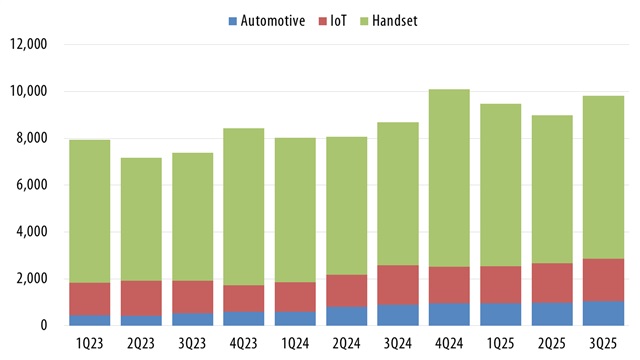
*Note: Figures and times of this chart are based on Qualcomm's fiscal year.
Source: Qualcomm, compiled by DIGITIMES, December 2025
Global top-3 memory maker status, 4Q25
DIGITIMES forecasts that the memory industry's revenue will grow by over 20% in 2025 and by more than 40% in 2026. The revenue growth momentum in 2025 has been fueled by HBM demand and price increases in general-purpose DRAM and NAND flash products.
This trend is expected to continue into 2026. On the other hand, due to increased competition in the HBM market in 2026, memory manufacturers will focus their product development on GDDR7 and HBF. Furthermore, the allocation and construction of global memory production capacity will also be a test for manufacturers to maintain their competitive advantage.
According to DIGITIMES's observations, with AI continuing to drive demand for HBM and the supply shortage of general-purpose DRAM and NAND flash, the memory industry's revenue is expected to grow by more than 25% in 2025, exceeding US$200 billion. Looking ahead to 2026, the continued supply shortage of HBM and general-purpose memory will drive the memory industry's revenue growth by more than 40%, reaching US$300 billion.
Memory business revenues of top-3 makers, 4Q24-4Q25 (US$b)
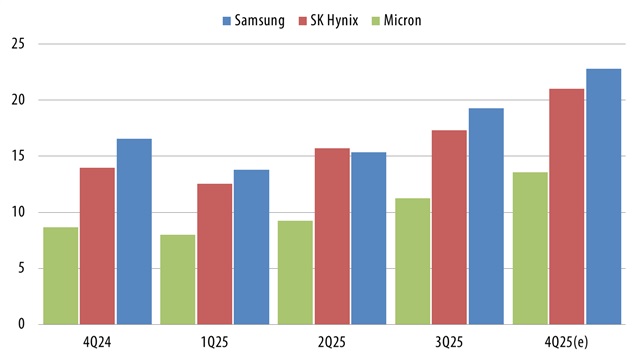
*Note: Samsung's and SK Hynix's revenues are calculated based on the exchange rate of US$1:KRW1,385.
Source: Companies, compiled by DIGITIMES, December 2025
Global smartphone shipment forecast update, 2026
DIGITIMES observes that memory prices have surged dramatically recently, with DRAM prices rising sharply and aggressively in the fourth quarter of 2025. This double-digit quarterly increase is expected to continue into the first quarter of 2026, severely impacting shipments and sales across consumer electronics, including smartphones.
Based on supply chain information, DIGITIMES has revised down its global smartphone shipment forecast for 2026 to 1,202.2 billion units, adjusting the annual growth rate to -1.6%.
Compared to the December 2025 estimate of 1,255.4 billion units, DIGITIMES has lowered the overall global smartphone shipment forecast for 2026 by 53.2 million units, reducing the annual growth rate by 4.4pp. Apple and Samsung Electronics are expected to experience less impact from rising memory prices in their 2026 smartphone shipments and will still achieve positive growth.
Global smartphone shipments, 2024-2026 (m units)
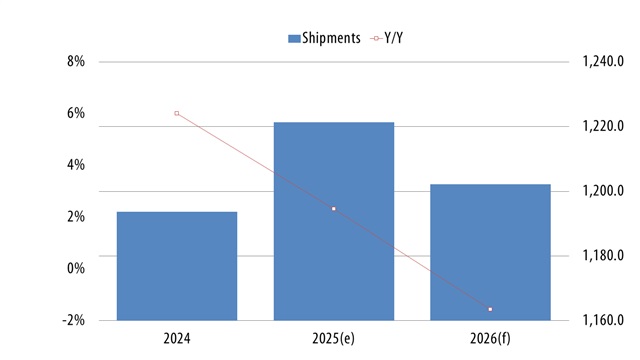
Source: DIGITIMES, December 2025
Article edited by Joseph Tsai