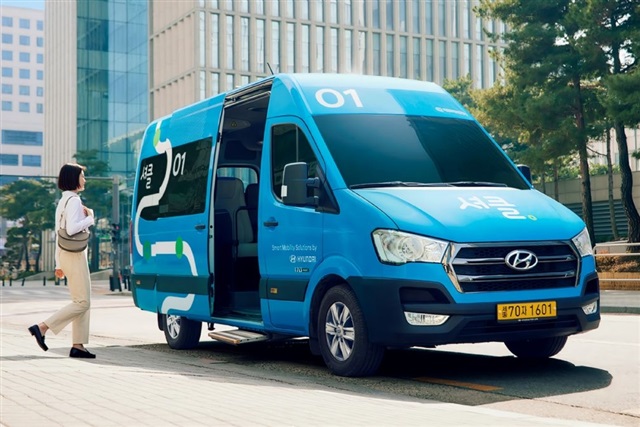
Hyundai Motor Group is stepping up efforts to expand its mobility business, investing in demand-responsive transit (DRT) platforms as part of its strategy to diversify beyond traditional vehicle development. The initiative aims to strengthen the company's role in the future mobility market while addressing social issues such as transportation disparities between urban and rural areas.
AI-powered transit flexibility
DRT differs from conventional public transport by using artificial intelligence to dynamically route vehicles in response to passenger ride requests. Instead of fixed stops, the service uses virtual stations, allowing greater flexibility, shorter waiting times, and higher vehicle utilization. The model seeks to reduce inefficiencies while improving accessibility for underserved communities.
Hyundai introduced its DRT app, Shucle, in 2021, beginning trial operations in Sejong Special Autonomous City in South Korea. The service has since expanded to additional regions in the country. The company also plans to join a demonstration project in Hungary by August 2025, marking its first step into the European market.
Market growth and performance metrics
According to Market Research, the global DRT market is projected to increase from US$29.1 billion in 2024 to US$74.2 billion by 2030, reflecting growing demand for flexible, tech-enabled transport solutions.
Data from February 2025 shows that in rural areas, DRT services cut average travel time from 74 minutes on conventional public transport to 29 minutes, a reduction of 61%. Waiting time dropped from 55 minutes to 14 minutes, while overall ride and walking times also decreased. In urban areas, where public transport systems are more developed, overall travel time rose slightly from 32.4 minutes to 36.5 minutes. However, users benefited from reduced transfers and greater route options, improving convenience.
Revenue model and social impact focus
The business model currently generates revenue by supplying software to local governments, though returns remain modest compared with investment costs. Hyundai positions the service primarily as a tool to bridge mobility gaps and support transportation-disadvantaged populations. Company officials note that while governments already provide subsidized welfare taxis in farming and fishing communities, inefficiencies remain in dispatch and accessibility. Hyundai sees platform-based DRT as a solution to better match services with real-time demand, enhance ride-sharing efficiency, and ensure support reaches target groups.
Regulatory challenges and future outlook
Scaling up DRT faces regulatory hurdles. As an emerging service, operators must often apply for temporary exemptions under regulatory sandboxes. Clearer guidelines on operational methods, data protection, and dispatch volumes are still needed to enable broader deployment.
Hyundai views DRT as a stepping stone toward autonomous mobility. The company intends to refine DRT services in advance of self-driving adoption, creating a foundation for future autonomous shuttles and driverless taxis.
Article translated by Jingyue Hsiao and edited by Jerry Chen