

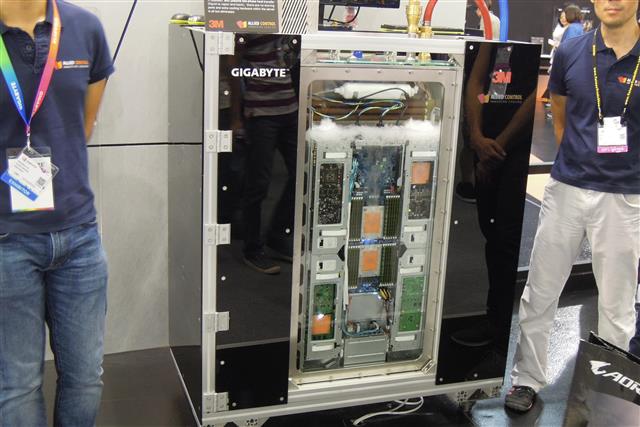
As Intel and AMD are expected to release their next-generation server CPUs in the first quarter of 2021, US- and Europe-based datacenter operators have accelerated their paces in adopting liquid cooling solutions for the new systems, according to sources from the upstream supply chain.
Intel's next-generation Ice Lake processors will come with improved computing capability compared to the existing Cooper Lake-P CPUs, but their thermal design power, expected at between 250-300W, is also much higher than the Cooper Lake-P platform's 150-250W.
AMD's third-generation EPYC processors codenamed Milan will see 15-20% performance improvement from the previous-generation CPUs, the sources said. Combining the CPUs with AMD's Instinct MI100 HPC GPU accelerator in high performance computing (HPC) systems, the performance can be further improved. However, thermal design power of the flagship EPYC 7763 processor reportedly can reach as high as 280W.
Nvidia's Ampere-based A100 GPU also features an enhancement of 20 times in performance compared to the previous-generation products based on the Volta architecture, but the TDP of the GPU is at 400W.
Google is said to be pushing the development of immersion liquid cooling technology, while Alibaba has already adopted immersion liquid cooling solutions at some of its datacenters, the sources noted.
Microsoft and Facebook are reportedly still conducting proof of concept (POC) for immersion liquid cooling solutions and will start adopting them in 2021, the sources pointed out.
The adoption rate of liquid circulation solutions by datacenter operators is expected to increase at a faster pace because of lower installation costs, the sources said.
Datacenter operators are interest in immersion liquid cooling solutions
Photo: Digitimes file photo
Article translated by Joseph Tsai