

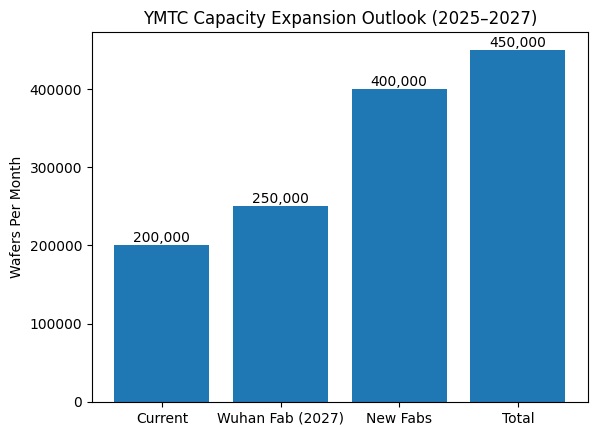
Yangtze Memory Technologies Corp (YMTC) plans to build two additional fabrication plants, alongside a third facility nearing completion — a move that would more than double its production capacity once all three sites are operational, according to people familiar with the matter.
The expansion comes as Beijing accelerates efforts to reduce reliance on foreign semiconductor technology, following US export controls on advanced chipmaking tools. A cross-party group of US lawmakers this month proposed further tightening restrictions on China's semiconductor sector.
The two new plants are each expected to reach a capacity of 100,000 wafers per month. YMTC currently operates two fabs with a combined monthly output of 200,000 wafers. The third facility, located in Wuhan, is expected to begin operations later this year and reach a monthly capacity of 50,000 wafers by 2027.
Domestic supply chain gains traction
Construction of the third facility has been completed, and equipment installation is underway. More than half of the tools have been sourced from domestic suppliers, including equipment used for the vertical stacking of chip layers.
YMTC has strengthened ties with local firms such as Advanced Micro-Fabrication Equipment Inc. (AMEC) since being added to the US Entity List in December 2022. The shift underscores a broader push toward localization as Chinese firms adapt to trade restrictions.
Reuters was unable to determine the timeline or location for the two additional planned fabs. YMTC did not respond to a request for comment, while AMEC also declined to comment.
Market share gains driven by capacity expansion
Founded in 2016 with backing from local governments and state investment funds, YMTC has advanced its technical capabilities in recent years. Analysts say its Xtacking 4.0 architecture is comparable to products from global leaders such as Samsung Electronics.
According to UBS, YMTC accounted for 11.8% of the global NAND flash market last year. Samsung Electronics led with 30.4%, followed by SK Hynix, Kioxia Holdings, and Micron Technology. UBS expects YMTC's share to exceed 14% by early 2027.
Analysts said Chinese memory makers are increasingly gaining share through capacity expansion rather than pricing alone, supported by strong demand from artificial intelligence infrastructure. According to a report by the South China Morning Post, while Chinese suppliers have historically benefited from price advantages, recent gains have been driven more by volume growth.
Research estimates cited in the report indicate China's memory capacity could expand by up to 140,000 wafers per month this year, with further increases expected in 2027. However, analysts noted that new capacity typically takes nine to twelve months to ramp and is unlikely to significantly affect global supply-demand dynamics until 2027.
Expansion into DRAM adds strategic dimension
YMTC is also expanding into DRAM, with all three new fabs expected to allocate part of their capacity to memory products used for temporary data processing. The company has sent low-power DRAM samples to customers and is awaiting feedback to guide future production decisions.
Broader industry trends point to continued strength in memory demand, with analysts expecting rising contract prices for both DRAM and NAND, driven by AI demand and supply constraints. Some observers cautioned that early inventory buildup may be amplifying price increases, though demand from cloud service providers and GPU manufacturers remains strong.
Credit: Sherri Wang
Article edited by Jerry Chen