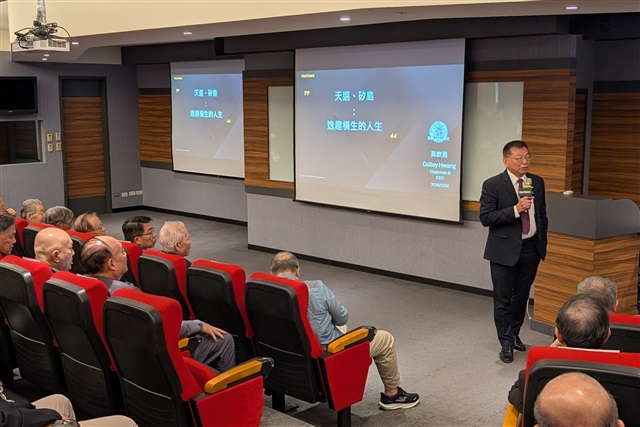
Taiwan and South Korea have long defined the frontlines of global tech rivalry. Now, that relationship is evolving into something far more nuanced. Driven by the demands of the AI supercycle and mounting geopolitical pressures, the two are settling into an uneasy but necessary "frenemy" dynamic. DIGITIMES president Colley Hwang laid out this shift in a lecture on February 24, 2026, mapping the hidden vulnerabilities and emerging interdependencies that will shape both nations' tech futures. His analysis, centered on TSMC and Samsung, is clear: the era of pure head-to-head competition is over. Collaboration is now a strategic imperative.

Credit: Digitimes
Samsung's juggling act — and TSMC's patience
Hwang's critique of Samsung draws on the Empty Fort Strategy — the idea that projecting strength across too many fronts can expose weakness rather than command it. Samsung's ambition to be a top brand, chip designer, and manufacturer all at once is its Achilles' heel. The competing priorities create an inherent conflict of interest. TSMC, by contrast, plays the long game, focusing its resources and waiting for the right moment to move.
Hwang frames Samsung's struggle to keep pace as a triple-threat crisis: capital imbalance, R&D disparity, and ecosystem weakness. TSMC reinvests nearly 100% of its profits — over US$50 billion annually — into capital expenditure (CapEx). Samsung cannot match that scale. TSMC also fields three times the R&D personnel dedicated to its foundry business, and counts over 520 customers alongside a sprawling network of suppliers and design service partners. Samsung lacks a comparable ecosystem. Hwang's takeaway is pointed: companies that build their lead through focused execution, rather than trying to win on every front, are the ones that endure.
Debt, reserves, and the infrastructure gap
Headline-grabbing advances in chip manufacturing can obscure a more revealing picture. Hwang's analysis of the underlying economic fundamentals shows a meaningful divergence. Taiwan's GDP per capita has recently surpassed South Korea's. More striking is the contrast in financial position: South Korea carries an estimated US$600–700 billion in foreign debt, with a significant short-term component, while Taiwan holds US$610 billion in foreign reserves and carries minimal debt.
Yet Taiwan has its own blind spots. South Korea's national infrastructure is notably stronger. Korean cities — including those in the third and fourth tier — are served by advanced expressways and smart urban investments that Taiwan has yet to match. It is a quiet but significant gap in long-term national development.
Why rivals need each other
Hwang's argument for a Taiwan-Korea alliance comes down to hard necessity. Taiwan does not have Korea's cutting-edge high-bandwidth memory (HBM), which is critical for advanced packaging. Global players like Nvidia depend on both nations' capabilities working in concert. The US$37 billion trade deficit Taiwan runs with Korea is not a vulnerability — it is a measure of how deeply the two economies are intertwined. Taiwan is buying HBM from Korea at scale to power its AI server manufacturing. As geopolitical tensions simmer, particularly around Taiwan, a diversified and cooperative supply chain becomes a strategic buffer for both sides.
Pure rivalry is an outdated frame for the modern tech world. Taiwan and South Korea are bound together by market forces and strategic necessity alike. Their "frenemy" relationship is not a compromise — it may be the most pragmatic path to staying competitive at the frontier of global innovation.

Credit: Digitimes
Note: The legendary Professor Lin Chiu-shan, a titan in Korean Studies, graced the audience to attend Colley Huang’s latest speech. At 92, Professor Lin remains a living bridge of history. Throughout his career, he moved within the inner circles of the Blue House, maintaining close ties with two South Korean presidents, Park Chung-hee and Park Geun-hye. He was also a rare diplomatic pioneer who traversed North Korea during the Cold War, creating a vital opening in the then-frozen relations between Taiwan and the North.
Article edited by Jerry Chen