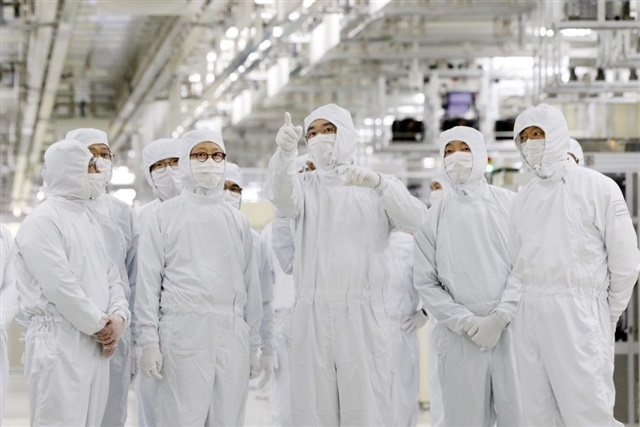
Samsung Electronics' foundry utilization exceeded 80% in the first quarter of 2026, its highest level in over a year, increasing the probability of a quarterly profit turnaround this year.
Industry sources cited by Sedaily said first-quarter utilization at Samsung's Pyeongtaek P2 and P3 foundry lines, which produce 4nm, 5nm, and 7nm chips, reached the 80% range. In 2025, mature-node utilization had remained below 50% due to weak orders.
The recovery has been driven by product validation rather than pricing. Performance verification of sixth-generation high-bandwidth memory (HBM4) base dies, and the Exynos 2600 mobile processor, led to increased orders from US and Chinese technology companies.
Industry executives expect first-half utilization to remain above 80%, supported primarily by mature-node demand.
HBM4 and 2nm Exynos anchor recovery
The turning point came in the second half of 2025, when Samsung applied its 4nm process to the logic base die of HBM4 developed by its memory division. The performance improvement increased foundry orders.
In February, a Samsung semiconductor executive confirmed initial commercial HBM4 shipments at 11.7-13Gbps using a 4nm logic base die, with power efficiency improved by about 40%. The company expects HBM4 revenue to triple in 2026.
Samsung has increased output on its 2nm process. The Exynos 2600 mobile application processor is in production on 2nm, with reported performance exceeding comparable Qualcomm chips. Supply for the Galaxy S26 is expected to expand.
Seoul Shinmun reported that Exynos 2700, built on the 2nm SF2P process, could supply about 50% of Galaxy S27 volumes, compared with roughly 25% for the S26.
G-enews previously reported first-half utilization recovering toward 60%, supported by thermal improvements in Exynos 2600 using Heat Pass Block technology.
Long-term AI contracts support non-memory recovery
The utilization rebound is also underpinned by long-term contracts that extend beyond smartphones and memory.
CNBC reported that Samsung secured a KRW22 trillion (approx. US$15 billion) AI chip agreement linked to Tesla. YTN previously disclosed a KRW22.8 trillion contract with a US technology company extending to 2033.
From 2027, Samsung is expected to produce Tesla's AI5 chips and CMOS image sensors (CIS) for Apple, further diversifying its advanced-node customer base.
Market observers expect Samsung's non-memory divisions, including foundry and System LSI, to return to profit as early as the fourth quarter of 2026. Expanded production of automotive AI chips, mobile processors, and image sensors is scheduled from 2027.
The foundry recovery strengthens Samsung's position as an integrated device manufacturer, combining memory and advanced logic production.
Article edited by Jack Wu