

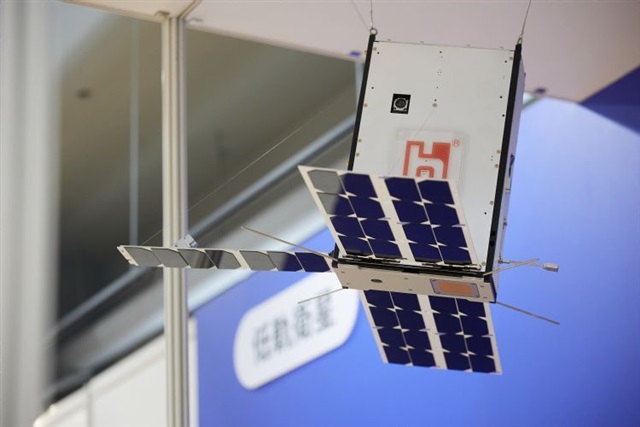
Driven by its 3+3+3 strategy, Hon Hai Precision Industry (Foxconn) is actively participating in the emerging space industry, including low Earth orbit (LEO) satellites. In addition to continuously developing key components for ground receiving equipment, LEO satellites, and communication payload systems, the company also plans to assist satellite manufacturers with production and manufacturing. Through these efforts, Foxconn aims to become a leader in the new space industry.
Designed in the UK, manufactured in Taiwan
At the 2025 UK-Taiwan Space Roundtable held on September 23, Jen-ming Wu, director of the Next-Generation Communications Research Center at Hon Hai Research Institute, stated that to turn UK-Taiwan cooperation from a concept into concrete action, the most practical model is "designed in the UK design, manufactured in Taiwan." This approach can improve efficiency and shorten the time-to-market for products.
Wu further explained that the manufacturing process can be divided into two key stages from "0 to 1" and "1 to 100." The former refers to the process from concept to prototype, encompassing design, research and development, and manufacturability considerations. The latter focuses on transforming the design into a standardized process, including assembly, testing, and integration, ensuring readiness for large-scale mass production.
Leveraging advantages to offer end-to-end solutions
In terms of space industry development, the UK has advantages in front-end design and system planning, offering innovative applications and market-oriented solutions. Taiwan, on the other hand, can leverage its mature supply chain and manufacturing capabilities to rapidly turn designs into commercialized products. This division of labor not only enhances R&D efficiency but also accelerates the adoption of innovative outcomes in the market.
Wu pointed out that the future space industry will cover many applications, including LEO satellites, non-terrestrial network (NTN) communications, positioning and navigation, and the Internet of Things (IoT). These fields require both innovation and scalability. For Taiwan, it is difficult to break into the global market alone; international cooperation is essential to amplify its strengths and gain a competitive edge.
The UK possesses reliable application and service platforms that can build trust on the market side, while Taiwan can support the overall system with cost-effective, high-quality hardware products. If combined, they could offer comprehensive end-to-end solutions.
Wu emphasized that time is a critical factor in the space industry competition. Shortening product development cycles through UK-Taiwan cooperation can reduce risks and accelerate return on investment. This would strengthen their influence in the global market and allow them to quickly accumulate successful case studies.
Article translated by Eifeh Strom and edited by Joseph Chen