

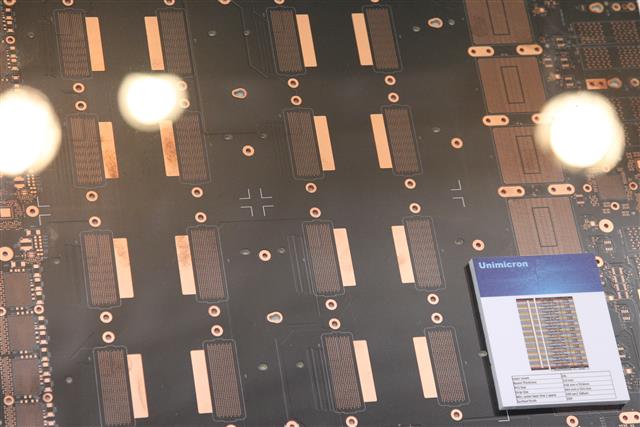
Unimicron Technology's board of directors has resolved to allocate NT$17.4 billion (US$594.2 million) in capex for 2021, with over 90% of the sum and the majority of another budget of NT$24 billion for 2020 to be spent on IC substrate business, particularly ABF substrate capacity expansions in Taiwan, according to company sources.
TS Shen, the firm's general manager of finance, said at a recent investors conference that heavy investments in 2020 and 2021 are needed to support construction of a new plant in Yangmei, northern Taiwan and meet clients' ever-higher capacity and technology requirements.
The Yangmei plant requires total investment of NT$28.5 billion, accounting for 70% of the firm's combined capex for 2020 and 2021. And the remaining expenses will be mostly spent on its existing two IC substrates plants, also in northern Taiwan, with investment in plants in China to take less than 5%, the company said.
The new plant will be dedicated to production of ABF substrates enabling integration of heterogeneous chips solutions. It is slated to start small-volume production in the second half of 2020 before reaching full utilization in 2024, the company disclosed.
Both Intel's EMIB (embedded multi-die interconnect bridge) and TSMC CoWoS processes require the support of ABF substrates for heterogeneous chips integration, and such substrates entail far higher specs for materials, circuit layouts and circuit density than the current mainstream IC substrates, prompting Unimicron to inject heavy resources into R&D in this segment and boost yield rates, according to industry sources.
Its peers including Taiwan's Nan Ya PCB and Kinsus Interconnect Technology and Japan's Ibiden are also proceeding with capacity expansions for ABF substrates, but Unimicron has preempted them in building partnerships with Intel and TSMC further cementing its leaderships in the segment, the sources said.
Article translated by Willis Ke