
Moore Threads has entered a strategic partnership with Lightwheel Intelligent (Beijing) Technology (Lightwheel.ai) to jointly develop a domestic simulation and synthetic data infrastructure platform for embodied AI, highlighting China's broader push to reduce reliance on foreign AI computing and robotics software ecosystems.
The partnership combines Moore Threads' full-function GPU platform and KUAE AI computing cluster with Lightwheel's self-developed "solve-measure-generate" simulation framework to create high-fidelity synthetic data generation capabilities for embodied AI and robotics training, per Securities Times.
The collaboration comes as embodied AI developers increasingly face a growing bottleneck in acquiring real-world training data. Physical data collection for robots remains expensive, difficult to scale, and challenging to reproduce consistently across complex environments.
According to Moore Threads, simulation-generated data has become one of the key pathways to bridge the industry's data gap, but scaling such workloads requires significantly greater computing power. In a typical robotics operation task, rendering volume for a single generalized trajectory can reach 48,000 frames, while hundreds of trajectories can expand into millions of frames, creating substantial pressure on GPU rendering and physics simulation capabilities.
The company said these workloads require simultaneous support for AI computing, graphics rendering, physical simulation, and hardware-level ray tracing to ensure the physical realism of synthetic data.
China pushes domestic GPU stack into robotics AI
The partnership reflects a broader trend in China's AI industry, where domestic GPU vendors are increasingly positioning themselves beyond traditional AI training workloads and into robotics, physical AI, and embodied intelligence applications.
Moore Threads said the two companies have jointly built a localized workflow spanning "real trajectory → simulation modeling → data augmentation," enabling large-scale production of high-confidence synthetic data while tackling technical challenges such as flexible object grasping simulations.
Lightwheel, described by the companies as a physical AI data and simulation infrastructure provider, contributes its proprietary simulation platform and GPU-based physics solver.
According to Beijing Business Today and East Money, the platform supports unified simulation across rigid bodies, soft bodies, fluids, and particles while integrating real-world physical parameters, including mass, friction, deformation, and contact dynamics into virtual environments.
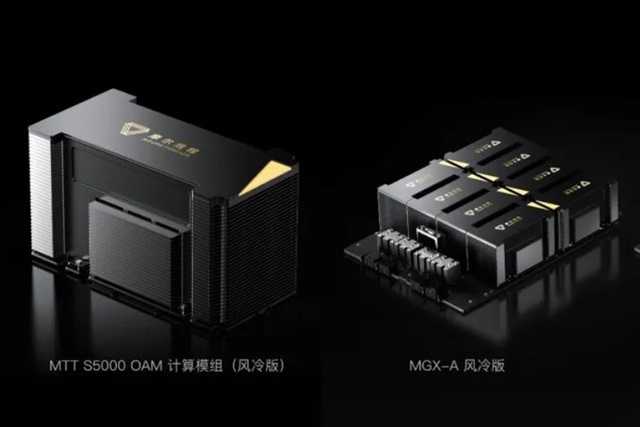
The companies noted that the simulation system has already been adapted to Moore Threads' MUSA GPU architecture and can run on the MTT S5000 AI accelerator with native GPU acceleration and hardware ray-tracing support.
Moore Threads said its MUSA architecture allows a single chip to simultaneously support AI computing, graphics rendering, scientific computing, physical simulation, and ultra-high-definition video encoding and decoding. Its flagship MTT S5000 AI card is also among the few domestic GPUs in China supporting both hardware-level ray tracing and AI training and inference workloads.
Synthetic data race intensifies
The companies said the KUAE thousand-GPU computing cluster built on the MTT S5000 platform can support large-scale generalized rendering across variables such as object position, material properties, viewing angles, and environmental conditions, allowing embodied AI data generation to move from limited collection toward industrial-scale production.
Moore Threads also claimed that hardware ray-tracing acceleration using the MTT S5000 RT Core can improve rendering performance by 2.7 times in complex physical simulation environments.
Beyond data generation, the two companies plan to deepen cooperation in embodied AI evaluation platforms and closed-loop physical AI simulation systems, aiming to extend the partnership from synthetic data production into a broader "simulation-training-evaluation" ecosystem.
The collaboration also underscores how China's embodied AI sector is increasingly attempting to build vertically integrated domestic infrastructure stacks spanning chips, simulation algorithms, and robotics training data, particularly as geopolitical tensions continue to reshape access to advanced AI hardware and software technologies.
Article edited by Jack Wu