

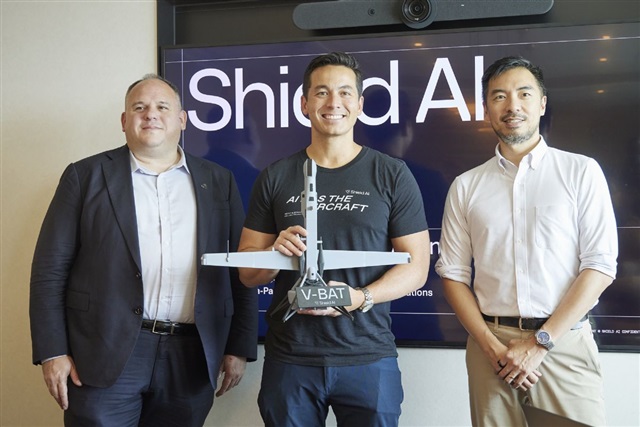
US defense technology unicorn Shield AI is expanding its presence in Taiwan as the Russia-Ukraine war drives growing demand for asymmetric warfare capabilities and defense technologies. At its first press event in Taiwan on October 2, co-founder and CEO Brandon Tseng outlined plans to deepen local partnerships, expand its supply chain, and build its Taiwan workforce.
Shield AI established its Taiwan office in 2025 and currently has only two locations in Asia: Taiwan and South Korea. Taiwan is its largest base in the region, highlighting the market's strategic importance to the company.
Tseng said Shield AI is pursuing military procurement opportunities with Taiwan's Ministry of National Defense while working with local partners to develop and localize autonomous systems.
Partnerships span air and sea
Shield AI currently has three major collaborations underway in Taiwan. It is working with Aerospace Industrial Development Corp. (AIDC) and the National Chung-Shan Institute of Science and Technology (NCSIST) to pursue Coast Guard Administration contracts, including establishing a local maintenance system for its Hivemind autonomy software and V-BAT vertical takeoff and landing (VTOL) drone.
The company is also integrating Hivemind into the domestically developed Mighty Hornet 3 drone to enable autonomous, coordinated missions.
For maritime applications, Shield AI is partnering with Thunder Tiger Group to integrate its AI autonomy technology into Thunder Tiger's unmanned surface vessels. The companies completed field testing in waters off Pingtung by the end of July 2026.
Supply chain and workforce grow
Taiwan is also becoming an increasingly important supply-chain hub for Shield AI. Taiwanese suppliers currently account for 16% of the V-BAT supply chain, primarily providing printed circuit board assemblies (PCBAs) and other electronic components. Shield AI aims to raise the share to 25%.
Tseng said Taiwanese suppliers have considerable room to expand their participation, including in X-BAT, Shield AI's new fighter aircraft currently under development, potentially creating additional opportunities for local manufacturers.
Shield AI is also expanding its local workforce. The company started operations in Taiwan with just one employee in 2025, but its headcount has since grown to 11 and is expected to reach 20. In 2027, Shield AI plans to recruit employees in sales, government relations, software engineering, and supply-chain management, with a longer-term goal of employing hundreds of people in Taiwan.
Founded in 2015, Shield AI is valued at US$13 billion and develops AI-powered autonomy technology and unmanned systems for platforms ranging from V-BAT to F-16 fighter aircraft and collaborative combat aircraft (CCA).
Tseng served seven years in the US Navy as a Navy SEAL and surface warfare officer, with deployments to Afghanistan, the Pacific, and the Arabian Gulf. He also has family ties to Taiwan. His father immigrated from Taiwan. His grandfather, who served as a Taiwanese diplomat in South America and other regions for 35 years, is a fifth-generation direct descendant of Zeng Guofan, a statesman and military general of the late Qing dynasty.
Hivemind operates without GPS or comms
Software is at the core of Shield AI's business. Its Hivemind AI autonomy platform enables unmanned systems to conduct missions and coordinate with one another even in environments where GPS and communications are disrupted.
Tseng said that while many countries are seeking to build drone forces numbering in the millions, increasing fleet size makes human control progressively more difficult and creates greater exposure to electronic warfare. Operating unmanned fleets at such scale therefore requires highly capable autonomous systems.
Hivemind has been integrated into more than 40 unmanned platforms and has been deployed in Ukraine, where Tseng said it has supported more than 21 strike operations. V-BAT has also been deployed by the US Coast Guard and, since 2026, has contributed to narcotics seizures valued at more than US$1 billion, demonstrating the platform's operational maturity.
A defense industry source said Taiwan's drone development has progressed relatively slowly and that policy-related constraints have further complicated development.
Tseng said Shield AI's primary objective in Taiwan is to enable locally developed unmanned systems to execute missions autonomously. Whether working with private companies or government agencies, Shield AI can use its software development kit (SDK) to add AI autonomy capabilities to drones, unmanned platforms, and mission-specific systems.
The longer-term objective of international collaboration, Tseng said, is to establish "sovereign AI" capabilities. In a conflict, operators should not have to depend on the US or the original technology supplier to modify systems, perform upgrades, or update AI models.
Giving customers control over the development, modification, and deployment of AI autonomy for their own drones and unmanned systems is therefore critical to Shield AI's localization strategy.
Article translated by Jingyue Hsiao and edited by Jerry Chen