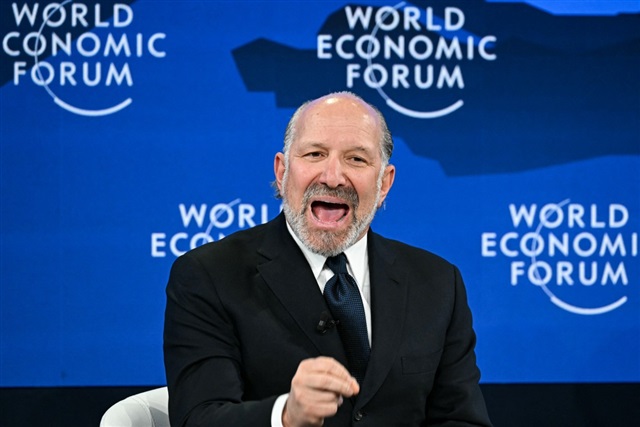
US Commerce Secretary Howard Lutnick is driving a fundamental reordering of the global semiconductor supply chain. According to exclusive analysis from DIGITIMES analyst Luke Lin, the administration has shifted its pressure campaign away from advanced logic chips and toward memory, delivering a blunt ultimatum to South Korea's two dominant producers: build wafer fabs in the US or face tariffs of up to 100%.
The policy tilt immediately reshapes competitive dynamics. US-based Micron Technology stands to emerge as the primary beneficiary, while Taiwan has secured what insiders describe as a strategic "hall pass" from Washington, an arrangement that contrasts sharply with the demands now placed on Seoul.
Lutnick has repeatedly framed the objective in sweeping terms. The administration wants the US to account for 40% of global semiconductor production capacity. That ambition is already being addressed in logic chips, where Taiwan Semiconductor Manufacturing Co.(TSMC) has committed to advanced manufacturing in Arizona. Memory, however, remains a glaring vulnerability. The US still depends heavily on imports of DRAM and NAND, a market dominated by Samsung Electronics, SK Hynix, and Micron.

Credit: US Department of Commerce
According to Lin, South Korean memory makers initially believed that targeted investments in US advanced packaging would satisfy Washington's expectations and preserve their access to most-favoured-nation treatment.
That assumption has now been overturned. A central reference point is SK Hynix's April 2024 pledge to invest US$3.87 billion in an advanced packaging facility in West Lafayette, Indiana, focused on high-bandwidth memory for AI processors. The project, distinct from Samsung's larger logic-oriented foundry expansion in Texas, was designed to localise a critical part of the AI supply chain and was premised on roughly US$450 million in federal support under the CHIPS and Science Act.
From the administration's perspective, such commitments fall short. The Trump team has reportedly dismissed packaging projects, arguing that they are inadequate and amount to symbolic gestures rather than genuine reshoring. Full-scale wafer fabs—facilities that actually manufacture memory chips—typically require investments five to ten times larger.
"The message to Korean firms is clear," Lin said. "If you don't manufacture the memory wafers here, you pay 100% tariffs."
That position effectively rewrites the meaning of equal treatment. In the administration's view, market access is no longer determined solely by nationality but by reciprocal investment. Without multibillion-dollar wafer fabs on US soil, Korean memory chips entering the American market could be subject to prohibitive duties, creating immediate pressure on Seoul's flagship technology companies.
The contrast with Micron could not be sharper. As a domestic producer that has already aligned its expansion plans with US industrial policy, Micron is expected to receive preferential quota treatment. Lin believes the new tariff regime will likely be applied on a company-by-company basis rather than strictly by country.

Credit: US Department of Commerce
That distinction creates a powerful regulatory opening: Micron could ship chips from its own overseas fabs in Taiwan and Japan either duty-free or within generous quotas, effectively treating them as extensions of its US capacity.
Recent corporate moves reinforce that interpretation. Micron's acquisition of a facility in Tongluo, Taiwan, from Powerchip Semiconductor Manufacturing Corp.(PSMC) has been publicly framed as a technology partnership. Lin sees it more as a pragmatic asset purchase, aimed at rapidly installing equipment and expanding output for the US market before a tariff barrier takes full effect.
Taiwan's broader treatment under the policy framework has surprised many observers. Commerce Department documents cite a US$250 billion investment commitment from Taiwan, covering semiconductor fabs and related guarantees. Lin characterises the figure as a diplomatic "softball" rather than a hard demand.
"The US essentially looked at the answers Taiwan had already written and then wrote the test questions to match," he said.
The headline number appears to aggregate existing commitments rather than impose a wholly new burden. It includes TSMC's previously announced investment plans, such as the US$65 billion pledged under the previous administration, as well as extensive use of government-backed credit guarantees that allow Taiwanese firms to finance projects without injecting equivalent new equity.
By comparison, South Korea has been pressed into a far more complex package—reportedly totalling US$500 billion—that even includes obligations to support the revival of US shipbuilding, an industry in which America currently lacks competitiveness. Taiwan, with semiconductors as its single overriding strategic asset, was offered a streamlined arrangement that largely formalises investments already in motion.
A further layer of intrigue comes from Micron's boardroom. Former TSMC chairman Mark Liu, now a Micron board member, has recently disclosed a substantial personal purchase of Micron shares. Lin notes that while insider buying is often a signal of confidence, the scale of Liu's investment invites speculation about a deeper role.
"If the shareholding is substantial, it could be a hint that Micron values him for a higher executive role," Lin said.
Given Micron's deepening integration with Taiwan's supply chain, including prospective collaboration with TSMC on base dies for next-generation high-bandwidth memory, Liu's experience would provide a natural bridge between US manufacturing imperatives and Taiwanese operational expertise.
Beyond individual companies, Lin expects the policy to accelerate a more decisive decoupling of supply chains. By 2028, North America—principally the US and Mexico—is projected to account for the bulk of AI server assembly for US customers. That shift would pull along demand for mature-node components used on server boards and peripherals.

Credit: US Department of Commerce
The implications are already being felt in Taiwan. TSMC, constrained more by shortages of experienced engineers than by equipment, is consolidating its domestic operations. Older production lines are being phased out or repurposed for advanced packaging, while some used equipment is being sold to Vanguard International Semiconductor.
The aim is to redeploy skilled staff toward advanced packaging lines and overseas fabs, ensuring compliance with increasingly stringent "Made in America" requirements without derailing the company's technology roadmap.
Lin also points to a critical diplomatic moment that helped shape today's outcome: the timing of TSMC chairman and CEO C.C. Wei's White House visit last year.
The visit came days after a fraught meeting between President Trump and Ukraine's Volodymyr Zelenskyy, which reportedly left Trump feeling slighted. Wei's arrival, accompanied by a large investment pledge, provided a sharply contrasting narrative.
Lin argues that this episode generated personal goodwill toward the Taiwanese chipmaker, which has since translated into policy flexibility. Although the new headline target stands at US$250 billion, the administration is reportedly allowing TSMC to count its previously committed US$165 billion toward that total—giving Trump a politically resonant number while sparing the company from the full weight of a fresh obligation.
Article edited by Jack Wu