
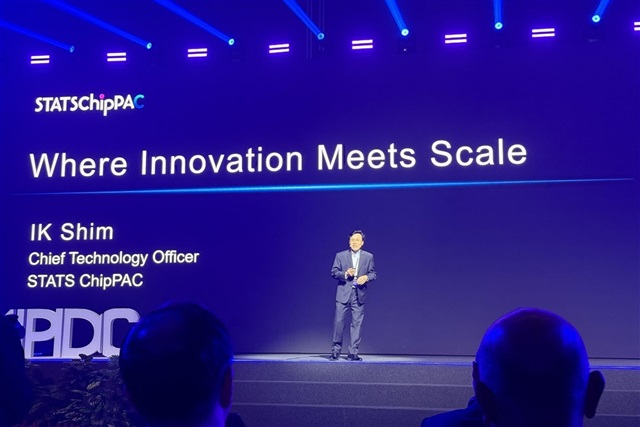
IK Shim, Chief Technology Officer of STATS ChipPAC, opened the 2025 Advanced Packaging Developers Conference (APDC) with a clear message: the semiconductor industry's greatest challenge is no longer invention itself, but turning invention into a manufacturable, scalable reality.
Welcoming distinguished guests, authors, and colleagues, Shim said this year's theme—"Where Innovation Meets Scale"—captures the core dilemma facing chipmakers as the pace of technological change accelerates. The semiconductor landscape, he observed, is advancing at an unprecedented rate, demanding ever more complex, multi-level integrations and dramatic improvements in power efficiency. "The real challenge," Shim declared, "is not just innovation—but scaling innovation."
Innovation architectures demand volume production
Shim outlined a set of foundational technologies shaping what he called the "systems of tomorrow," emphasizing the urgent need to bring complex 2.5D, 3D, and emerging 3.5D architectures into volume production. These structures, he noted, will underpin the high-bandwidth, high-density computing systems required for the AI and high-performance computing (HPC) era. Among the most critical areas of development are ultra-fine pitch interconnection technologies that enable higher bandwidth and lower latency, thermal and power management innovations to maintain energy efficiency, and manufacturing scalability to ensure cost competitiveness and mass adoption.
Chiplet integration and power delivery advances
To support these advances, Shim discussed several enabling technologies now driving the next generation of packaging. Heterogeneous chiplet integration, initially through chip-on-panel approaches and eventually via hybrid bonding, will be crucial for building high-density modules. Hybrid bonding, including integrated die-to-wafer solutions, features prominently on the APDC agenda this year. Vertical power delivery through advanced substrates and interposers—including PGB structures—will enhance electrical performance, while embedded power regulators and efficient voltage management systems represent new frontiers that require close cross-industry collaboration.
Optics meet electronics in next-gen data centers
Shim also pointed to co-packaged optics (CPO) as a pivotal development for integrating photons and electronics, enabling optical fiber connections directly to chips—an essential advance for next-generation data centers. Fan-out panel-level packaging (FOPLP) will likewise be indispensable for large-scale AI and HPC devices, which require package footprints many times larger than conventional designs. Related sessions at APDC will focus on high-density redistribution layer (RDL) fabrication using photo-imageable dielectrics. Looking ahead, Shim said multi-dimensional heterogeneous microsystem integration will tie these innovations together, combining diverse materials and architectures into unified, high-performance modules.
Together, these advances are setting the stage for what Shim described as "the next era of computing connectivity and intelligent devices." Many of these topics, he added, would be explored in detail during APDC's afternoon breakout sessions.
Ecosystem collaboration drives packaging innovation
A key theme of Shim's address was that no company can meet these challenges alone. The next phase of packaging innovation, he argued, depends on a deeply interconnected ecosystem spanning equipment suppliers, materials developers, research institutions, and academia. Equipment partners are indispensable for achieving automation, data integration, and manufacturing efficiency—elements that allow complex packaging processes to scale reliably. Materials partners are driving progress in advanced substrate interposers and thermal interface materials. Institutions and consortia, meanwhile, establish the standards and methodologies that help transform new ideas into shared industry practices, while universities remain the foundation for cultivating future engineers and enabling long-term research breakthroughs.
Shim concluded by reaffirming that technology leadership is built on application-driven innovation, partnership, and scale. He called for broader global research and development collaborations and joint development platforms to bridge the gap between conceptual breakthroughs and high-volume production. That, he emphasized, is the purpose of APDC itself—to bring together developers, engineers, and problem solvers from across the industry to transform ideas into manufacturable technologies that will define the next era of AI and high-performance computing.
Article translated by Joseph Chen and edited by Jerry Chen