
While ASML executives explore how to scale extreme ultraviolet (EUV) lithography output beyond 110 units by 2028, China is pursuing indigenous advanced lithography systems. ASML plans to produce at least 80 EUV tools in 2027 and is investigating a further capacity increase of approximately 30% in 2028 to satisfy massive global capital expenditure in artificial intelligence (AI) infrastructure. However, the prospect of domestic Chinese tools raises long-term uncertainty over the lithography landscape.
Surging AI infrastructure demand drives EUV tool expansion
Training and executing increasingly complex AI models requires immense computing power, driving demand for advanced AI accelerators that rely on leading-edge foundry nodes and high-bandwidth memory (HBM).
Fabricating advanced logic and modern memory devices requires increasingly lithography-intensive process flows. For leading chipmakers including TSMC, Samsung Electronics, Intel, SK Hynix, and Micron, expanded EUV availability is vital for ramping next-generation manufacturing capacity. Foundries continue to add capacity for advanced nodes to support explosive AI demand, while sustained adoption of HBM and DDR5 continues to bolster memory market growth.
China accelerates indigenous lithography timelines
In China, prospects for domestically developed advanced lithography tools are beginning to emerge as Beijing seeks to eliminate dependence on ASML. Consequently, ASML leadership faces dual pressures: managing aggressive global manufacturing expansion while monitoring China's domestic tool development milestones.
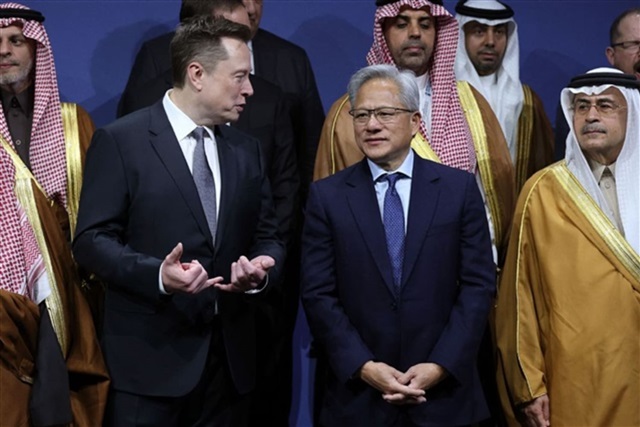
These concerns align with recent assessments by Nvidia CEO Jensen Huang and Tesla CEO Elon Musk. Musk predicted that advances in lithography and chipmaking could help China address its AI compute deficit within two to three years. Huang separately suggested that China could develop its own advanced lithography systems by around 2030.
During a recent public interview, Musk noted that China could address its computing constraints through advances in lithography and chip manufacturing within two to three years, far outstripping timelines estimated by Western industry observers. In an interview with CCTV Finance, Musk added that Chinese domestic AI large language models demonstrate high technical maturity, delivering real-world performance per unit of compute that ranks near global top-tier benchmarks.
Mass production capabilities threaten global tool dominance
At a recent technology summit, Huang addressed questions regarding China's semiconductor self-sufficiency timelines. Huang predicted that China could develop its own advanced lithography systems by around 2030.
Huang emphasized that once fundamental technological breakthroughs mature, domestic Chinese vendors could draw on their strength in high-volume manufacturing. He argued that deployment and scale-up of indigenous equipment across local fabs would then be a matter of time.
If China succeeds in developing advanced lithography tools, they could strengthen the domestic chip supply supporting its expanding AI ecosystem, a strategic trajectory that tech leaders and policymakers alike are closely monitoring.
Article translated by Yunnie Cheng and edited by Ysi Chen