

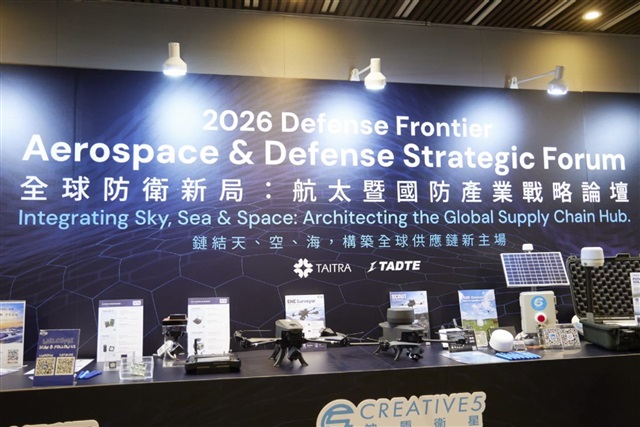
As defense technology and unmanned vehicles increasingly extend beyond traditional defense industries into the ICT and semiconductor sectors, Taiwan's manufacturers are being urged to go beyond the role of component suppliers and strengthen their system integration (SI) capabilities. That was the message from Lo Cheng-fang, honorary chairman of the Asia UAV Additive Manufacturing Industry Association, at a forum on October 6.
Speaking at the "2026 Global Defense Outlook: Aerospace and Defense Industry Strategy Forum" hosted by the Taiwan External Trade Development Council (TAITRA), Lo said drones are, by nature, a system integration business, and components are not simply a case of "the stronger, the better." A good SI or full-system manufacturer must define specifications backward from the final product and mission requirements, rather than just assembling existing parts.
No one-size-fits-all parts
For example, even among multirotor drones, a long-endurance reconnaissance drone may need a motor with low power consumption to extend flight time, while an interception drone may only need to fly for a few minutes but must deliver extremely high speed. The material, voltage, discharge coefficient and performance requirements for the two motors are completely different.
Lo said component makers should not chase a single product that can be used for everything, because excessive versatility can increase weight, cost and power consumption, ultimately dragging down overall drone performance. He added that propulsion systems, control units, communication modules, payloads, imaging and energy are all highly interconnected.
He likened the supply chain to a sports team working together, saying the key is not to maximize the performance of one critical component, but to ensure all parts coordinate effectively to achieve the final product target.
No shortcut to cheaper drones
Cost reduction is another challenge the industry must face collectively, Lo said. In recent years, the US defense system has focused on lowering the cost of unmanned systems, and the US-backed Drone Dominance Program (DDP) aims to cut the cost of small attack drones from the current US$5,000 to US$2,300.
Lo said such a sharp cost reduction cannot be achieved simply by scaling up output. Every part of the supply chain must improve production efficiency, expand capacity and lower unit costs as the product scales. If even one component fails to keep up, it can become a cost bottleneck for the entire product.
He said the defense supply chain is fundamentally a collective project, which will further amplify the value of SI in the future. Strong interdependence among suppliers means that if any company fails to match the cost and scale-up pace of the others, it can affect the overall competitiveness of the industry.
Lo, who previously served as chairman of Geosat Aerospace & Technology, is now honorary chairman of the association and has been actively organizing the industry. One of his tasks is to help domestic component makers unite around common goals rather than work alone to optimize their own products.
Article edited by Jerry Chen