
Samsung Electronics is showing renewed momentum in the AI memory race as it deepens ties with both OpenAI and AMD, two partnerships that could strengthen its position in the next-generation HBM4 ecosystem after ceding early ground in AI memory to rival SK hynix.
A San Francisco sit-down
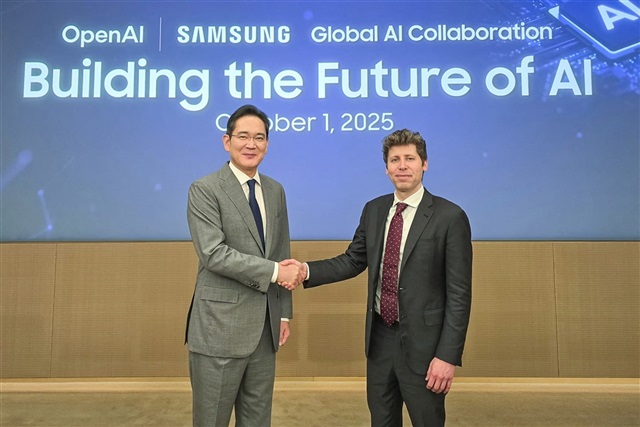
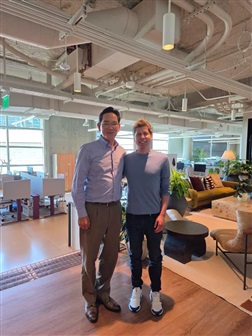
The latest development came on July 25, when Samsung Executive Chairman Lee Jae-yong met OpenAI CEO Sam Altman at OpenAI's headquarters in San Francisco, according to OpenAI and South Korean media including Yonhap News Agency. OpenAI did not disclose details of the meeting, but Korean media speculated that the two discussed expanding cooperation in AI infrastructure, including HBM, DRAM, advanced foundry services and broader semiconductor collaboration.
Credit: Yonhap News
Industry observers also believe the companies may have discussed Samsung's internal AI transformation. Samsung has become one of OpenAI's major enterprise customers, and OpenAI said in June that it would provide ChatGPT and its Codex coding assistant to all Samsung employees in Korea and to all employees of the company's Device eXperience Division worldwide, as part of Samsung's effort to integrate generative AI into its operations.
The meeting reflects an increasingly close relationship between the two companies. Samsung and OpenAI announced a strategic partnership in October 2025 to expand advanced memory production and jointly accelerate next-generation AI infrastructure. Samsung said the collaboration would focus on advanced memory technologies and AI infrastructure, while Reuters later reported Samsung was expected to supply HBM4 memory for OpenAI's first in-house AI chip, citing the Korea Economic Daily.
OpenAI has also described its framework with the South Korean government, Samsung and SK hynix as the first publicly announced national-level strategic AI partnership in the Asia-Pacific region.
The July meeting came one day after Altman met South Korean President Lee Jae-Myung and attended an AI summit in San Francisco, underscoring South Korea's growing importance in OpenAI's global AI infrastructure strategy. The summit, held on July 24, also drew Samsung's Lee alongside SK Group Chairman Chey Tae-won and Hyundai Motor Group Chairman Chung Eui-sun, and formed part of President Lee's US itinerary, which included separate meetings with Nvidia CEO Jensen Huang and Anthropic CEO Dario Amodei.
Credit: Samsung
AMD edges toward a contract
Samsung is simultaneously making progress with another major AI customer.
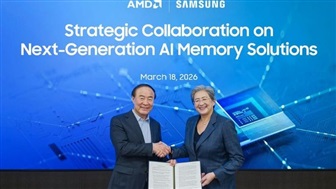
AMD Chair and CEO Lisa Su said on July 23, in interviews following AMD's Advancing AI 2026 event, that a definitive HBM4 supply agreement with Samsung is "almost close" to completion, according to Seoul Economic Daily and Wccftech. Her comments suggest the companies are moving beyond the memorandum of understanding signed in March toward large-scale commercial supply.
The March agreement, reached during Su's visit to Samsung's Pyeongtaek semiconductor campus, designated Samsung as AMD's primary HBM4 supplier for the Instinct MI455X, while also covering next-generation DDR5 memory for AMD's EPYC processors and the Helios platform and expanding discussions on potential foundry cooperation. Primary supplier status does not imply exclusivity, and neither company has disclosed pricing or volumes. Reuters reported at the time that Samsung would supply HBM4 memory for AMD's next-generation accelerators while both companies explored broader manufacturing collaboration.
Su's latest remarks indicate negotiations have progressed from a framework agreement toward final commercial contracts, potentially positioning Samsung as one of AMD's key HBM4 suppliers as production ramps up.
Credit: AMD
AMD Helios sets the clock
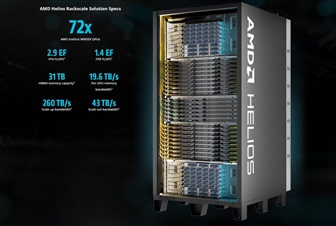
The timing is significant because AMD has already moved its Helios AI rack platform into production with Samsung memory inside it. Su said shipments would begin late in the third quarter of 2026 and expand in the fourth quarter. A finalized HBM4 supply agreement would lock in volumes for AMD's next wave of AI accelerator deployments.
Each Helios unit is sold as a complete cabinet rather than as individual chips, combining 72 Instinct MI455X accelerators with processors, networking equipment and cooling. AMD specifies up to 432 gigabytes of HBM4 per accelerator, or roughly 31 terabytes across the rack. Samsung's mass-produced HBM4 carries 36GB in a 12-layer stack, and the company produced the logic die beneath the memory stack on its own 4-nanometer foundry process.
South Korean media also reported that Samsung executives, including Samsung Foundry President Han Jin-man and Samsung Device Solutions America President Sangyeun Cho, attended Su's keynote and held discussions afterward with AMD Corporate Vice President and Product Chief Technology Officer Joe Macri and other executives. While Samsung executives declined to comment on contract negotiations, saying only that an important meeting with AMD would take place soon, Macri described the companies as maintaining a "cooperative relationship" when asked about HBM supply and potential foundry manufacturing.
The developments suggest Samsung's relationship with AMD is extending beyond memory into broader semiconductor cooperation, although neither company has announced any foundry agreement.
Catching up to Nvidia
The AMD and OpenAI partnerships represent an important strategic shift for Samsung.
Samsung entered the generative AI boom at a disadvantage after failing to secure a meaningful share of Nvidia's HBM supply chain, allowing SK hynix to emerge as the dominant supplier of HBM used in Nvidia's AI accelerators. Counterpoint Research data cited by Reuters put SK hynix at 53% of the HBM market in the third quarter of 2025, ahead of Samsung at 35% and Micron at 11%, while Samsung has worked to regain competitiveness through its HBM4 products and advanced packaging technologies. Samsung began commercial HBM4 shipments in February 2026.
Winning AMD and OpenAI therefore provides Samsung with an alternative route into the expanding AI infrastructure market, reducing its reliance on Nvidia-driven demand while positioning HBM4 as the centerpiece of its comeback strategy.
Where the two deals meet
The partnerships may also reinforce one another. OpenAI has become one of AMD's largest AI infrastructure customers, while Reuters reported Samsung is expected to supply HBM4 both for AMD's next-generation accelerators and OpenAI's custom AI processor. If both projects proceed as expected, Samsung could benefit directly from supplying OpenAI's proprietary chips and indirectly through AMD-powered AI systems deployed by OpenAI.
The momentum extends beyond those two customers. South Korean media reported on July 26 and 27 that Samsung had signed a memorandum of understanding with Broadcom worth about US$200 billion through 2030, spanning HBM supply and sub-2-nanometer foundry work, as part of a broader round of AI chip supply agreements involving both Samsung and SK hynix.
Taken together, Samsung's recent engagements with AMD and OpenAI suggest the company is beginning to establish a broader AI ecosystem strategy centered on next-generation memory, advanced packaging and potentially foundry services, as competition expands beyond Nvidia's AI hardware platform. They also sit within a wider South Korean effort, on display at the San Francisco summit, to be regarded less as a supplier of memory and chip hardware and more as a core partner in AI infrastructure, manufacturing applications and industrial policy.
Article edited by Jack Wu