South Korean President Lee Jae-myung and a delegation of the country's most powerful business leaders convened with NVIDIA founder and CEO Jensen Huang in Silicon Valley this week, in a series of meetings and public appearances that cast Korea as a cornerstone of the global AI infrastructure push.
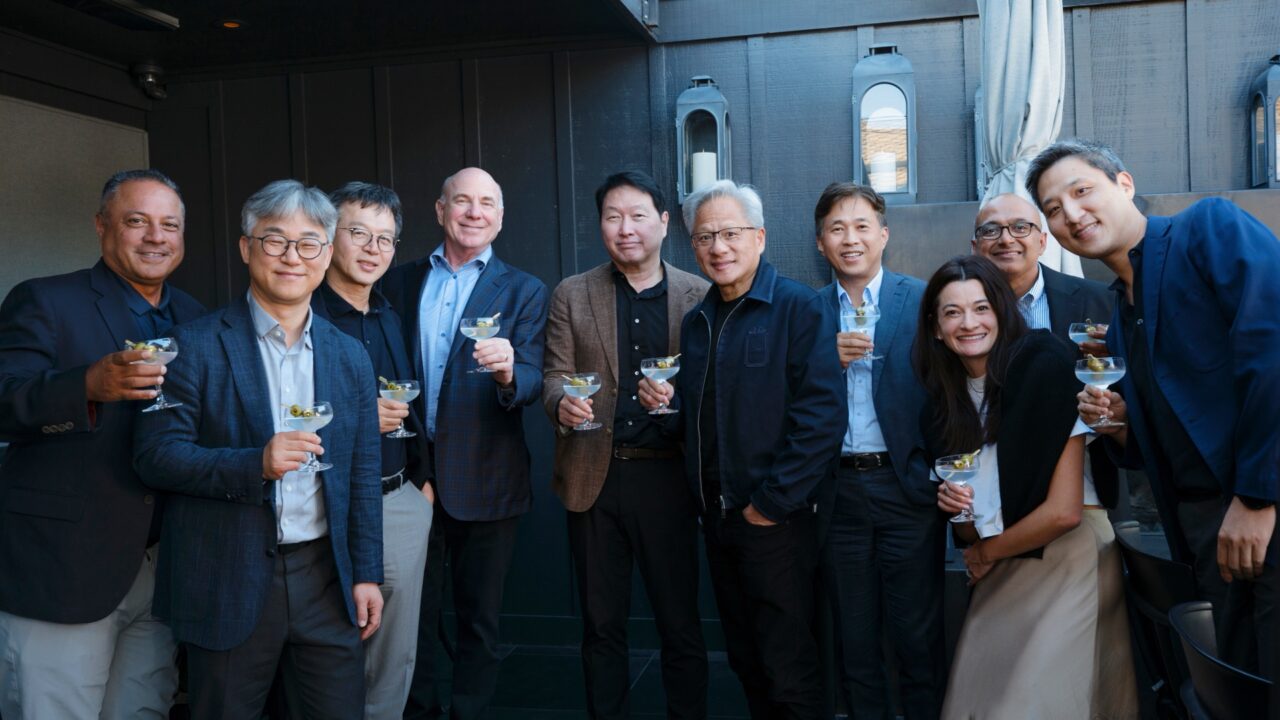
The gatherings began Thursday evening, July 23, when Huang hosted SK Group Chairman Chey Tae-won along with executive teams from SK hynix and SK Telecom for dinner in Woodside, California — a warm-up to the main event and a reflection of the two groups' deepening memory chip partnership, which was formally expanded in June to cover codevelopment of memory for NVIDIA platforms spanning AI infrastructure, personal AI and physical AI.
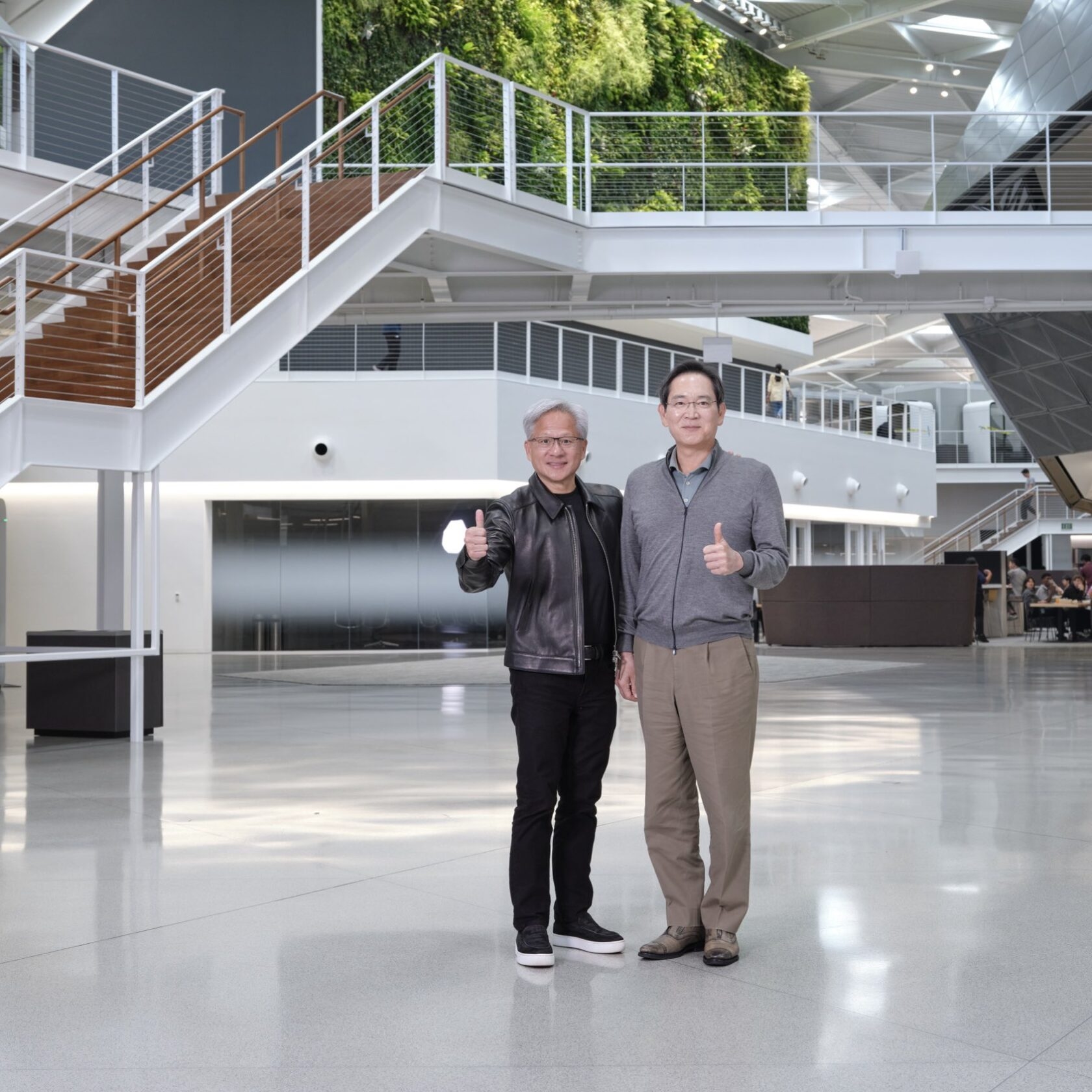
Friday afternoon brought a smaller but symbolically significant visit: Samsung Executive Chairman Lee Jae-yong, Hyundai Motor Group Executive Chairman and CEO Euisun Chung, and NAVER founder and Chairman Lee Hae-jin joined Huang for a tour of NVIDIA's headquarters in Santa Clara. The Korean executives posed for photos with Huang in the lobby of the Endeavor building — whose angular design references the triangles that underpin modern computer graphics — as NVIDIA employees worked around them.
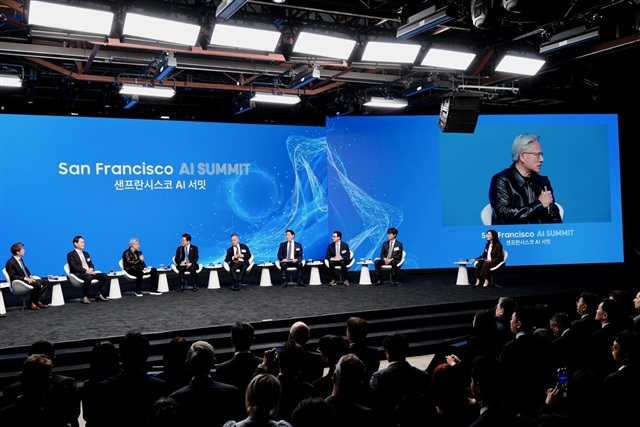
The summit's main event arrived Friday evening at the Midway, a premier venue in San Francisco's Dogpatch district. Moderated by Stanford University's Soh Kim, the stage brought together an unusually dense concentration of global AI and compute leadership.
Credit: Nvidia
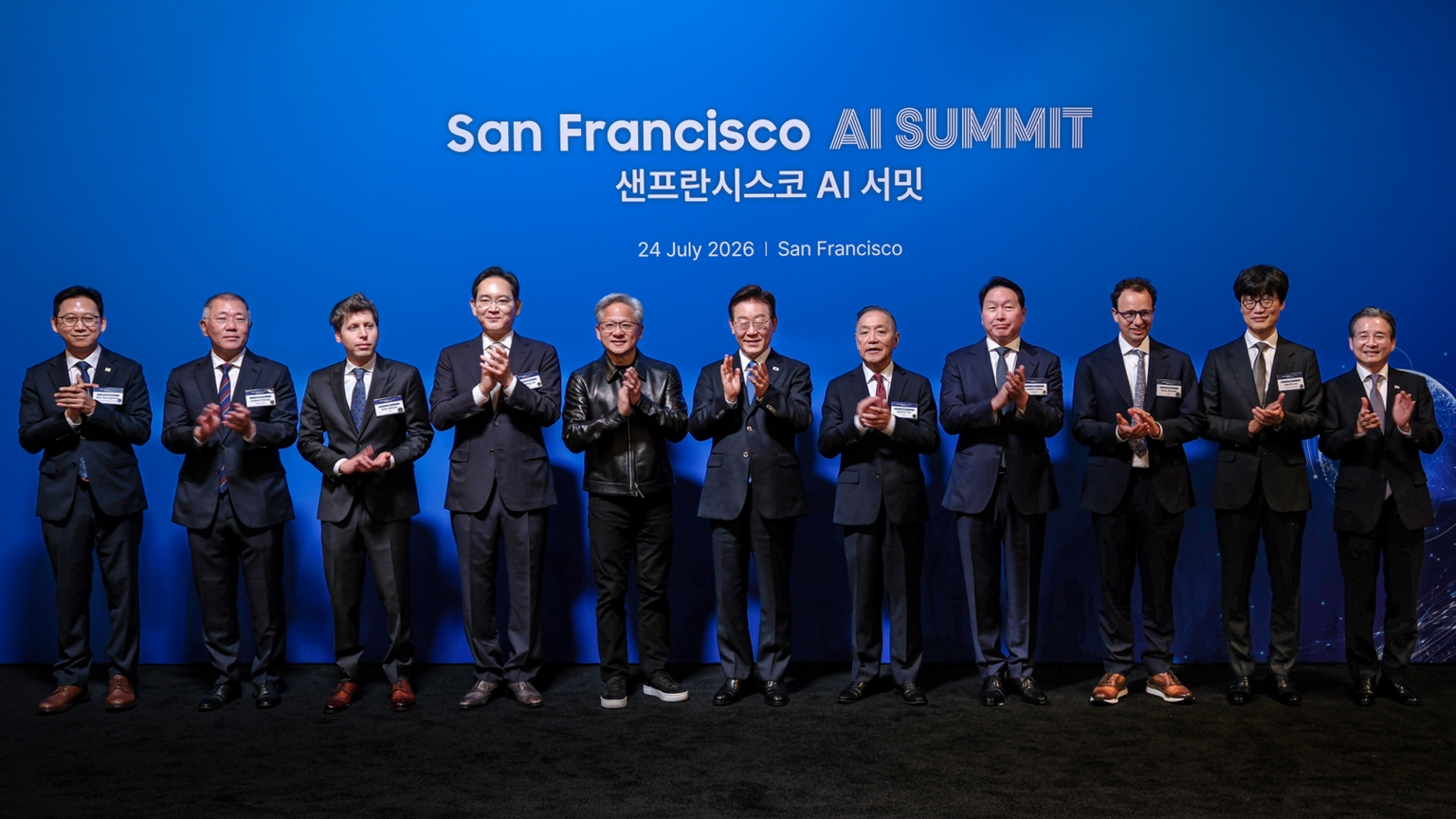
Alongside President Lee and Huang stood OpenAI CEO Sam Altman, Broadcom CEO Hock Tan and Anthropic CEO Dario Amodei — the American side of what has become a tightly interlocked AI supply chain. Korea's industrial vanguard filled out the other half: Samsung's Lee Jae-yong, SK's Chey Tae-won, Hyundai's Euisun Chung and NAVER's Hae-jin Lee. The companies represented on stage carry a combined market capitalization exceeding 20 quadrillion Korean won.
President Lee opened with what he called the "San Francisco AI Declaration," a sweeping address that drew a deliberate parallel between San Francisco's resurrection from the 1906 earthquake and Korea's own transformation from one of the world's poorest nations after the Korean War into an IT powerhouse. "The AI revolution is not a story of the future," he said. "It is the present we are all building together."
The declaration was built around four pillars. First, Korea would become an indispensable node in the global AI supply chain — a reliable semiconductor production base and supply chain partner, backed by the June announcement of approximately 4,700 trillion won ($3.4 trillion USD) in AI project investment and a shift toward a multi-polar domestic production system spanning the capital region and provincial areas.
Second, Korea would become the fastest nation to deploy AI across industry and daily life — positioning itself as a global AI testbed and production platform, with an "AI for All" national project targeting all 50 million citizens set to launch before year's end, covering public administration, welfare and education.
Third, Korea would act as a global hub expanding AI markets beyond the leading nations, working with international organizations under the banner of "AI for All, AI to solve humanity's challenges," and building horizontal cooperation networks with developing countries to generate new talent, ideas and markets.
Fourth, and most ambitiously, Lee called for a human-centered AI order — pointing to Korea's AI Basic Law, enacted in January this year, and introducing the concept of an "AI Basic Society" in which small businesses, vulnerable populations and ordinary citizens share in AI's benefits rather than being left behind.
Lee was pointed about the stakes of supply chain stability, telling the audience that even the world's most advanced AI model cannot function without a reliable supply of advanced semiconductors — and that even the most advanced chip creates no value without the massive demand that AI now generates. He called on global companies to choose Korea as their innovation and investment stage.
Huang matched the ambition. Tracing a 25-year partnership — from seeding Korea's gaming culture to the high-bandwidth memory chips that make modern AI systems possible — he put it plainly: "If not for the invention of HBM memory in Korea, NVIDIA wouldn't have been able to invent the supercomputers that power AI today. This really is the golden age for Korea."
Chey offered a candid window into the scale of demand. Every time he has dinner with Huang, Chey said, Huang tells him "more chips" — and he predicted that whatever number Huang quoted that day, he'd ask for more the next time they met.
Altman was equally direct: "There really would not have been what we have, this incredible AI revolution, without Korea."
Amodei said Korea plays a role "throughout the stack, from semiconductors to infrastructure to an incredible concentration of talent."
President Lee closed with a reference to the 1990s American sitcom Friends — "I'll be there for you, because you'll be there for me" — and likened the assembled global business leaders to the Golden Gate Bridge, connecting the world across divides.
Anchoring the week's announcements was a newly established joint AI research lab between NVIDIA and the Korea Advanced Institute of Science and Technology (KAIST), to be housed at the KAIST Kim Jaechul Graduate School of AI in Seoul. It is the first such lab between a Korean university and any global technology company, and will draw on NVIDIA's Nemotron open models and AI cloud computing infrastructure alongside KAIST's research faculty.
Credit: Nvidia
Reading between the lines
NVIDIA's publishing choices tell a story the press releases don't.
SK Group got the dinner. The evening before the summit, SK Group Chairman Chey Tae-won and the SK hynix and SK Telecom teams gathered with Huang in Woodside — a private, unhurried setting that NVIDIA chose to highlight in its own PR blog, not just in a joint release. That placement matters. When a company controls its own narrative and still leads with a partner's name, it is signaling relationship depth, not just deal flow.
Samsung's Lee Jae-yong, by contrast, got a photo in a lobby. He appeared at the Santa Clara campus tour and was mentioned in the coverage — but briefly, almost in passing.
Credit: Nvidia
More telling: when Huang visited Korea last month, Lee Jae-yong was not in the room. For the chairman of the world's largest memory chipmaker to be absent from that visit, and then present but peripheral in San Francisco, suggests the Samsung-NVIDIA relationship is being managed at the operational level rather than the chairman level — or that there is active distance between the two that neither side is advertising.
SK hynix has pulled ahead of Samsung in HBM supply to NVIDIA. President Lee's speech acknowledged as much without naming names, noting that SK hynix had recently completed a successful NASDAQ listing after reaching the top of the global HBM market. The social calendar appears to reflect that hierarchy. Dinners in Woodside are not given to vendors. They are given to partners. The distinction, in Jensen Huang's world, is everything.
Article edited by Joseph Chen