
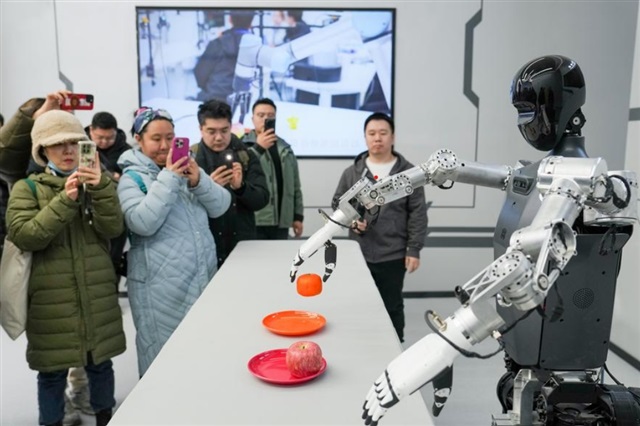
China's embodied AI sector is entering a financing cycle that increasingly resembles the early days of electric vehicles. Investors, local governments, and technology groups are backing robotics companies that could translate AI into machines for factories, warehouses, public services, and eventually homes.
Morgan Stanley forecasts the global humanoid robot market could reach US$7.5 trillion by 2050, with China accounting for 30% of global adoption. That has made embodied AI one of the clearest commercialization stories in the next phase of AI.
Capital is moving fast. Unitree Robotics, valued at CNY42 billion (US$6.19 billion), has cleared its listing review, setting what is described as the fastest A-share IPO record. Deep Robotics, valued at CNY13.9 billion, and Leju Robotics, valued at CNY4.3 billion, are also seeking listings on the STAR Market and ChiNext. In Hong Kong, nearly 50 robotics companies are waiting to go public, accounting for more than 10% of IPO applicants, 36Kr reported.
Private markets are also surging. From January to May 2026, China's embodied AI sector recorded more than 230 funding events worth over CNY57 billion. Astribot completed three rounds in three months, raising more than CNY1 billion and lifting its valuation above CNY10 billion. Spirit AI raised CNY1.5 billion in an A+ round after four rounds in three months, bringing total fundraising to about CNY5 billion and pushing its valuation above CNY20 billion.
The logic is straightforward: capital is hunting for the next monetizable AI frontier after large models and computing infrastructure. China's 15th Five-Year Plan outline has called for embodied AI to become a new growth engine. The question is whether robotics can produce China's next "EV moment," when domestic supply chains, policy support, and aggressive deployment helped local EV makers scale after Tesla catalyzed the market.
Supply chains cut robot costs
Tesla's Optimus is moving toward mass production with heavy reliance on China's supply chain, while Chinese robotics companies are driving down hardware costs. In humanoid robots, motors and drives account for about 35% of costs, sensors 10%, dexterous hands 18%, and reducers 20%. Even Tesla's Optimus reportedly sources more than 70% of its components from Chinese suppliers.
Unitree has built its cost edge through self-developed motors, reducers, and dexterous hands. Its Go2 Air quadruped robot is priced below CNY10,000, while the basic G1 humanoid robot sells for CNY85,000. Boston Dynamics' Spot costs about US$74,500, or roughly CNY500,000, while Figure 02 is priced at about US$59,000, or roughly CNY420,000.
Component prices are also falling. From 2023 to 2026, domestic harmonic reducers fell from CNY3,000–5,000 per unit to CNY1,500–2,000. Servo motor prices dropped by more than 40%, while six-axis force sensors fell from above CNY5,000 to CNY1,500–2,000. Core component costs have generally fallen by more than 50%, cutting the hardware cost of a single humanoid robot by CNY100,000–200,000, according to Securities Times.
Cheaper hardware is only the entry ticket. Robots for homes, retail, and general services remain expensive, return-on-investment cycles are long, and buyers remain cautious.
Robot intelligence becomes the real race
China's early strength was in manufacturing and application scenarios, while the US led in models. That gap is narrowing as embodied AI shifts from single vision-language-action frameworks toward multimodal stacks combining VLA with world models.
Alibaba's AMap has launched embodied robot training data and maps. ByteDance's Seed unit has reportedly made embodied AI a core focus and begun hiring robotics business leaders.
Spirit AI has become a model-first example. Founded in January 2024, it focuses on building a general-purpose robot "brain." On June 3, its Spirit v1.6 embodied foundation model ranked first on RoboArena, outperforming Nvidia Cosmos3 and Physical Intelligence's Pi0.5.
Founder and CEO Han Fengtao said Spirit AI's latest funding will be used roughly equally for model training, data reserves, and talent recruitment. The company aims to reach a 95% task success rate after only one hour of fine-tuning and accumulate one million hours of real-world interaction data in 2026.
Yet benchmark performance is not industrial reliability. Models that work in controlled tests can struggle on factory floors, where lighting, material deformation, and equipment wear affect outcomes. Spirit AI's cooperation with CATL, JD.com, and Bosch is still mostly pilot-based, with large recurring orders yet to emerge.
Commercialization comes first
Business applications are moving faster than consumer markets. Deep Robotics' revenue rose from CNY50 million in 2023 to CNY337 million in 2025, with gross margin reaching 52.83% and net profit turning positive at CNY29 million.
Unitree's revenue rose from CNY159 million in 2023 to CNY1.699 billion in 2025. Its gross margin reached 60.13%, while net profit hit CNY278 million, up 191% year on year.
Pressure appeared in the first quarter of 2026. Unitree's revenue rose 68.49% to CNY423 million, but net profit excluding non-recurring items fell 52.55% to CNY40.52 million. From January to September 2025, research and education accounted for 73.6% of Unitree's humanoid robot revenue, while industry applications accounted for only 9.01%.
That makes industrial deployment the real test. Deep Robotics, Unitree, Ubtech, and AgiBot are moving toward manufacturing, logistics, and inspection. State Grid could become a major early customer, with reported 2026 procurement plans worth CNY6.8 billion for about 8,500 embodied AI devices.
Policy support brings speed and risk
Local governments are central to China's embodied AI buildout, providing land, guidance funds, industrial bases, data collection centers, and early application scenarios. More than 20 provinces and cities have listed embodied AI as a priority, while guidance funds have exceeded CNY100 billion, Leaderobot.com reported.
The model recalls Hefei's long-cycle support for CXMT, a reference for how government capital can build strategic industries. For embodied AI, public capital can function as industrial infrastructure if it supports real supply chains, jobs, technology localization, and deployment.
Data is the next bottleneck. Embodied AI needs force, tactile, trajectory, and manipulation data that cannot be scraped from the internet. Ma'anshan and Zigong are already building robot training fields and data collection centers to fill that gap.
The opportunity is large, but the risk is clear. China has more than 150 humanoid robot companies, with more than half being startups or cross-sector entrants. Its embodied AI market was only about CNY5.3 billion in 2025, while 2030 forecasts point to around CNY400 billion.
China's embodied AI sector may yet repeat the EV miracle. But the winners will not be those that raise the most money or build the most industrial parks. They will be the companies that combine core technology, government resources, capital discipline, and reliable delivery — then prove robots can create measurable economic value beyond pilots and policy-backed showcases.
Article edited by Jerry Chen