

CONNECT WITH US

Research insight: Taiwan's auto tech pushes beyond components into autonomous systems

Jessie Lin, Taipei
0

Credit: DIGITIMES

A DIGITIMES Research observation at the 2026 Taipei International Auto Electronics Show found that Taiwan's automotive electronics industry is steadily shifting from supplying individual components toward integrated systems spanning autonomous driving sensors, in-cabin safety, autonomous logistics vehicles, and localized supply-chain integration.

Unlike earlier editions of the exhibition, which primarily showcased discrete parts, this year's show highlighted a more ambitious direction: Taiwanese suppliers are beginning to link sensors, in-cabin monitoring systems, autonomous driving components, and full vehicle platforms into more unified solutions.

Upgrading vehicle sensing: infrared AI and radar fill safety gaps

As autonomous driving and advanced driver-assistance systems (ADAS) evolve, competition in vehicle sensing is increasingly defined not by the number of sensors deployed but by their ability to maintain reliable performance in high-risk environments — such as night driving, rain, fog, backlighting, and blind spots around large vehicles.

Compal Electronics subsidiary Sylux showcased an infrared AI sensing system that illustrates how Taiwanese firms are extending beyond traditional imaging sensors toward redundancy systems designed for low-visibility scenarios. Its product line is structured into Core, Plus, and Prime tiers, corresponding to Level 2 through Level 4 autonomous driving applications. The Core line targets entry-level safety sensing, while Plus and Prime offer improved resolution and field of view for more advanced detection needs.

Rather than replacing cameras or radar systems, these solutions are designed to complement them, filling critical perception gaps in conditions where conventional sensors struggle.

Separately, Whetron is pursuing a multi-sensor strategy that includes edge AI imaging, 60 GHz in-cabin radar, and 77 GHz blind-spot radar for commercial vehicles. Its applications range from unintended acceleration prevention and low-speed automatic emergency braking to child presence detection, seat occupancy sensing, driver monitoring, and blind-spot protection for heavy vehicles — underscoring a broader shift from external perception toward in-cabin safety and regulatory-driven features.

Smart cabins: from infotainment to safety platforms

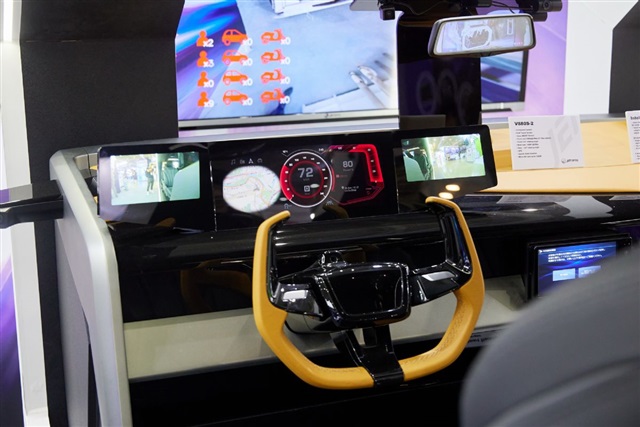
In-cabin systems, once focused on displays and entertainment, are increasingly being repositioned as safety and monitoring platforms. The Automotive Research & Testing Center (ARTC) highlighted how Taiwan's supply chain is moving toward vertical integration of cabin sensing technologies.

ARTC demonstrated integrated applications combining cameras and millimeter-wave radar inside the cabin, enabling driver gaze tracking, physiological monitoring, child presence detection, and sentry-style surveillance. When ADAS is active, in-cabin cameras continuously track driver attention, issuing alerts if prolonged distraction is detected and potentially initiating takeover functions. Millimeter-wave radar, meanwhile, can monitor heart rate and respiration while also supporting cabin safety and external surveillance modes.

This reflects a broader convergence of smart cabin systems with active safety functions, regulatory requirements, and vehicle control mechanisms.

ARTC also highlighted the breadth of Taiwan's supply chain supporting these systems, spanning AI chips, edge computing modules, high-performance controllers, in-cabin imaging, radar modules, and smart displays. Key participants include Novatek Microelectronics, Elan Microelectronics, and MediaTek in cockpit chips; ASUS, VIA, Neousys, and Advantech in high-compute modules; and firms such as Chimei Automotive, oToBrite, and Whetron in imaging and sensing systems. Radar and display components are supplied by companies including Nutek, Tmytek, WNC, AUO, Pegatron, and General Interface Solution, among others.

ET35: a blueprint for deep supply-chain integration

China Motor Corporation's ET35 autonomous logistics vehicle emerged as a key case study of Taiwan's evolving automotive electronics ecosystem. The 3.5-ton autonomous delivery vehicle boasts a localization rate exceeding 90% and integrates 86 domestic suppliers across autonomous driving, electrification, connectivity security, vehicle manufacturing, and field validation.

The autonomous driving stack includes chips from Elan and Realtek Semiconductor, cameras from Chimei Automotive and oToBrite, radar from firms including CubTEK, Whetron, and WNC, LiDAR from Compertum Microsystem, and control systems from Inventec. System integration and cooperative positioning are handled by Kingwaytek.

The vehicle also integrates connectivity and cybersecurity systems, including telematics boxes, vehicle cybersecurity testing, and cloud security management. Participants include DFI Inc. for telematics, ARTC, TÜV, and Carota for cybersecurity testing, and EGK for cloud security services. Electrification components include batteries from Foxconn and motors from Shihlin Electric.

On the vehicle and deployment side, China Motor provides the platform, ARTC handles validation testing, and logistics operators such as HCT Logistics and momo participate in real-world operations. Elan also contributes smart intersection applications, and HCT Logistics operates an autonomous driving control center.

From components to systems: Taiwan's auto pivot

Overall, the 2026 Taipei International Auto Electronics Show underscored a structural shift in Taiwan's automotive electronics sector. As demand grows for ADAS, in-cabin safety systems, autonomous logistics, and commercial vehicle platforms, Taiwanese suppliers are moving beyond component-level participation toward system integration and application-level deployment across the automotive value chain.

Article translated by Elaine Chen and edited by Jerry Chen
