

CONNECT WITH US

Foxconn shoots for the stars — and Starlink's playbook

Ninelu Tu, Taipei
0

Credit: Foxconn

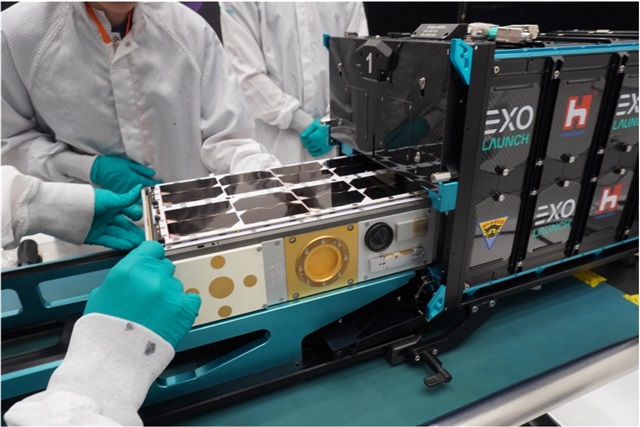
Foxconn's Hon Hai Research Institute has launched its second-generation low-Earth-orbit satellites, PEARL-1A and PEARL-1B, from Vandenberg Space Force Base in California aboard a SpaceX Falcon 9 rocket. The mission has entered an on-orbit validation phase as part of a satellite networking strategy.

The two satellites carry Ka-band inter-satellite link payloads and will fly in a front-and-back formation to verify direct satellite-to-satellite transmission. The mission will also test inter-satellite docking transmission and use a compact ionospheric probe to monitor the space communications environment.

Foxconn said this second-generation effort marks a shift in technical focus from its first-generation mission, which completed its phased operations in January 2026 after more than two years of activity.

Shift toward networked constellations

Competition in low-Earth-orbit broadband constellations is increasingly about linking satellite nodes in orbit and reducing dependence on terrestrial infrastructure. Inter-satellite link technology is a key competitive differentiator in SpaceX Starlink's second-generation constellation, and validating ISL on a small-satellite platform positions Foxconn to pursue networking capabilities beyond component manufacturing.

Foxconn described the PEARL program as a pathway to validate ISL ahead of wider deployment, signaling a move toward becoming a systems integrator. The company emphasized hands-on, on-orbit experience to refine next-generation satellite design and systems integration, rather than merely supplying parts.

First-gen groundwork and iterative design

Hon Hai Research Institute said that during the first-generation PEARL mission, it accumulated experience in orbital maneuvering, link tuning, and data validation through multiple ground receiving stations in Taiwan, Europe, and Svalbard, Norway. Operations were coordinated from its satellite control center in Neihu, and Foxconn said real-world, on-orbit feedback informed second-generation system design and iterative optimization.

The company framed those results as building a closed-loop development capability and other soft assets that are difficult to replicate. It also said it plans to increase in-house component production as part of a vertical integration strategy tied to systems integration and testing.

Next applications

With the second-generation PEARL satellites now in orbit, Foxconn intends to accelerate development of several use cases, including supplemental mobile communications, Direct-to-Cell services, connectivity for remote areas, industrial IoT, and backup communications for specific sites. The company said it will continue to assess market demand and technology maturity, prioritizing areas where it can leverage its manufacturing strengths and core systems integration, assembly, and testing capabilities.

Analysts noted that satellite systems integration and testing closely overlap with Foxconn's established contract design and manufacturing services model. Beyond raising the in-house production rate of components and pursuing vertical integration, the company is targeting core low-Earth-orbit commercialization opportunities, including Direct to Cell, rural connectivity, industrial IoT, and backup communications.

The mission places Foxconn among a growing set of companies pushing into space as industrial competition on the ground intensifies. By focusing on inter-satellite links and systems integration, the company aims to add higher-value technical services to its manufacturing portfolio and provide technical support to global satellite operators and partners.

Article translated by Jingyue Hsiao and edited by Jerry Chen