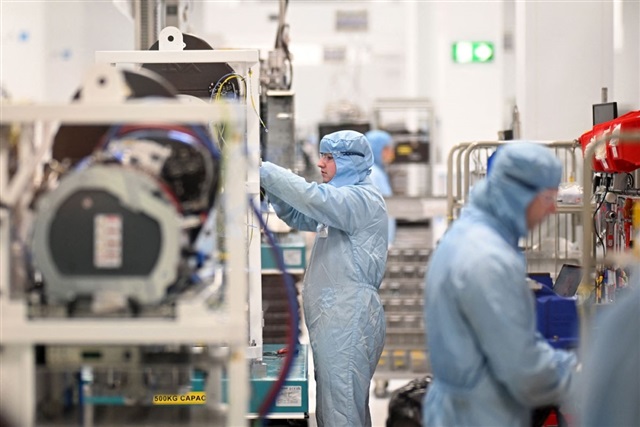
US semiconductor equipment maker KLA said growing AI infrastructure demand is accelerating investment in advanced logic chips, high-bandwidth memory (HBM), and advanced packaging, driving higher process control intensity, while supply constraints and cost pressures remain ongoing risks.
According to Reuters and MarketBeat, KLA posted revenue of US$3.3 billion in the second quarter of fiscal 2026 (ended December 2025), up 7% year-over-year and above market expectations of US$3.25 billion, while net profit climbed 39% to US$1.15 billion.
By business segment, KLA's services revenue reached US$790 million in the second quarter of fiscal 2026, rising 6% quarter-over-quarter and 18% year-over-year, extending a 16-year record of annual growth with a compound annual growth rate (CAGR) exceeding 12%, while product revenue totaled US$2.51 billion.
CFO Bren Higgins said on the earnings call that second-quarter revenue came in above the midpoint of prior guidance, while non-GAAP gross margin rose to 62.6%, supported by stronger services performance and improved manufacturing efficiency.
CEO Rick Wallace said rising chip system complexity has expanded process control requirements from wafers into advanced packaging. KLA has integrated AI-driven analytics into its solutions to streamline manufacturing workflows and shorten time to yield targets. Advanced packaging-related revenue within KLA's systems business reached US$950 million in 2025, up more than 70% year-over-year.
For the third quarter of fiscal 2026, KLA forecasts revenue of US$3.2 billion to US$3.5 billion, exceeding market expectations of US$3.28 billion.
Higgins said the wafer fabrication equipment (WFE) market is expected to expand to US$120 billion in 2026 and reach around US$135 billion when advanced packaging components are included.
However, shipments in the first half of 2026 are likely to be constrained by the limited availability of long-lead-time components such as optical parts and customer fab construction timelines, while rising DRAM costs used in imaging systems are placing short-term pressure on margins.
In the memory segment, Wallace said process control intensity has risen sharply for HBM-related DRAM production, driven by higher device value, tighter tolerance margins, increased metal layer counts, and broader adoption of advanced lithography, all requiring more frequent inspection and metrology to meet high-performance computing (HPC) standards.
On geopolitical developments, KLA expects its China market in 2026 to remain flat or post slight growth, amid localization efforts in China and continued adjustments to US export controls on advanced technologies.
Article edited by Jack Wu