
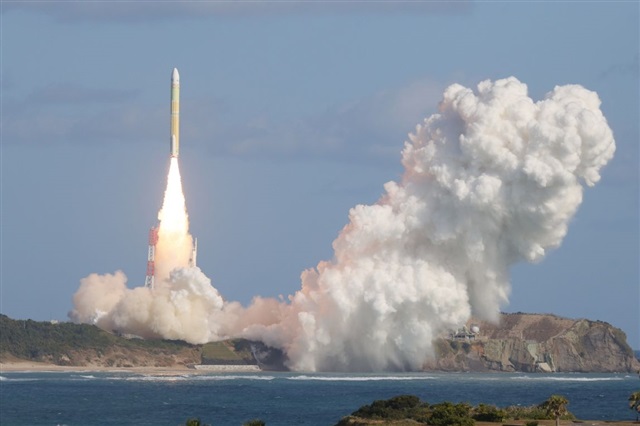
Japan's flagship heavy-lift rocket, the H3, suffered another setback on Sunday after its eighth flight failed, dealing a blow to the country's ambitions to strengthen its independent space capabilities.
After two postponements, the rocket lifted off at 10:51 a.m. on Dec. 22 from the Tanegashima Space Center in Minamitane, Kagoshima Prefecture. But the mission was aborted when the second-stage engine malfunctioned at high altitude, causing the burn to end prematurely. The rocket failed to reach its planned orbit, and the Michibiki-5 satellite it was carrying was unable to separate, preventing it from entering service.
According to reports by Nikkei and Sankei newspapers, Shigeki Kobayashi, head of the launch response task force and the State Minister of Education, Culture, Sports, Science and Technology, told reporters later that day that the government regretted the failure and would conduct a thorough investigation into its cause.
The Japan Aerospace Exploration Agency, or JAXA, said it was intensifying efforts to determine why the second-stage engine shut down earlier than expected. The incident marks the H3 rocket's second launch failure, following a similar second-stage problem during the launch of Michibiki-1 in March 2023.
The payload for the failed mission, Michibiki-5, was designed to support Japan's Quasi-Zenith Satellite System, a regional positioning network often described as Japan's version of GPS. Developed by Mitsubishi Electric and operated by the Cabinet Office, the satellite is intended for applications such as automotive navigation and location-based services.
Japan currently has five positioning satellites in orbit, including Michibiki-6, which was launched in February 2025. The government had planned to add Michibiki-5 and a seventh satellite scheduled for launch in February 2026, forming a seven-satellite constellation during fiscal year 2026. That system would have allowed Japan to achieve high-precision positioning using domestically built satellites, reducing its heavy reliance on the United States' GPS network.
The H3 rocket is intended to replace the H2A, Japan's previous mainstay launch vehicle, which is set to be retired in June 2025. Designed to compete in the rapidly expanding commercial launch market, the H3 aims to offer lower costs and greater operational flexibility to private-sector customers.
The eighth H3 mission was originally scheduled for Dec. 7 but was postponed after an anomaly was discovered in a rocket component during preparations. Although the rocket was placed on the launch pad on Dec. 16, engineers identified a separate issue with ground equipment, prompting a second delay.
It remains unclear whether the earlier technical problems were connected to Sunday's launch failure. JAXA officials said further analysis would be needed to determine whether the incidents shared a common cause.
Article edited by Jack Wu