

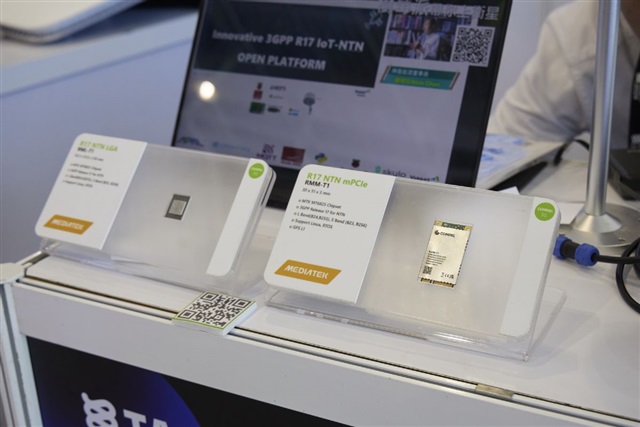
Space-related business opportunities have returned to the spotlight, and SpaceX is expected to go public in bringing data centers to space. Within Taiwanese IC design companies, MediaTek is leading in involvement and business scale in the satellite sector. It currently focuses primarily on satellite communications, maintaining influence in the formation of satellite broadband network standards and promoting direct-to-cell smartphone applications. Additionally, its subsidiary Airoha offers GNSS positioning chips, and its newly developed Ethernet chips have teamed up with MediaTek's Wi-Fi chips for satellite communication ground transceivers.
Unlike SpaceX, which has devoted significant forward-looking efforts to topics such as placing data centers in space or colonizing Mars, MediaTek's focus on space-related business opportunities remains more centered on communications and IoT applications. For example, in future areas such as 6G, low Earth orbit (LEO) satellite networks will be indispensable as supporting infrastructure.
Over the past several years, MediaTek has steadily rolled out technologies related to 5G-Advanced NR for non-terrestrial networks (NTN). Beyond their most well-known application in smartphones, an increasing number of AIoT applications in specialized scenarios will also require satellite broadband systems to function properly. For example, if connected vehicles are to operate continuously across large regions where there are areas with no traditional terrestrial broadband coverage, satellite communications will be essential.
In the future, long-haul autonomous logistics vehicles will also require the ability to stay constantly connected and maintain close links with satellites. MediaTek's long-term investment in this technology is aimed at securing more business opportunities in this area in the future. In November 2025, MediaTek confirmed that it had partnered with the European Space Agency (ESA) and multiple related suppliers to complete a live 5G-Advanced satellite broadband connection via OneWeb's LEO satellites, in compliance with 3GPP Release 19 specifications.
With the rising awareness of low environmental impact, satellites are becoming a promising solution. Environmental monitoring applications deployed in natural settings require sensing devices to be lightweight, compact, and low-power to be deployed widely without causing negative environmental impact. For connectivity, these devices cannot rely on existing broadband networks, positioning satellites as a promising option.
The maturity and adoption of satellite communications are among the key factors determining whether the overall 6G communications standards can be rapidly commercialized. Many blind spots in terrestrial network coverage can be filled by satellites, bringing closer the realization of application scenarios in which electronic devices can stay connected anytime, anywhere. Tangible business opportunities may still be difficult to identify in the short term. However, some Taiwanese IC design companies have already begun to assess potential entry points and the technical challenges involved, showing clear preparations for future innovation.
Article translated by Emily Kuo and edited by Jack Wu