


According to the latest report published by DIGITIMES Asia, global data center AI chip shipments are projected to grow from 30.5 million units in 2024 to 53.4 million units in 2030. This data center AI chip category includes high-end and mid-range GPUs, application-specific AI chips (such as Google's TPUs), AI server CPUs, and networking/interconnect-related chips (e.g., Switch ASICs/rack-scale-up Interconnect Chips/DPUs & NICs).
Data Center AI Chip Shipments Continue to Grow
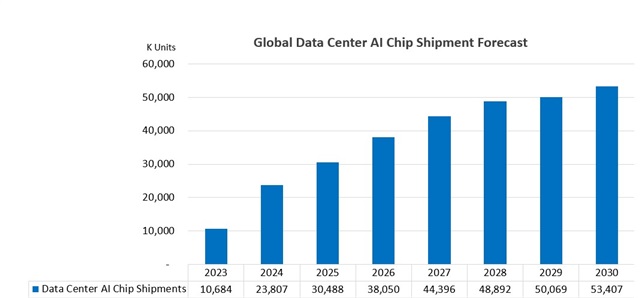
Credit: DIGITIMES
In terms of growth rate, the fastest-growing segments by shipment volume include application-specific AI chips, mid-range GPUs that use GDDR DRAM (such as Nvidia CPX GPUs), and interconnect-related chips, such as NVSwitch ICs. Among these five chip categories, the shipment volume growth rates for high-end GPUs and AI server CPUs are relatively lower over the 2024–2030 period, with a Compound Annual Growth Rate (CAGR) of only about 10%. However, when considering the revenue from high-end packaging and end-market sales, the growth rate will be much higher than the shipment growth rate. The main reasons for this include the increased content value per chip and the adoption of advanced packaging.
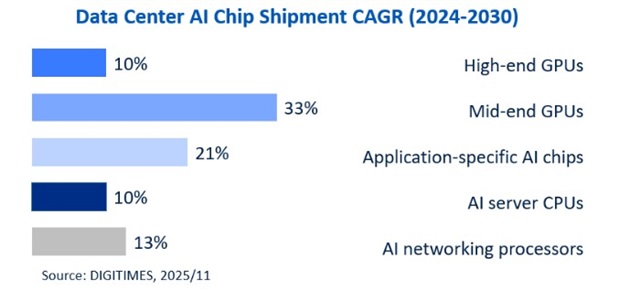
Credit: DIGITIMES
For example, AMD recently forecast that the global server CPU revenue Total Addressable Market (TAM) CAGR will reach 18% between 2025 and 2030 (implying that the Average Selling Price CAGR for server CPUs could exceed 7% due to the jump in core count and the adoption of more advanced processes and packaging). For GPUs, despite relatively moderate growth in shipments, wafer foundry and packaging revenue CAGRs are both expected to exceed 40% in 2024-2030, driven by the increasing number of GPU and I/O dies per chip.
💰 Data Center AI Chip Packaging Revenue Remains Focused on GPUs
Recently, application-specific AI chips like Google's TPU and AWS's Trainium have garnered significant attention for their tailored power-efficiency characteristics, sparking speculation that they might replace GPUs. According to the latest "Global Data Center AI Chip Packaging Market Forecast 2024-2030" report published by DIGITIMES Asia, the overall revenue share of data center AI chip packaging will remain GPU-centric throughout the 2024–2030 forecast period. It is estimated that by 2030, packaging revenue for data center GPUs will remain over 40% higher than that of application-specific AI chips.
While AI server CPUs and AI networking-related chips have high shipment volumes, the high-end packaging market will still be overwhelmingly dominated by GPUs and application-specific AI chips.
🚀 Drivers and Inhibitors for Advanced Packaging of Data Center AI Chips
DIGITIMES Asia forecasts that the global market size for advanced packaging of data center AI chips will grow from US$5.6 billion in 2024 to US$53.1 billion in 2030, representing a CAGR of over 40%. This aligns closely with AMD's recent Financial Analyst Day estimate that the global Data Center TAM CAGR will exceed 40% over the next five years.
Here is a summary of the main drivers and inhibitors for the global market for advanced packaging of data center AI chips:
Key Drivers:
The AI wave and the computing power arms race among tech giants. Advanced packaging driving system-level scaling to extend Moore's Law. Geopolitical competition between the U.S. and China, and the rise of Sovereign AI initiatives.
Key Inhibitors:
The re-evaluation of return on investment (ROI) relative to massive computing power investments.The impact of cheaper and more efficient new technologies.
In the following article, we will discuss the future outlook for major AI chip packaging technologies in data centers. For more details on AI Chips, check out: AI Chip packaging
Article edited by Jack Wu