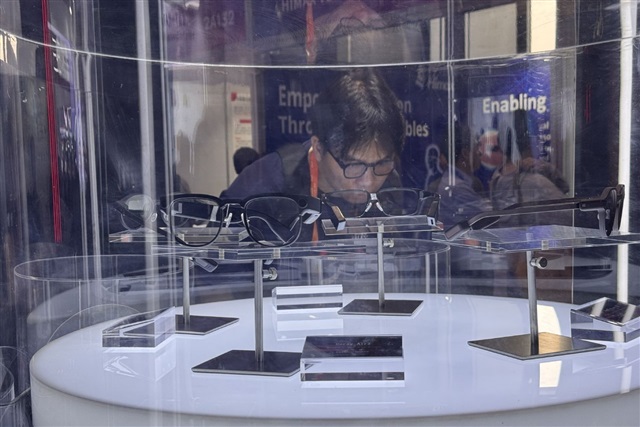
The industry has converged on a single precondition for consumer adoption of augmented reality (AR) glasses: the product must look like ordinary eyewear. The China International Optoelectronic Exposition (CIOE) 2026 showed how differently the two critical component groups — microdisplays and waveguides — are responding to that constraint...
DIGITIMES Intelligence said Google used SEMICON Taiwan 2026 to outline the direction of its AI infrastructure strategy, focusing not only on next-generation TPU products but also on how rising AI compute demand is accelerating TPU iteration and deployment.
At SEMICON Taiwan 2026, Google outlined the direction of its AI infrastructure, and DIGITIMES notes that the discussion extended well beyond its next-generation TPU. Rather than focusing on a single chip, Google described how it links large numbers of TPUs into an integrated computing system spanning compute clusters, data centers, and ultimately multiple data centers, while also addressing the power constraints that emerge as the system continues to scale.
DIGITIMES Intelligence forecasts the global semiconductor market will expand from US$791.7 billion in 2025 to US$1.6 trillion in 2026, representing year-on-year growth of 109.1%.
As humanoid robots gradually move from laboratory proofs-of-concept and enter industrial manufacturing and commercial service, their underlying motion control and environmental perception capabilities have become core indicators of product maturity. Major humanoid robot makers are actively seeking the best balance between performance and cost efficiency through architecture restructuring, in-house vertical integration, and supply-chain strategic cooperation.
ASML's latest update suggests High NA EUV is no longer confined to laboratory validation. With 10 systems already operating across four customers worldwide, and three more in shipment or installation, the technology is beginning to enter production ramp-up. The shift matters because adoption now hinges less on optical promise and more on whether chipmakers can justify the added cost.
Taiwanese chip packaging firms are advancing fan-out panel-level packaging (FOPLP) and glass-substrate development as AI processors demand ever-larger reticle sizes and more complex packaging. Their early manufacturing scale, automation progress, and substrate design choices could help determine who controls the next bottlenecks in high-end chip assembly.
Chinese GaN power semiconductor maker Innoscience gained direct access to capital markets after listing in Hong Kong at the end of 2024, giving it fresh funding to expand GaN capacity and technology development.
DIGITIMES observed that as AI systems continued to scale, interconnect requirements inside AI data centers had expanded from chips, packages, and boards to racks, clusters, and eventually inter-data-center connections.
For the past two years, China's AI companies have competed on a single axis: whose model performs best. That contest is starting to give way to a harder one — whether those models can actually run, at scale, on chips made in China, as US restrictions on advanced AI chip exports raise the stakes of that question.
ASIC and GPU shipments will reach a "golden cross" in 2027, with ASIC shipments expected to surpass GPU shipments for the first time at 15.3 million units, DIGITIMES Intelligence analyst Stella Weng said. She also said AI is driving a "qualitative change" in memory architecture inside AI servers.
The global memory market is entering a sharp upcycle as cloud providers boost capital spending and demand for AI infrastructure lifts DRAM, NAND, and HBM prices. According to DIGITIMES, the three largest upstream memory chip makers are headed for a more than threefold jump in combined DRAM and NAND revenue in 2026, with supply constraints likely to keep pricing firm until new capacity arrives in 2027.
Optical communications will likely enter AI server racks in 2028, DIGITIMES analyst Joyce Chen said on August 20 at a semiconductor industry forum in Taipei, as rising AI cluster scale drives demand for faster data transfer, lower latency, and higher-bandwidth interconnects.
The AI industry is watching the rise of co-packaged optics (CPO) as faster AI systems now depend on more efficient links between chips and data centers. At DIGITIMES Tech Forum 2026 in Taipei, analyst Jerry Zheng said the technology is moving toward mainstream adoption as bandwidth demand outpaces computing gains.
The speed of AI data center deployment is raising the bar for power and cooling suppliers. Chipmakers such as Nvidia and AMD are refreshing platforms annually, with each generation bringing sharp increases in power density and thermal requirements. Suppliers that cannot match that pace in R&D or capacity deployment risk missing the next design cycle.
DIGITIMES analyst Luke Lin, speaking on a recent podcast, used Intel's latest equity fundraising plan to examine who is benefiting most from the current surge in server CPU demand and how much more capital Intel may need to reach the 1.4nm generation.