

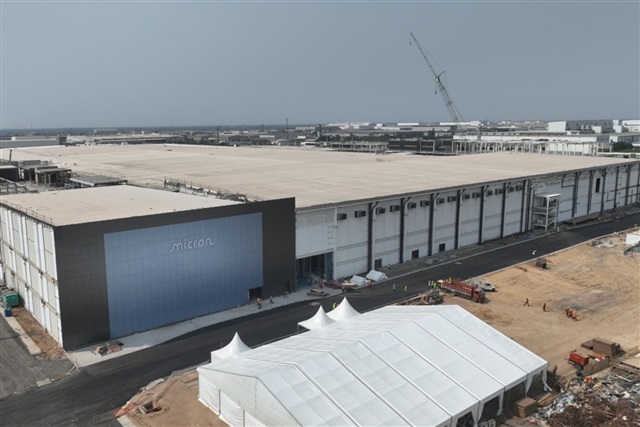
Micron Technology's Sanand assembly, test, marking, and packaging plant has given India something it lacked until recently: a live semiconductor manufacturing operation with global supply-chain relevance.
But as the facility moves beyond its launch phase, the industry conversation is shifting from inauguration to execution — and from symbolism to whether India can build the system needed to make semiconductor manufacturing competitive, resilient, and scalable.
That is the broad picture emerging from comments shared with DIGITIMES Asia by Dr. Danish Faruqui, CEO of Fab Economics and co-chair of the Global Semiconductor Policy Council, and by Sanchit Vir Gogia, chief analyst and CEO at Greyhound Research.
Faruqui argues that Sanand has already moved beyond symbolism through a series of tangible milestones. In his words, the site has "moved beyond its symbolic status" through "concrete operational and ecosystem-wide milestones," including integration into Micron's international network and the shipment of India-made memory modules to Dell for domestic laptops.
Faruqui also points to Micron's plan to scale from tens of millions of chips in 2026 to hundreds of millions in 2027, noting that the facility is already handling advanced memory technologies rather than only "older, 'safe' legacy tech."
In that view, Sanand is no longer just a politically important project — it is already part of Micron's global manufacturing chain and could become a more meaningful contributor to the company's memory output over time.
Faruqui also flags the transfer of advanced packaging capabilities, including thermal compression bonding, as evidence that India is being asked to do more than low-complexity backend work.
Gogia's assessment is more measured. "In semiconductors, the first shipment doesn't prove very much," he said. What matters, he argued, is what happens once operations settle into routine and the system starts getting tested under normal manufacturing stress. That is when the real indicators emerge: yield stability, defect patterns, frequency of intervention, and how far the plant still depends on global support networks.
Gogia points out that Sanand may be operational, but it has not yet demonstrated that it is "independently stable at scale." For now, he sees the facility as still in a controlled ramp phase, where many of the hardest variables remain below the surface.
That is also where the two assessments begin to overlap. Each, in a different language, suggests that Sanand's future will be decided less by the plant itself than by the ecosystem that forms around it.
Faruqui is explicit on that point, calling the local ecosystem the "lifeblood" of Micron's ability to ramp from "tens of millions to hundreds of millions of chips by 2027." Without it, he warns, Sanand would remain "an isolated, high-cost island vulnerable to global supply shocks." He identifies five areas that must develop quickly: materials and chemicals, equipment servicing and spares, cleanroom support, just-in-time logistics, and reliable infrastructure such as uninterrupted power and ultrapure water.
Gogia makes much the same point from an operating perspective. "Semiconductor manufacturing only looks like a facility story from a distance," he said. "In practice, it's an ecosystem problem." In mature clusters, he noted, the engineer is local, the spare part is stocked nearby, and the response is routine. In developing ecosystems, support often comes from outside the region, stretching downtime and raising costs.
That distinction matters as Sanand tries to evolve from a project location into a semiconductor cluster.
For suppliers, tool vendors, and materials companies, Micron's launch may therefore be significant in a broader way than the first shipment suggests. If Sanand's next phase depends on uptime, servicing speed, and local support depth, then the opportunity extends well beyond Micron itself — to gas suppliers, filtration specialists, substrate makers, testing support firms, cleanroom maintenance providers, and equipment service teams able to set up a local presence.
Faruqui directly links cost competitiveness to this cluster effect, saying Micron will need nearby partners to reduce shipping delays and operational friction. He notes that meeting global profitability benchmarks at the Sanand site could still prove difficult through the 2026–2027 ramp, given geoeconomic conditions and local operating-cost variables.
Gogia frames the same issue differently, saying India has built the "visible infrastructure" quickly, but the support layer is still being assembled.
Talent is another pressure point. India's semiconductor push has often leaned on the country's strength in chip design, but manufacturing requires a different workforce profile and a different kind of discipline.
Faruqui says one underestimated risk is that "it is easier to hire a designer than a yield specialist or an equipment maintenance engineer." If Micron cannot build or access that talent fast enough, he warns, output from Sanand could be less competitive than that from more established hubs such as Taiwan or Malaysia.
Gogia extends that argument into what he describes as the human side of manufacturing. "Semiconductor ecosystems aren't just technical systems. They're also human ones," he said, pointing to housing, commute times, retention, and relocation willingness as factors that can directly affect response times and operating performance.
There is also a wider question about where Sanand sits in the semiconductor value chain. Gogia notes that assembly and test are valid entry points and that many countries have started there. But he also cautions that higher-value influence is increasingly tied to advanced packaging and integration, especially as AI systems drive new demand patterns. In his framing, India is now part of the semiconductor supply chain, but "not yet operating in the parts of the value chain that drive the most strategic influence."
That may be why the next 12 to 18 months matter more than the opening ceremony did. Gogia says this is the period when it will become clear whether "the investments around Sanand should start interacting, not just existing in proximity." Faruqui, meanwhile, says the ecosystem must scale quickly enough to support Micron's planned ramp and reduce dependence on global backup.
If local supplier density deepens, service response improves, external dependence falls, and workforce readiness strengthens, Sanand could begin to look like the nucleus of India's first credible semiconductor manufacturing cluster. If those pieces do not lock together, the Micron plant may still stand as an important industrial milestone — but one that remains, in Gogia's phrase, a "strong standalone facility" rather than a fully developed ecosystem.
For now, Micron has pushed India into a new phase of the semiconductor conversation. The next stage will show whether Sanand can turn that opening into a manufacturing system.
Article edited by Jerry Chen

