


In 3Q22 (FY 4Q22 for Apple), Apple's Mac saw record highs in sales. Yet, Apple has warned that the 4Q22 sales will see a clear decline compared to 4Q21, falling to the same fate as the others in the struggling PC sector. Supply chain sources pointed out that Apple couldn't spare itself from the softened consumer market momentum. It's estimated for the first half of 2023, each brand will be dealing with the last bit of the pain period.
Data from DIGITIMES Research showed that the global notebook shipment for 3Q22 saw a YoY decrease of 24.4%. In contrast, not only did Apple see no decline in 3Q22, but the Mac also went against the trend and saw a YoY increase of 25% with a revenue of US$11.5 billion. According to Apple CEO Tim Cook, the momentum came from the latest MacBook Air model equipped with the M2 processor, as well as the delayed shipments of orders from 2Q22 due to the China lockdown.
Apple has also announced that Mac sales in 4Q22 won't be able to maintain this high growth margin. The main reasons are the strong US dollar and 4Q21's high shipment base period. Mac's revenue will see a clear decline. The supply chain estimated that in terms of shipment, a double-digit decrease can be expected.
From the second half of 2022 to the first half of 2023, the sector will be in a decline. Besides Microsoft's Surface, all other brands, including Apple, will reach double digits in YoY decrease and this will last until 2Q23.
At the recent Microsoft earnings call, the company pointed out that Surface sales in 4Q22 will be under 5%. Industry analysis pointed out that both Apple and Microsoft were heavily affected by the China lockdown in 2Q22. The delayed orders and Surface's new products are what contributed to its relatively strong performance in the second half of 2022.
Performance of Mac and Surface in the first three quarters of 2022
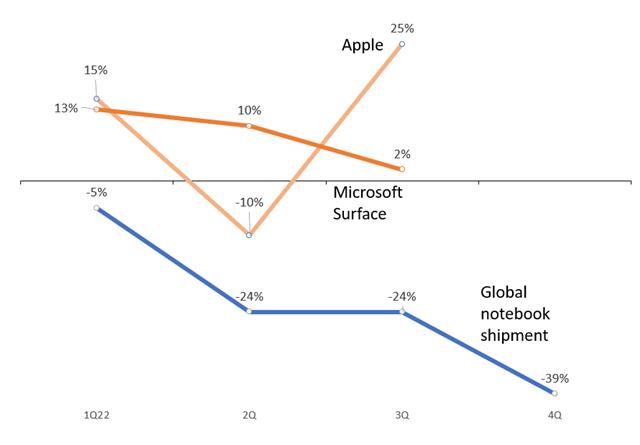
Notes: Data for global notebook shipments comes from DIGITIMES research, with 3Q and 4Q being estimated values.
Credit: Apple, Microsoft, compiled by DIGITIMES Asia, November 2022.
Despite that, PC brands including Apple and Microsoft couldn't avoid the impact of the weak consumer market. Industry sources pointed out that after the excitement of a new product and the delayed shipments are completed, things will "return to normal." The PC sector has been suffering from this weak market since the end of 2Q22. Be it Chromebooks, consumer notebooks, or the last saving grace in business notebooks, all are struggling with little to no signs of recovery.
Intel CEO Pat Gelsinger pointed out that the economic environment outlook is tough. From the US rate increases to the energy crisis and war in Europe, there is no good news in sight. Thus, it'll still be an uphill battle in 2023. In the PC market, consumer PC is weak, and corporate PC demand is also softening. Gelsinger believes that the 2022 global PC market size will decrease to 295 million units, a YoY decrease of 15-19%.
Gelsinger stated that in 3Q22, everyone is doing inventory clearance, yet the progress is slower than expected. With inventory gradually reducing, the estimated global PC shipment in 2023 will be between 270 million and 295 million units, meaning a further decline of up to 8.47%. This figure is estimated by referencing brand factories and software manufacturers that partnered with Intel.
However, industry sources pointed out that Intel's estimates are relatively optimistic. Right now, most markets estimated that the decline in 2023 will reach double digits. Even if there's a chance for a bounceback in the second half, the entire year will still be relatively weak. It'll be a year of resting and recovery. When it comes to their 2023 budget, most brands have also stated that they'll be more cautious.
The good news is that the PC sector believes that after the pandemic, the market can better establish its rigid demands. Currently, the sector is just in a re-balancing period after shipment highs and supply issues. With the penetration rate of PCs increasing, the demand to upgrade devices will start to appear in 2023. The outlook toward the long-term momentum of PCs is still positive.
Article translated by Jack Wu