Abhi Talwalkar has been steering LSI since 2005, initiating a series of restructuring programs from inside out, repositioning the company's product development strategy and finally transforming LSI into one of the most dynamic semiconductor companies in Silicon Valley today. Talwalkar discussed his approach to corporate restructuring during a recent interview with Digitimes.
Q: LSI had been a comprehensive chipmaker before you started restructuring the company. Is there a single keyword to depict your ideas about the implementation of restructuring programs?
A: It is hard to describe in one word, but I will stress the importance of "strategy" to LSI. To be more precise, I would use "market-led" to highlight the process: enterprises in today's world have been very concerned about market movements because only the markets in which there are strong dynamics will have the impetus to stimulate growth; LSI is looking at the markets which will sustain growth over the next 10-15 years.
In addition to acknowledging that products for servers and storage devices will sustain continued growth in the coming 10-15 years, we also believe that the rise of mobile networking applications will also stir up demand for wireless infrastructure and equipment in the next 15 years, and therefore we decided to step into that market. We have recognized a number of core competitive strengths that we need, as well as the markets which we have to deepen; we have maintained our course and growth momentum through endless technology integrations and product roadmap updates.
LSI was not managed in this way 5-7 years ago; it had engaged in too many markets. You cannot be in "focus" if you have more than enough markets to take care, and you will be unable to reach economies of scale to be able to compete with other companies. So I think being "focus" and "market-led" is a fundamental change at LSI.
Q: Is it more difficult to restructure a company than to set up a new firm?
A: Yes, setting up a new company is purely a documentary process. But the growth at LSI was faster than competitors' in past years, which was reflected in out stock price. LSI posted a growth rate of 9% in 2011, but the growth rate might have reached as high as 12-13% expelling the impact of floods in Thailand. Our growth rate in the second half of 2011, at 16%, was more remarkable given that most fellow semiconductor firms stayed flat or suffered losses in 2011. Earlier in 2012, some analysts predicted that LSI is going to post a growth of 18% in the year compared to a 3-5% growth for the global semiconductor industry, indicating the growth momentum at LSI.
Q: In the basic infrastructure equipment sector, business opportunities are there for the taking, but the market for flash data cards or controllers has a totally different business model. How does LSI manage the two distinctively different business models?
A: Indeed, basic infrastructure devices such as components for servers, storage, enterprise networking and mobile networking now account for 75-80% of LSI's total sales, but I will say that this market is hard to grab. However, once you have gained access in the market, your relationships with clients grow very close and solid, and other competitors are unable to replace your position because of the technologies involved.
The other 20-25% of our business is consumer products, including hard drive silicon and flash storage processor silicon, and those components are mostly for PC applications such as notebooks and ultrabooks. We also prevail in this segment because we boast relatively advanced architecture for the development of HDD and flash storage processors.
In the SAS (Serial Attached SCSI) market, we led our rivals in the two previous generations of products, and have been able to gain a lead of 3-9 months each generation. For the three generations of controller chips for HDDs using 65, 40 and 20nm processes, samples of 20nm products are available now, we maintain a lead of 3-6 months.
Q: More and more consolidations are going on in the chipset market, will this be the same in the networking and storage sectors?
A: Absolutely. The handheld device segment accommodated players including Broadcom, Qualcomm, Intel, Marvell Technology and LSI (Agere Systems) as well as ADI, Texas Instruments (TI), Freescale Semiconductor and Infineon Technology for 3-4 years, but 3-4 of them have withdrawn from the sector, and two others have merged.
With respect to the SoC market for hard drives, vendors including LSI, Marvell, Renesas Electronics, STMicroelectronics and LinkMedia have also been undergoing consolidation for four years. In the SAS server solution segment, there are only two players currently prevailing in the market, which previously accommodated LSI, Broadcom, Marvell, Maxim and Adaptec.
Consolidation will certainly occur, since the development of advanced technologies requires a large amount of capital. I think there is room for further consolidation in some markets such as the networking sector which has been much too fragmented.
LSI completed a number of acquisition deals in the past five years, including the HDD business units of Infineon and Agere Systems. Those acquisition projects were aimed primarily for market consolidation and sustaining profits through economies of scale.
Q: Are you deliberately making LSI a debt-free company?
A: Yes. This is a decision of the company, because we are capable of soliciting enough capital without raising debts. We had total debts of US$600 million when we began the resturcturing processes and managed to repay the last portion of our loans three years ago.
Being a debt-free company, LSI has a sound balance sheet, which we think that will make LSI a safe investment target. Nowadays, we also have abundant cash flow enabling us to stick on our strategy pertaining to technology development.
Q: The IT industry in China has been progressing rapidly over the past few years, including the server and wireless networking segments. What are the differences in technological development between Taiwan and China?
A: There are a number of areas posting great growth potential in China, with some sectors already being the largest globally. We expect annual demand for semiconductor components in China to reach US$150 billion or 40-50% of total global demand in 2-3 years, or even sooner. This is a lucrative market, but we did not anticipate semiconductor demand in China to expand at such a rapid pace 5-6 years ago. Although opportunities are there in China, there is still a long way to go for China-based semiconductor companies.
The support of the Taiwan government in the 1970s made the semiconductor industry what it is in Taiwan today, and has created a number of outstanding semiconductor firms in various sectors. MediaTek is a good example and there are some semiconductor firms with larger capital.
I think semiconductor companies in Asia, particularly those in Taiwan and China, will face challenges with respect to software development in the future, given the complexity on high level of integration of the technologies involved. Citing MediaTek again, the vendor still relies heavily on solutions for entry-level and mid-range handsets for income, but much has to be done in the high-end smartphone sector. This indicates that demand for software is relatively low in the entry-level to mid-range segment.
Semiconductor firms in China will also face this challenge. However, Huawei, ZTE and Lenovo, among other system companies, have done well in regards to vertical integration. For example, Huawei has set up its own semiconductor unit, and LSI has been cooperating with these firms.
Large-scale ODMs in Taiwan are venturing into cloud computing and data center businesses, which I think have been successful because some Web 2.0 firms including Google, Facebook, Amazon as well as Microsoft have all set up their own datacenters which will certainly stir up demand in the server, storage and network architecture sectors, and they need to cooperate with Taiwan-based suppliers directly. I think that Taiwan's ODMs will be able to grab 50-60%, which is high, of datacenter equipment orders released by those Web 2.0 firms.
Q: How do you assess the prospects of the semiconductor industry in 2012?
A: I think the consensus of the industry is that there will be a pretty good second half of the year thanks to inventory digestion in 2011 and the first half of 2012. We expect to see demand-driven growth dynamics coming from smartphones, mobile Internet connectivity, video traffic as well as ultrabooks.
Additionally, the launch of Windows 8, increasing competition in the tablet PC sector and substantially growing demand for flash memory products will likely create growth momentum for the industry.
Q: What are principles you apply when developing new business models?
A: LSI has already identified our primary markets as well as the application markets where we can become the No.1 or No. 2 vendor in the sector. Most of our production lines have captured the top or second ranking in their respective fields. We will be ahead of our rivals in the flash memory and flash storage processor sector, and aim to spearhead PCIe flash memory in the next 2-3 years. We are also the top vendor with respect to HCD (host controller device) business which we almost planned to give up five years ago. In short, maintaining our status as the top or second-ranked vendor in each respective market will be the essence of our growth strategy.
This interview was translated from Chinese.
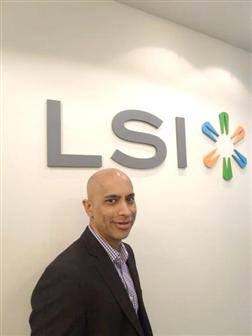
LSI CEO Abhi Talwalkar
Photo: Cage Chao, Digitimes, June 2012
Article translated by Steve Shen