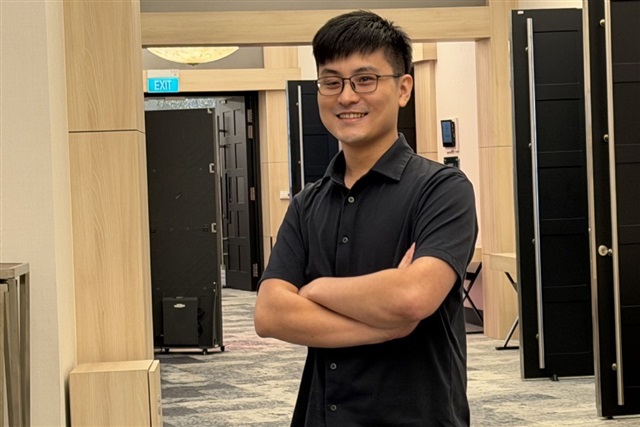
Singapore is building a semiconductor R&D hub by attracting both multinational investment and overseas research talent. Dr Yu-chieh Chien, a Taiwanese scientist at the Agency for Science, Technology and Research's Institute of Microelectronics (A*STAR IME), is one example.
Taiwan's motorcycle market emerged from the seasonal lull in September 2026, with total registrations rising to 70,189, up 16.78% month-over-month. Electric scooter sales also rebounded, with 3,482 units sold in the month, up 32.9%.
Hotai Motor said Taiwan's auto market should remain stable in the fourth quarter, after September sales came in better than expected and the company kept its full-year 2026 forecast at 430,000 vehicles. The distributor also said sales of Toyota, Lexus, and Hino models will still target 165,000 units in 2026.
The National Science and Technology Council (NSTC) has announced the details of its next five-year quantum research program as Taiwan prepares to wrap up its current NT$8 billion (US$252.14 million) National Quantum Team project by the end of 2026.
Samsung Electronics says its India operations, which it set up in 1995, have evolved from a manufacturing base into a global innovation hub. The South Korean company is pitching the country as a source of technology for its worldwide business, rather than only as a market and production base.
Da Yi Cheng Technology (DYC) has rapidly expanded in recent years, benefiting from the global semiconductor capacity expansion wave, which has driven demand for second-phase electrical and mechanical installation work. The company is now applying its experience in the US, Japan, Germany, and Singapore.
NTT Data expects India to contribute a larger share of its global artificial intelligence (AI) business than it does of its overall IT services business, as the Japanese company pushes ahead with a three-year investment program in the country focused on data centers.
Despite intense technology competition between the US and China, cooperation between the two sides on the open-standard RISC-V architecture continues to deepen, with US intellectual property provider MIPS expanding its work with Chinese industry.
Taiwan memory suppliers Nanya Technology and Winbond Electronics have set new monthly revenue records for 11 and 10 consecutive months, respectively, as their September 2026 consolidated revenues continued to grow.
South Korean outsourced semiconductor assembly and test (OSAT) provider LB Semicon is expanding power semiconductor backend capacity at its Gumi plant as it steps up efforts to reduce its reliance on display driver integrated circuits (DDIs) and a highly concentrated customer base, backed by new business from Qualcomm and Renesas and KRW30 billion (approx. US$22.3 million) in planned equipment investment.
China's leading AI models have narrowed their performance gap with US rivals to a record low, while DeepSeek's latest advances in memory efficiency and its deepening work with Huawei suggest Chinese developers are finding ways to improve model performance despite tighter access to advanced US chips.
China's WG Tech has reportedly begun the second phase of investment in its through-glass via (TGV) glass substrate production line, with total future capacity projected to reach 1 million square meters a year. Analysts say Chinese makers have moved ahead of South Korean rivals by building production lines first, then accelerating product output and customer validation, giving China an early lead in glass substrate commercialization.
The recent summit between US President Donald Trump and Chinese President Xi Jinping concluded without progress on automotive issues—namely, whether Chinese automakers might enter the US market or build manufacturing plants on American soil. While the prospect had previously sparked anxiety among American, European, and Japanese carmakers, the topic yielded no tangible breakthrough during the talks.
Japan's Kyushu Semiconductor Industry Exhibition, known as K-Semi, grew 36% at this year's edition in Fukuoka, held from September 30 to October 1, 2026, as chip makers expanded their presence in Kyushu. The event also added a semiconductor design zone for the first time and was held alongside the debut Kyushu Next-Generation Energy Exhibition, or K-Ene.
Huawei is increasingly framing its semiconductor strategy around a simple constraint: if advanced process nodes remain limited, more performance must come from architecture, interconnect and system-level efficiency.
China's National Day holidays have opened one of the fourth quarter's most important promotional windows for consumer electronics. For smartphones, the timing is especially significant: Apple, Xiaomi, Vivo, Oppo and Honor have all launched new models since September, while Huawei introduced its Mate 90 series on October 1.