

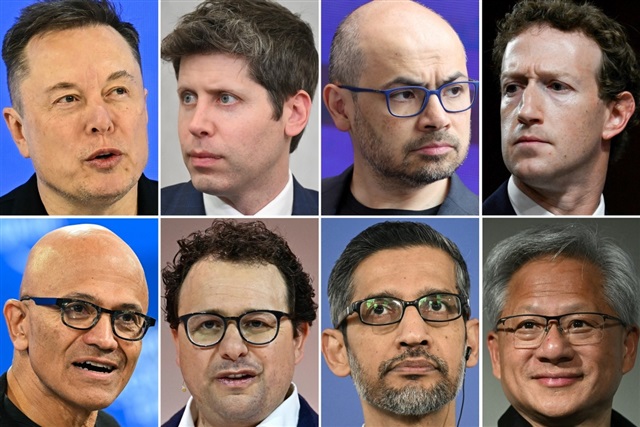
Calls from leading US AI developers to slow frontier model development are colliding with the rivalry they were partly meant to manage. Within days of Anthropic CEO Dario Amodei's proposal, US President Donald Trump cast the push as a conspiracy that benefits China, Chinese state media called it a US containment strategy, and European governments said halting AI was not an option, leaving little common ground for the coordinated slowdown its backers say is needed.
Amodei's essay, published on September 12 and endorsed by OpenAI CEO Sam Altman and xAI's Elon Musk, outlined a framework to pace frontier AI capabilities and create more time to manage safety risks. It said "global pacing will require cooperation with China," but also urged Washington to tighten chip export controls and crack down on distillation. "If we execute these measures well, I believe they would slow China's progress enough to widen America's lead significantly over the next three to five years," Amodei wrote.
Trump sees a plot that helps China
On September 13, Trump brushed off the calls, saying "very negative forces" were raising exaggerated concerns. "We're leading China in AI. We're the most sophisticated country in the world, and frankly I want to keep it that way because whoever wins AI wins," he told reporters.
On September 14, he escalated on Truth Social. "The only control or 'guardrails' that AI needs is a STRONG AND SMART (High IQ!) PRESIDENT, and the US has that, in spades!" he wrote. "There is a SICK conspiracy going on against AI and Data Centers, and the only one that is happy about it is China." He also said Amodei was "now pretending to be a 'perfect little angel.'"
Nvidia CEO Jensen Huang took a live phone call from Trump on stage at the All-In Summit in Los Angeles on the same day, during which the president dismissed AI dangers as a "hoax," Bloomberg reported. The pushback, Trump said, was "just playing right into the hands of a lot of people that don't want to see it happen," adding: "And that could be political people. It could also be China."
Huang agreed with the president, saying Trump had seen through the issue's complexities. He praised Jacob Coxon, the Anthropic researcher who resigned over safety fears, as courageous and said whistleblowers should be taken seriously, but argued that the panic had created a false choice between fast innovation and AI safety.
Beijing sees a containment strategy
The Chinese state-run Global Times said a close reading of Amodei's essay "reveals its hidden agenda," describing it as "in essence, a 'Cold War playbook' for the AI sector." Its true purpose, the paper said, is to attempt to curb China's AI development through technological barriers and regulatory monopolies and to exclude China from the global AI governance system, which it warned would raise the "risks of loss of control in global AI development.
China's Foreign Ministry spokesperson Guo Jiakun told a regular briefing on September 14 that "spreading various threat narratives" and "engaging in confrontation and malicious competition" would only disrupt global AI governance and were "not in the interests of any party." China worries that the safety warnings could be used as a pretext by the US to tighten export restrictions on advanced technology further, Sun Chenghao, a fellow at Tsinghua University's Center for International Security and Strategy, told Bloomberg.
Some Chinese researchers argue a slowdown would lock in US incumbents. "Those who already possess resources can afford a pause. Those who are still building their careers cannot," Zhang Xuanming, a researcher on Alibaba's Qwen team, wrote on X, the SCMP reported. (Alibaba owns the SCMP.) Beijing also views US models themselves as a threat: state security minister Chen Yixin wrote on Sunday that Anthropic's Mythos and OpenAI's GPT-5.5-Cyber could pose serious risks to China's critical information infrastructure, according to Reuters.
Europe says stopping is not viable
Germany's digital affairs ministry said on September 14, "We do not consider halting development to be a viable option for Europe," adding that effective oversight would require both the US and China to participate and that Berlin is raising the issue at the G7, Reuters reported.
"The EU is in favor of developing innovation in artificial intelligence, but companies have to prove their services are safe for citizens to operate in the bloc," European Commission spokesperson Thomas Regnier said. A spokesperson for British Prime Minister Andy Burnham welcomed AI companies "talking openly about the risks," but said, "we shouldn't assume that the existing framework will always be sufficient as AI capabilities develop."
A dual credibility problem
Kenton Thibaut, senior resident fellow for China at the Atlantic Council's Digital Forensic Research Lab, described "a dual credibility problem: China doubts US motives for engaging in safety talks, while Washington has concrete reasons to question whether China would honor, report, or operationalize any safety arrangement."
He noted that Amodei's essay demands "ironclad verifiability" while "protecting the lead of the US and its allies," calling that "a tall order for two countries that share deep mutual distrust." A comprehensive pause "is highly unlikely, because an undetected defection could shift the balance of power," Thibaut wrote. However, he sees a narrower path in deconfliction aimed at preventing "a serious model failure, unauthorized cyber operation, or nonstate misuse from being mistaken for deliberate state action."
Amodei has acknowledged the same bind, telling CBS News that the "toughest dilemma" over his proposal was whether China and other adversarial nations would do the same, according to Reuters. The two governments plan to discuss frontier AI safety risks this month, sources told Reuters, and the issue could come up at a summit between Trump and Chinese President Xi Jinping on September 24.
Article edited by Joseph Chen